
World War II Battles: Operation Torch
Introduction
Operation Torch was the first large-scale Allied amphibious operation of World War II and a pivotal moment in the conflict’s global trajectory. Launched in November 1942, it marked the beginning of sustained Anglo-American ground operations against Axis forces. Taking place across French North Africa, Operation Torch brought United States forces directly into combat against Germany and Italy, while also reshaping Allied strategy and cooperation.
The operation was not only a military undertaking but also a complex political and diplomatic challenge. Allied planners had to account for the presence of Vichy French forces, whose loyalties were uncertain, while coordinating land, sea, and air forces across vast distances. Success required precise timing, deception, and coordination on an unprecedented scale.
Operation Torch unfolded against the backdrop of mounting pressure on the Axis powers. In the east, the Soviet Union demanded the opening of a second front, while in North Africa, British forces were already engaged in a difficult struggle against German and Italian troops. The landings in Morocco and Algeria were intended to relieve pressure, secure vital territory, and set the stage for the eventual defeat of Axis forces in Africa. In doing so, Operation Torch became a crucial step toward Allied victory in Europe.
Historical Background
By 1942, World War II had entered a critical phase. The Axis powers controlled large portions of Europe, North Africa, and the Pacific. The Soviet Union bore the brunt of the fighting against Germany on the Eastern Front and repeatedly called for Western Allies to open a second front to divert German resources.
The United States, having entered the war after the attack on Pearl Harbor in December 1941, was still building its military strength. American leaders favored a direct assault on German-occupied Western Europe, but British leaders argued that such an operation was premature. Instead, they advocated a campaign in North Africa, where Axis forces were already engaged and where Allied naval superiority could be effectively applied.
North Africa held strategic importance. Control of the region would secure Mediterranean shipping routes, protect the Middle East, and threaten Axis positions in southern Europe. British forces had been fighting in the region since 1940, but progress was slow and costly. A coordinated Anglo-American operation offered the prospect of decisive change.
Another complicating factor was the political status of French North Africa. Following France’s defeat in 1940, Morocco and Algeria were controlled by the Vichy French government, which maintained formal neutrality but collaborated with Germany. Allied planners hoped that Vichy forces would offer limited resistance, but this assumption carried significant risk.
Against this backdrop, Operation Torch was conceived as a bold but necessary step to advance Allied strategy and demonstrate growing cooperation between Britain and the United States.
Main Events
Planning and Preparation
Planning for Operation Torch began in mid-1942. The operation called for simultaneous amphibious landings at three main locations: Casablanca in Morocco, Oran in Algeria, and Algiers in Algeria. These sites were chosen to secure key ports and airfields while minimizing the risk of direct confrontation with large Axis forces.
The operation required unprecedented coordination. Naval forces would transport and protect landing troops, air units would provide cover and support, and ground forces would secure objectives inland. Command structures had to integrate British and American leadership, a challenge given differences in doctrine and experience.
Diplomatic efforts accompanied military planning. Allied leaders sought to reduce potential resistance from Vichy French forces through negotiation and intelligence contacts. While some French officers were sympathetic to the Allied cause, loyalties were divided, adding uncertainty to the operation.
The Landings (November 8, 1942)
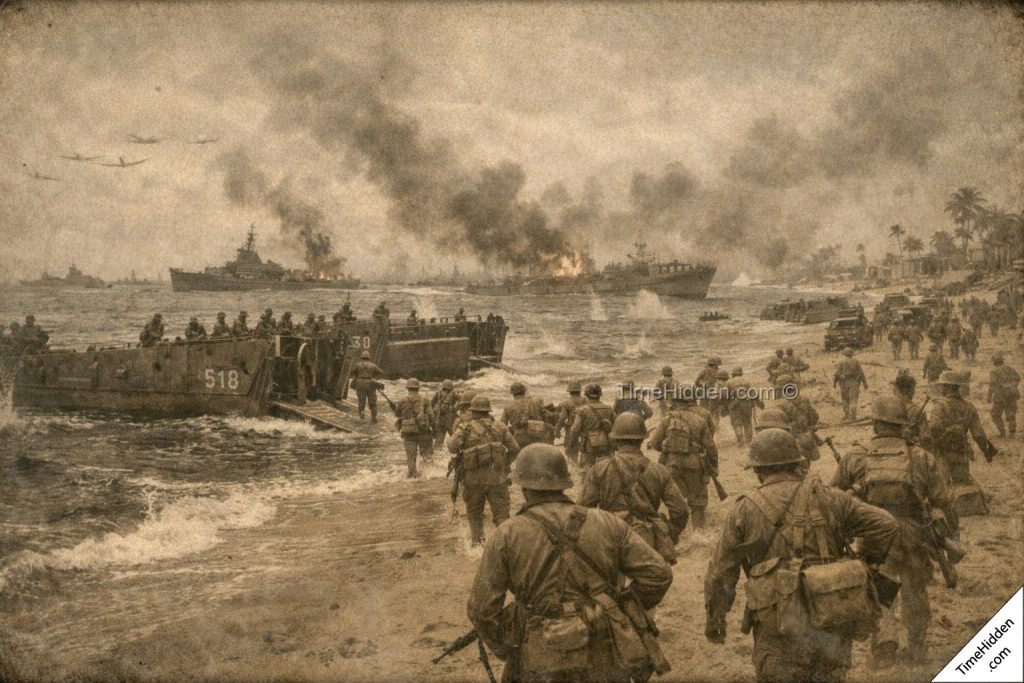
Operation Torch commenced on November 8, 1942. Allied forces landed at multiple measuring across hundreds of miles of coastline. The landings represented the first major combat deployment of United States ground forces against the Axis.
At Algiers, resistance was relatively limited. Allied troops secured key objectives within days, aided by internal resistance elements that disrupted Vichy command structures. In Oran, resistance was stronger, and fighting continued for several days before Allied forces gained control of the city and its port facilities.
The landings at Casablanca proved more challenging. Vichy French naval and coastal defenses resisted the Allied assault, leading to several engagements at sea and on land. Despite these difficulties, Allied forces eventually secured the area, establishing a vital base on the Atlantic coast.
Political Resolution and Ceasefire
As fighting continued, diplomatic negotiations intensified. Admiral François Darlan, a senior Vichy official present in Algiers, entered into discussions with Allied leaders. Following negotiations, Darlan ordered Vichy French forces in North Africa to cease resistance and cooperate with the Allies.
The ceasefire, formalized within days of the landings, transformed the strategic situation. French forces and facilities became available to the Allies, while Axis forces responded by occupying the remainder of Vichy France in Europe, ending its nominal neutrality.
Axis Response and the Tunisian Campaign
In response to Operation Torch, Germany and Italy rapidly reinforced Tunisia, seeking to establish a defensive line and prevent the Allies from advancing eastward. Axis troops were airlifted and transported into the region, creating a new front in North Africa.
Allied forces, advancing from the west, encountered determined resistance. The resulting Tunisian Campaign lasted several months and involved hard-fought engagements as both sides sought to gain the upper hand. While Operation Torch itself concluded with the securing of Morocco and Algeria, its true significance lay in setting the conditions for the final defeat of Axis forces in Africa.
Key Figures
Dwight D. Eisenhower
As Supreme Allied Commander for Operation Torch, Eisenhower oversaw the planning and execution of the landings. His leadership during this complex operation established his reputation and paved the way for future command roles.
George S. Patton
An American general who commanded forces during the Casablanca landings, Patton demonstrated aggressive leadership and gained valuable combat experience that would shape his later career.
Bernard Montgomery
Commander of the British Eighth Army in North Africa, Montgomery’s forces advanced westward following their victory at El Alamein, coordinating with Operation Torch to trap Axis forces.
François Darlan
A senior Vichy French official, Darlan played a decisive political role by ordering French forces in North Africa to cease resistance and cooperate with the Allies.
Harold Alexander
As a senior Allied commander in the Mediterranean, Alexander provided strategic coordination between advancing Allied forces during the subsequent North African campaign.
Significance and Impact
Operation Torch had profound strategic, political, and psychological consequences. Militarily, it marked the first major Allied offensive against Axis-controlled territory in the European and Mediterranean theater. It secured key bases, expanded Allied control of the Mediterranean, and placed Axis forces in North Africa under increasing pressure.
Politically, the operation reshaped relationships with French forces and undermined Axis influence in the region. The collapse of Vichy authority in North Africa strengthened the Free French movement and contributed to the eventual liberation of France.
For the United States, Operation Torch was a crucial learning experience. American forces gained combat experience, tested leadership, and refined coordination with British allies. Lessons learned in North Africa influenced later operations in Sicily, Italy, and Normandy.
Strategically, Operation Torch, combined with the Allied victory at El Alamein, sealed the fate of Axis forces in Africa. By May 1943, Axis resistance in North Africa had ended, opening the way for Allied invasions of southern Europe.
Conclusion
Operation Torch stands as a milestone in World War II history. It represented the moment when Allied strategy shifted decisively toward sustained offensive action against the Axis powers. More than a series of landings, it was a complex operation that combined military force with diplomacy, coordination, and long-term strategic vision.
From the beaches of Morocco and Algeria to the political negotiations that reshaped North Africa, Operation Torch demonstrated the growing strength and unity of the Allied coalition. It provided invaluable experience, strengthened Allied confidence, and created the conditions for future victories in Europe.
In the broader narrative of World War II, Operation Torch marks the beginning of the end for Axis ambitions in the Mediterranean. Its success confirmed that the Allies were capable of planning and executing large-scale joint operations, a capability that would ultimately lead to victory in Europe and the defeat of Nazi Germany.