
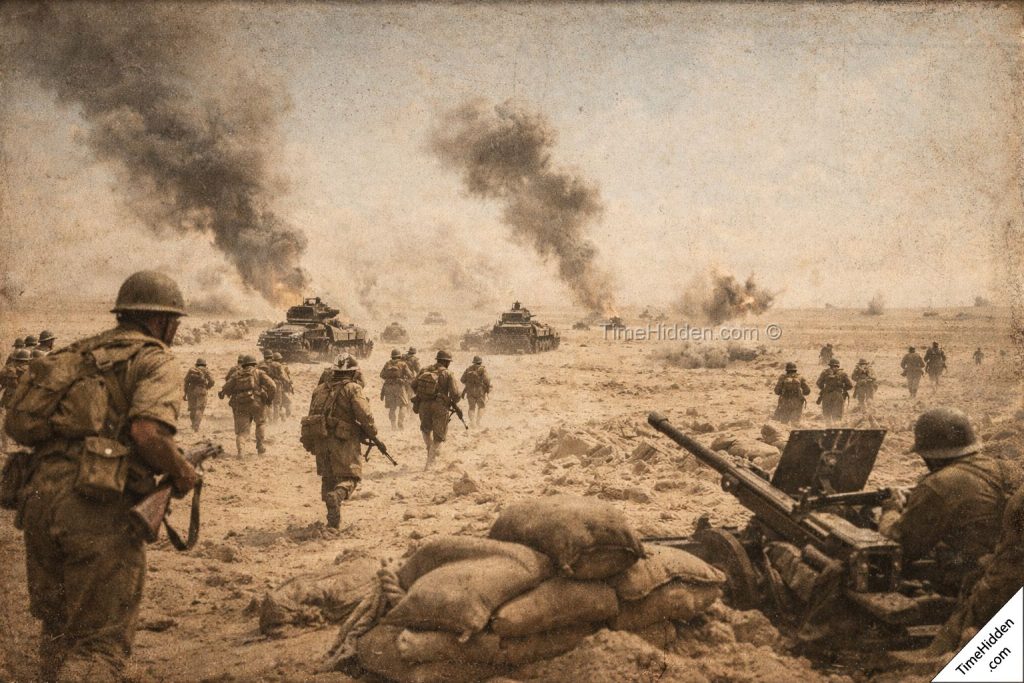
World War II Battles: Second Battle of El Alamein
Introduction
The Second Battle of El Alamein was one of the most decisive engagements of World War II and a defining moment in the North African campaign. Fought between October 23 and November 11, 1942, this battle marked a clear turning point in the struggle between the Allied forces and the Axis powers in the desert war. Taking place near the small Egyptian railway halt of El Alamein, the confrontation determined the fate of Egypt, the Suez Canal, and Allied access to vital imperial and global supply routes.
For months, Axis forces under German and Italian command had advanced across North Africa, threatening British positions and challenging Allied control of the eastern Mediterranean. El Alamein became the last defensive line before Alexandria and Cairo. A breakthrough by the Axis could have altered the strategic balance of the war far beyond North Africa.
Under new leadership, the British-led Eighth Army launched a carefully planned offensive that combined superior preparation, deception, and overwhelming material strength. The Second Battle of El Alamein did not merely stop the Axis advance; it began a sustained Allied counteroffensive that would ultimately drive Axis forces out of Africa. Its outcome reshaped Allied confidence and signaled that momentum in the war was beginning to shift.
Historical Background
The North African campaign began in 1940, following Italy’s entry into World War II on the side of Germany. Initial Italian advances into Egypt were soon reversed by British counterattacks. In response, Germany sent the Afrika Korps under General Erwin Rommel to stabilize the situation and assist its Italian ally.
Rommel quickly gained a reputation for bold maneuver warfare, launching a series of offensives that pushed Allied forces eastward across Libya. By mid-1942, Axis troops had reached Egypt, advancing to El Alamein, a narrow corridor between the Mediterranean Sea and the Qattara Depression. This geography limited maneuverability and made the area a natural defensive position.
The First Battle of El Alamein in July 1942 halted Rommel’s advance but did not decisively defeat Axis forces. Both sides dug in, preparing for renewed conflict. For the Allies, the situation demanded change. Leadership, training, and morale needed improvement, and resources had to be concentrated for a decisive blow.
In August 1942, Lieutenant General Bernard Montgomery assumed command of the British Eighth Army. He immediately focused on rebuilding confidence, improving coordination, and preparing a deliberate offensive. Rather than rushing into action, Montgomery emphasized planning, logistics, and numerical superiority. By autumn 1942, the stage was set for a battle that would determine the future of the North African war.
Main Events
Preparations and Strategic Planning
In the weeks leading up to the battle, the Allied command undertook extensive preparations. Montgomery reorganized the Eighth Army, integrating British, Australian, New Zealand, South African, Indian, and other Commonwealth units into a cohesive force. Emphasis was placed on training, communication, and combined arms tactics.
A key component of Allied planning was deception. Through a sophisticated operation involving dummy equipment, misleading radio traffic, and false troop movements, the Allies aimed to convince Axis intelligence that the main attack would occur in the south, rather than along the northern coastal sector.
At the same time, Allied supply lines were strengthened. The Eighth Army benefited from growing industrial output and improved logistics, ensuring ample supplies of fuel, ammunition, and vehicles. In contrast, Axis forces faced increasing shortages due to Allied control of the Mediterranean and effective attacks on supply convoys.
The Opening Assault (October 23–24, 1942)
The battle began on the night of October 23, 1942, with a massive Allied artillery barrage along the Axis defensive line. This marked the start of Operation Lightfoot, named for the plan to allow infantry to advance through minefields while minimizing the risk to armored vehicles.
Allied infantry units advanced methodically, clearing paths through extensive minefields known as “devil’s gardens.” Progress was deliberate and costly in time, but the objective was not immediate breakthrough. Instead, Montgomery aimed to draw Axis armored reserves into a battle of attrition where Allied numerical and material advantages would prove decisive.
Axis commanders, including Rommel, responded by committing their armored units to contain the Allied advance. The fighting settled into a tense struggle as both sides sought to gain the upper hand.
Attrition and Stalemate (Late October 1942)
Over the following days, intense fighting continued along the front. Allied forces launched repeated attacks to widen breaches and wear down Axis defenses. Axis troops resisted stubbornly, making effective use of defensive positions and counterattacks.
However, the balance increasingly favored the Allies. Axis fuel shortages limited mobility, while Allied forces maintained pressure across multiple sectors. The steady accumulation of losses and the inability to replace equipment weakened Axis defensive capacity.
Montgomery resisted calls for premature exploitation, remaining focused on his strategy of attrition. His goal was to ensure that when the breakthrough came, Axis forces would lack the strength to recover.
Operation Supercharge and the Breakthrough (November 1–4, 1942)
On November 1, the Allies launched Operation Supercharge, the decisive phase of the battle. Concentrated attacks were directed at a narrow sector of the Axis line, supported by overwhelming artillery and air power.
After fierce resistance, Allied armored units finally broke through. Axis defenses, already strained by shortages and continuous pressure, began to collapse. Rommel, recognizing the danger, ordered a withdrawal to preserve his remaining forces.
Although Adolf Hitler initially ordered Axis troops to hold their positions, the situation became untenable. The Allied advance continued, and Axis units retreated westward, abandoning the El Alamein line.
Axis Retreat and End of the Battle (November 1942)
By November 11, 1942, the Second Battle of El Alamein had ended in a clear Allied victory. Axis forces were in full retreat toward Libya, pursued by the Eighth Army. While the retreat was conducted with discipline in many sectors, the strategic initiative had irrevocably shifted.
The victory at El Alamein coincided closely with Allied landings in French North Africa under Operation Torch, further tightening pressure on Axis forces in the region. Together, these developments sealed the fate of the Axis position in North Africa.
Key Figures
Bernard Montgomery
As commander of the British Eighth Army, Montgomery was the architect of the Allied victory. His emphasis on preparation, morale, and clear objectives shaped the conduct and outcome of the battle.
Erwin Rommel
Known as the “Desert Fox,” Rommel commanded Axis forces in North Africa. Despite his tactical skill and leadership, he faced severe logistical constraints that limited his ability to counter the Allied offensive.
Claude Auchinleck
Former commander of Allied forces in the Middle East, Auchinleck played a crucial role earlier in halting the Axis advance and laying the groundwork for the defense of Egypt.
Harold Alexander
As Commander-in-Chief of Allied forces in the Middle East, Alexander provided strategic oversight and supported Montgomery’s approach to the battle.
Benito Mussolini
Italy’s leader, Mussolini had committed significant forces to North Africa. The defeat at El Alamein exposed the limitations of Italy’s military capacity and strained Axis cooperation.
Significance and Impact
The Second Battle of El Alamein had far-reaching consequences for World War II. Strategically, it ended the Axis threat to Egypt and the Suez Canal, securing a vital lifeline for the British Empire and Allied global communications.
The victory marked the first decisive defeat of German land forces by the Western Allies. It shattered the perception of Axis invincibility and boosted Allied morale at a critical moment in the war. British Prime Minister Winston Churchill famously remarked that before El Alamein, the Allies had never won a major victory, and after it, they never suffered a major defeat.
For the Axis powers, the battle signaled the beginning of the end in North Africa. The loss forced a prolonged retreat and ultimately led to the surrender of Axis forces in Tunisia in 1943. Resources that Germany could ill afford were lost, weakening its overall war effort.
Beyond immediate military outcomes, El Alamein demonstrated the importance of logistics, intelligence, and unified command. It validated the Allied approach of combining industrial strength with careful planning and coalition warfare.
Conclusion
The Second Battle of El Alamein stands as one of the most important battles of World War II. More than a clash of armies in the desert, it was a contest of strategy, preparation, and endurance. The Allied victory resulted from deliberate planning, effective leadership, and the ability to apply overwhelming force at the decisive moment.
From the opening artillery barrage to the Axis retreat across the desert, the battle unfolded as a clear narrative of shifting momentum. El Alamein marked the point at which the Allies seized the initiative in North Africa and never relinquished it.
In the broader history of the war, the Second Battle of El Alamein symbolizes the transition from defense to offense for the Western Allies. Its legacy endures as a reminder that careful preparation, unity of command, and strategic patience can change the course of a global conflict.