
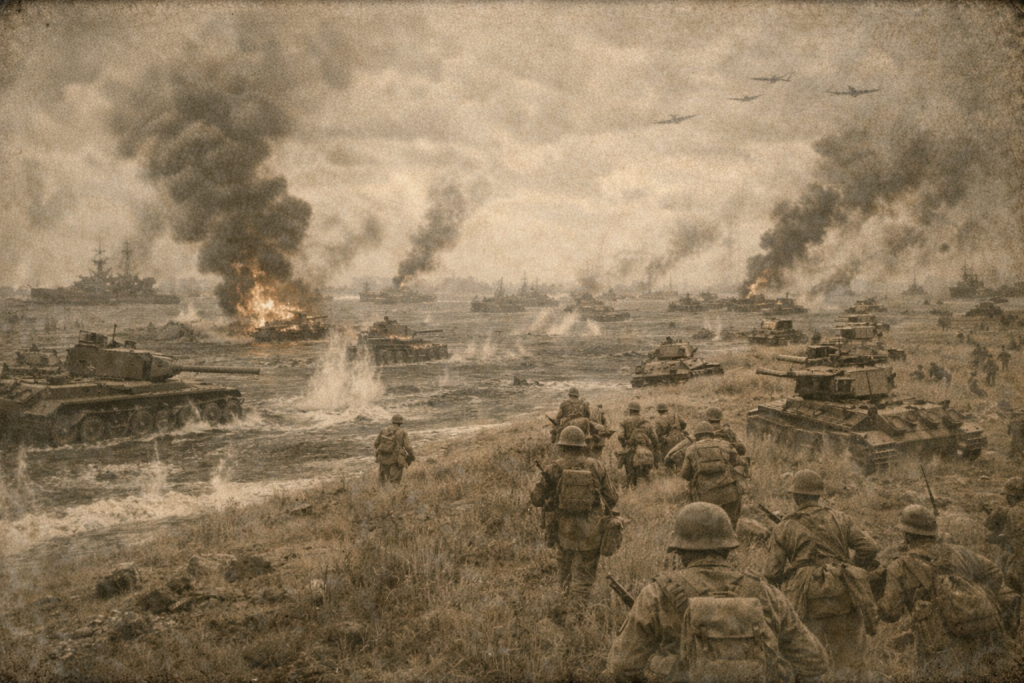
World War II Battles: The Battle of Kursk
Introduction
The Battle of Kursk was one of the most decisive engagements of World War II and a defining moment on the Eastern Front. Fought between July and August 1943, it represented the last major German strategic offensive against the Soviet Union. Unlike earlier campaigns characterized by rapid advances, Kursk became a test of preparation, intelligence, and industrial capacity. Both sides understood the significance of the battle well in advance, and months of planning shaped its outcome before the first shots were fired.
Centered around a large Soviet-held salient near the city of Kursk, the battle brought together enormous concentrations of men, vehicles, and equipment. German leadership hoped to regain the initiative after the defeat at Stalingrad, while the Soviet Union aimed not only to defend but to decisively weaken German offensive power. The result was a clash that emphasized coordination, defensive depth, and strategic patience. The Battle of Kursk marked a permanent shift in momentum, ensuring that from that point onward, the German Army would remain largely on the defensive in the East.
Historical Background
Following the German defeat at Stalingrad in early 1943, the balance of power on the Eastern Front had begun to change. German forces still controlled large areas of occupied Soviet territory, but their resources were stretched, and their ability to launch sustained offensives had been weakened. The Soviet Red Army, meanwhile, had gained confidence, experience, and increasing industrial support.
In the spring of 1943, the front lines stabilized temporarily, forming a large bulge around the city of Kursk. This salient extended westward into German-held territory and presented both a threat and an opportunity. For Germany, eliminating the salient could shorten the front line, destroy Soviet reserves, and restore strategic initiative. For the Soviet Union, holding Kursk offered the chance to absorb another German offensive and then transition to large-scale counterattacks.
German planners developed Operation Citadel, a coordinated attack from the north and south aimed at encircling Soviet forces within the salient. However, delays caused by equipment shortages and debates within the German High Command allowed the Soviets time to prepare. Soviet intelligence accurately identified German intentions, enabling extensive defensive preparations that would play a decisive role in the battle’s outcome.
Main Events
Timeline of the Battle of Kursk
-
February–March 1943: Front lines stabilize after the Battle of Stalingrad.
-
April–June 1943: German planning for Operation Citadel; Soviet defensive preparations intensify.
-
5 July 1943: German offensive begins against the Kursk salient.
-
5–11 July 1943: Heavy fighting along northern and southern attack axes.
-
12 July 1943: Major engagement near Prokhorovka; Soviet counteroffensive begins.
-
13–17 July 1943: German offensive momentum fades.
-
July–August 1943: Soviet strategic offensives push German forces westward.
-
23 August 1943: Soviet recapture of key cities marks the end of the Kursk campaign.
German Offensive: Operation Citadel
Operation Citadel was intended to be a decisive blow. German forces planned a pincer movement, with one attack advancing southward from Orel and another pushing northward from Belgorod. Elite armored units were assigned to lead the offensive, reflecting the importance German leadership placed on the operation.
When the offensive began on 5 July 1943, German forces encountered defenses far more extensive than expected. The Soviet Union had constructed multiple defensive belts, consisting of layered fortifications, obstacles, and strongpoints designed to slow and disrupt the advance. German units progressed, but at a much slower pace than anticipated.
Soviet Defensive Strategy
The Soviet High Command adopted a strategy of defense in depth. Rather than attempting to halt the German advance at the front line, Soviet planners intended to absorb the attack, wear down German forces, and then launch counteroffensives once the enemy’s strength had been reduced.
This approach required precise coordination and discipline. Soviet forces held their positions under intense pressure while reserves were carefully preserved for the decisive moment. The emphasis was on flexibility, allowing units to withdraw in an organized manner when necessary and reestablish defensive positions further back.
Turning Point: Prokhorovka and Soviet Counteroffensives
By mid-July, the German offensive had lost momentum. On 12 July, a major engagement occurred near Prokhorovka as Soviet forces launched a counterattack against advancing German units. While the fighting was intense, the broader significance lay in the strategic shift it represented. German forces were no longer able to sustain offensive operations at the scale required for success.
Simultaneously, the Soviet Union launched additional offensives against German positions outside the Kursk salient, forcing German commanders to divert resources and reconsider their plans. Within days, German leadership ordered the termination of Operation Citadel.
Soviet Advance After Kursk
Following the failure of the German offensive, Soviet forces transitioned to sustained strategic offensives. These operations pushed German troops back across wide areas, liberating key cities and forcing the German Army into a defensive posture that would persist for the remainder of the war. Kursk thus became not just a defensive victory, but the starting point for continuous Soviet advances.
Key Figures
German Leadership
-
Adolf Hitler: German leader who authorized Operation Citadel in an attempt to regain strategic initiative.
-
Field Marshal Erich von Manstein: Senior German commander who supported the offensive and sought flexibility in its execution.
-
General Walter Model: Commander of German forces attacking from the northern sector of the salient.
-
General Hermann Hoth: Commander of armored forces advancing from the south.
Soviet Leadership
-
Joseph Stalin: Leader of the Soviet Union, who approved the defensive strategy followed by counteroffensives.
-
Georgy Zhukov: Senior Soviet commander who advocated allowing the German offensive to exhaust itself before counterattacking.
-
Aleksandr Vasilevsky: Chief of the Soviet General Staff and key planner of the overall defensive and offensive operations.
-
Ivan Konev: Front commander involved in the counteroffensive phases following the German attack.
Supporting Roles
The battle relied heavily on the efforts of engineers, logisticians, and planners on both sides. Soviet industrial production, transportation networks, and intelligence capabilities played a decisive role in sustaining the defensive effort and enabling rapid counterattacks.
Significance and Impact
The Battle of Kursk was the final attempt by Germany to regain the initiative on the Eastern Front. Its failure marked the end of large-scale German offensive operations in the east. From this point onward, German forces were largely reactive, responding to Soviet advances rather than shaping the course of the war.
For the Soviet Union, Kursk demonstrated the maturity of its military strategy. The combination of accurate intelligence, layered defenses, and coordinated counteroffensives showcased a level of operational sophistication that had been lacking earlier in the war. The victory further strengthened Soviet morale and reinforced confidence in eventual victory.
Kursk also highlighted the growing importance of industrial capacity and logistics in modern warfare. The ability to produce, repair, and deploy equipment at scale proved decisive. The battle underscored that strategic patience and preparation could overcome even highly experienced and technologically advanced opponents.
On a broader scale, the outcome at Kursk influenced Allied perceptions and planning. It confirmed that the Soviet Union had become the dominant force on the Eastern Front and would play a central role in the defeat of Nazi Germany.
Conclusion
The Battle of Kursk stands as a landmark in World War II history. It was not defined by surprise or rapid maneuver, but by preparation, intelligence, and strategic endurance. Germany’s failure to achieve its objectives ended any realistic hope of regaining dominance in the East, while the Soviet Union emerged stronger, more confident, and firmly in control of the war’s direction.
Beyond its immediate military results, Kursk symbolized a fundamental shift in the nature of the conflict. It demonstrated that wars of industrial scale are decided not only by bold offensives, but by planning, coordination, and the effective use of national resources. As such, the Battle of Kursk remains a critical chapter in understanding how World War II was ultimately decided on the Eastern Front.