
World War II Battles: D-Day (Normandy)
Introduction
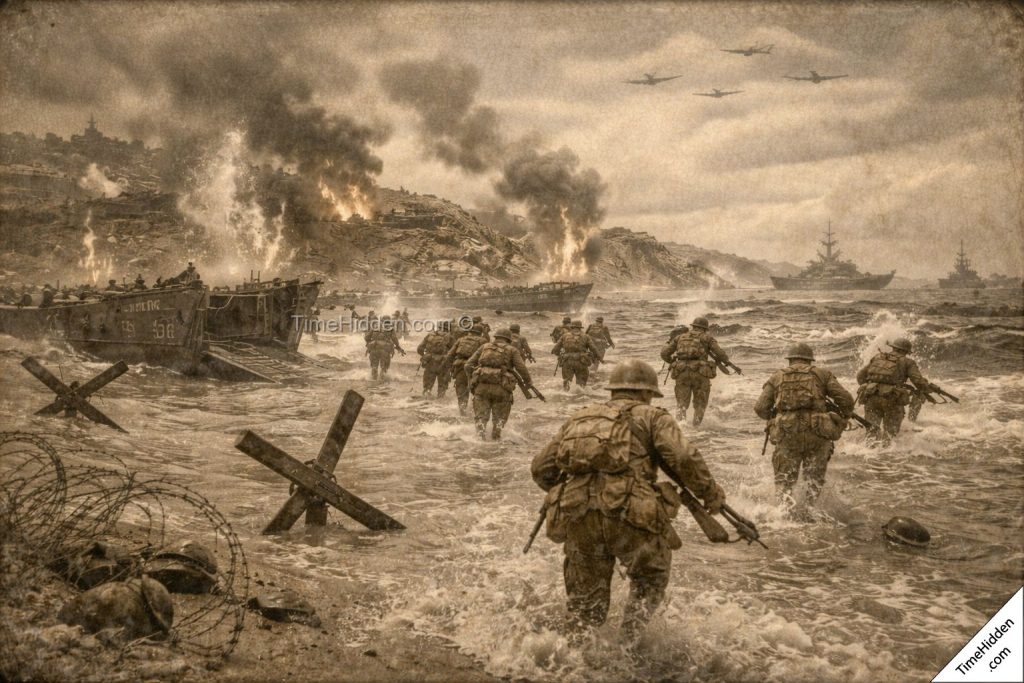
D-Day, formally known as the Normandy landings, stands as one of the most significant and carefully planned military operations in modern history. On 6 June 1944, Allied forces launched a massive amphibious invasion along the coast of German-occupied France, opening a long-awaited Western Front in Europe. The operation marked a turning point in World War II, demonstrating the ability of the Allies to coordinate land, sea, and air power on an unprecedented scale.
The success of D-Day was not the result of a single day’s actions alone, but the culmination of years of preparation, intelligence gathering, industrial production, and strategic cooperation among Allied nations. While the immediate objective was to secure a foothold in Normandy, the broader goal was far more ambitious: to liberate Western Europe and begin the final defeat of Nazi Germany. D-Day symbolized the transition from planning to execution, from containment to liberation, and from defensive postures to a sustained offensive that would ultimately bring the war in Europe to an end.
Historical Background
By 1943, the strategic situation in Europe was changing. Germany remained firmly in control of much of Western Europe, but it was under increasing pressure. In the east, the Soviet Union had halted and reversed German advances, while in the south, Allied forces had landed in North Africa and Italy. However, the absence of a major Western Front allowed Germany to concentrate significant forces against the Soviets.
The idea of a cross-Channel invasion had been discussed since the early years of the war, but it required overwhelming resources and coordination. The English Channel presented a natural barrier, and German forces had spent years fortifying the Atlantic coast, constructing defensive systems intended to repel any landing attempt.
In late 1943, Allied leaders agreed that an invasion of northern France was essential. Normandy was selected as the landing site due to its combination of accessible beaches, proximity to major ports, and the element of surprise. Extensive deception operations were launched to convince German commanders that the invasion would occur elsewhere, particularly near the Pas-de-Calais.
By the spring of 1944, Allied forces in Britain were assembled and trained, awaiting the right conditions. The invasion would require precise timing, favorable weather, and flawless coordination across multiple nations and military branches.
Main Events
Timeline of D-Day and the Normandy Landings
-
1942–1943: Early planning and buildup of Allied forces in Britain.
-
November 1943: Allied leaders formally approve the Normandy invasion plan.
-
Early 1944: Large-scale training exercises and deception operations intensify.
-
5 June 1944: Initial invasion delayed due to weather conditions.
-
6 June 1944: D-Day landings commence along the Normandy coast.
-
7–30 June 1944: Allies consolidate beachheads and expand inland.
-
July–August 1944: Breakout from Normandy and advance across France.
Planning and Preparation
The Normandy invasion, officially named Operation Overlord, was one of the most complex military operations ever attempted. It involved the coordination of land, naval, and air forces from multiple countries, including the United States, the United Kingdom, Canada, and several Allied nations in exile.
Planning emphasized secrecy and deception. A major effort, known as Operation Fortitude, aimed to mislead German intelligence about the timing and location of the invasion. Fake armies, false radio traffic, and misleading intelligence reports were used to create the illusion of an impending landing elsewhere.
Logistical preparation was equally critical. Specialized landing craft were developed, supply systems were planned in detail, and temporary harbors were designed to support forces once ashore. The success of D-Day depended not only on the initial landings but on the ability to sustain and expand the invasion force.
The Landings on 6 June 1944
In the early hours of 6 June, airborne units were deployed behind enemy lines with the mission of securing key routes and disrupting German responses. Shortly thereafter, naval forces began positioning themselves along the coast, providing support for the main landings.
At dawn, Allied troops landed on five designated beaches: Utah, Omaha, Gold, Juno, and Sword. Each beach had specific objectives, ranging from securing exits inland to linking up with neighboring forces. While resistance varied from sector to sector, the overall objective remained clear: establish a secure foothold on the continent.
By the end of the day, Allied forces had successfully landed tens of thousands of troops and large quantities of equipment. Although progress was uneven and challenges remained, the core objective of establishing beachheads had been achieved.
Consolidation and Expansion
In the days following D-Day, Allied forces focused on reinforcing their positions and pushing inland. German counterattacks were limited by confusion, disrupted communications, and the effectiveness of Allied air power.
The terrain of Normandy posed its own challenges, particularly the dense countryside that slowed movement and complicated coordination. Nevertheless, the steady buildup of men and material allowed the Allies to gradually expand their control. Temporary harbors played a crucial role in maintaining supply lines during this critical phase.
By late June, the Allies had secured a continuous front along the Normandy coast, setting the stage for a broader advance into occupied France.
Key Figures
Allied Leadership
-
Dwight D. Eisenhower: Supreme Commander of the Allied Expeditionary Force, responsible for overall planning and execution of the invasion.
-
Bernard Montgomery: Commander of Allied ground forces during the initial phase of the Normandy campaign.
-
Omar Bradley: Senior American commander overseeing U.S. ground operations in Normandy.
-
Trafford Leigh-Mallory: Commander of Allied air forces supporting the invasion.
German Leadership
-
Erwin Rommel: Senior German commander responsible for defending the Atlantic coast in northern France.
-
Gerd von Rundstedt: Overall commander of German forces in Western Europe.
-
Adolf Hitler: German leader whose decisions influenced the deployment and response of German reserves.
Supporting Roles
Beyond senior commanders, the success of D-Day relied on countless planners, engineers, intelligence officers, and support personnel. The coordination between naval crews, air units, and ground forces was essential in overcoming the challenges of the invasion.
Significance and Impact
D-Day marked the beginning of the end for German control of Western Europe. By establishing a permanent foothold in France, the Allies ensured that Germany would have to fight a sustained war on two major fronts. This development severely strained German resources and limited its strategic options.
The invasion demonstrated the effectiveness of Allied cooperation. Nations with different military traditions and command structures were able to operate together toward a common goal. This unity not only strengthened the military effort but also laid the groundwork for postwar cooperation.
From a strategic perspective, D-Day shifted the balance of power decisively. The liberation of France followed within months, and Allied forces advanced steadily toward Germany’s borders. The operation also boosted morale among occupied populations, signaling that liberation was no longer a distant hope but an unfolding reality.
D-Day’s legacy extends beyond its immediate military outcomes. It became a symbol of planning, coordination, and determination in the face of immense challenges, illustrating how complex operations can succeed through preparation and cooperation.
Conclusion
The Normandy landings on D-Day stand as one of the most influential events of World War II. They represented the moment when years of preparation, sacrifice, and strategic planning converged into decisive action. By successfully establishing a Western Front, the Allies transformed the course of the war in Europe.
D-Day was not an endpoint but a beginning. It opened the path to the liberation of Western Europe and the eventual defeat of Nazi Germany. Its significance lies not only in the scale of the operation but in what it demonstrated about unity, resolve, and the ability to overcome formidable obstacles through collective effort.
As a historical event, D-Day continues to be studied for its lessons in leadership, coordination, and strategic vision. It remains a powerful reminder of how careful planning and international cooperation can shape the outcome of global conflicts and alter the course of history.