
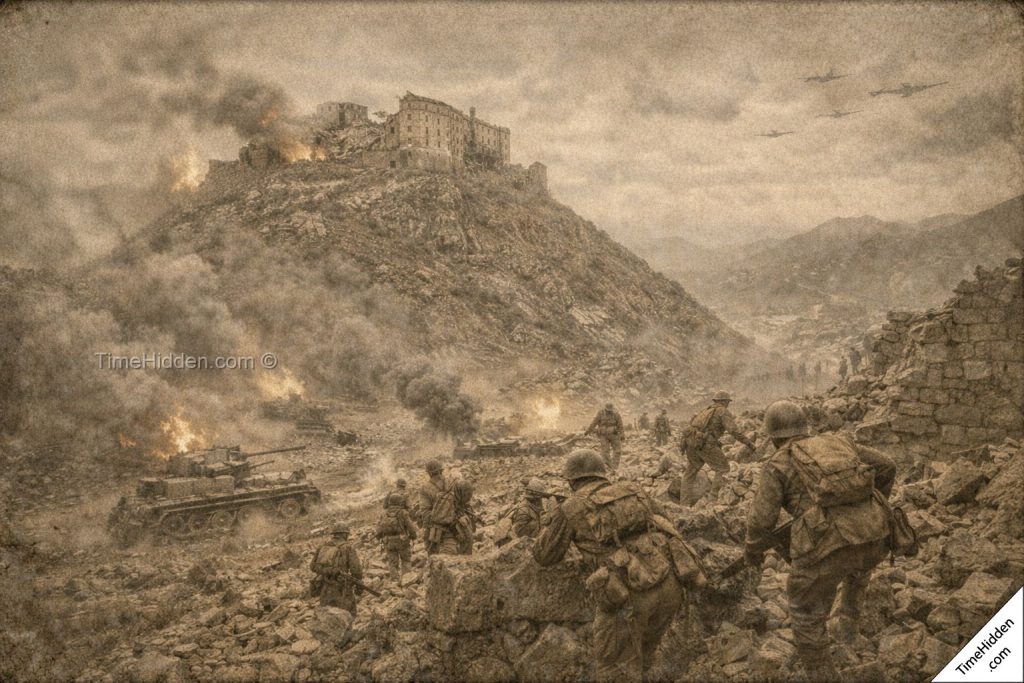
World War II Battles: Battle of Monte Cassino
Introduction
The Battle of Monte Cassino stands as one of the longest, most complex, and strategically significant campaigns of World War II in Western Europe. Fought between January and May 1944 in central Italy, it was not a single battle but a series of four major offensives conducted by Allied forces against well-prepared German defensive positions. At the heart of the struggle stood Monte Cassino, a rugged mountain crowned by the ancient Benedictine monastery of Montecassino, overlooking the Liri Valley and the main route to Rome.
For the Allies, breaking through this defensive line was essential to advance northward, capture Rome, and weaken German resistance in Italy. For the Germans, holding Monte Cassino delayed the Allied advance and tied down large enemy forces that could otherwise be used elsewhere in Europe. The campaign involved troops from many nations, including the United States, United Kingdom, France, Poland, New Zealand, India, and Germany, making it one of the most multinational operations of the war. The Battle of Monte Cassino became a symbol of determination, endurance, and the immense challenges of modern warfare in difficult terrain.
Historical Background
After the Allied landings in Sicily in July 1943 and the subsequent invasion of mainland Italy in September, Italy formally surrendered. However, German forces quickly took control of much of the country and established a series of defensive lines across the Italian peninsula. The most formidable of these was the Gustav Line, stretching from the Tyrrhenian Sea to the Adriatic Sea. Its purpose was to block the Allied advance toward Rome.
Monte Cassino occupied a key position within the Gustav Line. The mountain overlooked the Rapido and Liri river valleys, through which Highway 6 ran—the primary route to Rome. The terrain favored defense: steep slopes, narrow valleys, and limited routes of advance. German forces, primarily from the experienced 10th Army under General Heinrich von Vietinghoff, used the natural landscape to their advantage, creating strong defensive positions.
The Allies, under the overall command of General Sir Harold Alexander, faced significant challenges. Their forces were stretched along a long front, supply lines were difficult to maintain, and winter weather further complicated operations. Despite these obstacles, capturing Monte Cassino was considered essential. Without breaking the Gustav Line, the Allies could not exploit their numerical and industrial superiority to achieve a decisive breakthrough in Italy.
Main Events
First Battle: January 1944
The first phase began in mid-January 1944, primarily involving American and British forces. The Allied plan focused on crossing the Rapido River and advancing toward Monte Cassino. However, strong German defenses, difficult river crossings, and limited maneuvering space led to heavy Allied setbacks. The attacks failed to achieve their objectives, and the front stabilized with little territorial gain.
Second Battle: February 1944
In February, the Allies launched a renewed assault. A controversial decision was made to bomb the Monte Cassino monastery, based on the belief that German forces were using it as an observation post. Although this claim remains debated by historians, the bombing destroyed the centuries-old structure. Ironically, the ruins later provided improved defensive positions for German paratroopers. Despite determined attacks by New Zealand and Indian divisions, the second battle also ended without a breakthrough.
Third Battle: March 1944
The third offensive, launched in March, involved massive artillery bombardments followed by ground assaults. Allied forces attempted to seize the town of Cassino and the surrounding high ground. Fighting was intense and progress was slow. German defenders maintained control of key positions, and once again the Allies were unable to break through the Gustav Line.
Fourth Battle: May 1944 (Operation Diadem)
The final and decisive phase began in May 1944. Operation Diadem was a coordinated, large-scale offensive involving multiple Allied armies attacking across a wide front. French forces advanced through mountainous terrain to the west, British and Canadian units pushed through the Liri Valley, and the Polish II Corps was tasked with capturing Monte Cassino itself. After days of hard fighting, Polish troops finally secured the ruins of the monastery on May 18, 1944. The Gustav Line collapsed, opening the road to Rome, which the Allies entered in early June.
Key Figures Involved
General Sir Harold Alexander
As the overall Allied commander in Italy, Alexander coordinated the multinational forces involved in the Monte Cassino campaign. His strategic vision emphasized sustained pressure across the entire front rather than isolated attacks.
General Mark W. Clark
Commander of the U.S. Fifth Army, Clark played a central role in the early assaults on Monte Cassino. His forces faced some of the most difficult fighting of the campaign, particularly during the initial river crossings.
General Alphonse Juin
Leading the French Expeditionary Corps, General Juin demonstrated exceptional skill in mountain warfare. His troops’ successful advance through difficult terrain during Operation Diadem was crucial to the final breakthrough.
General Władysław Anders
Commander of the Polish II Corps, Anders led the final assault on Monte Cassino. The capture of the monastery ruins by Polish forces became a powerful symbol of Polish contribution and sacrifice during the war.
General Heinrich von Vietinghoff
As commander of the German 10th Army, von Vietinghoff effectively organized the defense of the Gustav Line. His forces delayed the Allied advance for months despite being outnumbered and under constant pressure.
Significance and Impact
The Battle of Monte Cassino had far-reaching military and political consequences. Militarily, it demonstrated the difficulty of offensive operations against a well-prepared defensive position, especially in challenging terrain. The campaign tied down significant German forces that might otherwise have been used to counter the Allied landings in Normandy in June 1944.
The destruction of the Monte Cassino monastery became one of the most controversial episodes of the Italian campaign, raising questions about military necessity and cultural preservation. After the war, the monastery was rebuilt as a symbol of reconciliation and historical continuity.
For the Allied coalition, Monte Cassino highlighted the importance of coordination among multinational forces. The final success was not achieved through a single decisive blow but through cooperation, adaptability, and persistence. The campaign also reinforced the strategic importance of Italy as a secondary but vital theater of the war.
Conclusion
The Battle of Monte Cassino was a defining chapter of World War II in Italy. Spanning four major offensives over several months, it tested the endurance, leadership, and coordination of both Allied and German forces. While progress was slow and costly, the eventual Allied victory broke one of the strongest defensive lines in Europe and paved the way for the capture of Rome.
Beyond its immediate military outcome, Monte Cassino became a lasting symbol of the complexities of modern warfare—where geography, strategy, and human determination intersect. The battle’s legacy endures as a reminder that victory in war often depends not on swift success, but on resilience, cooperation, and the ability to learn from setbacks.