
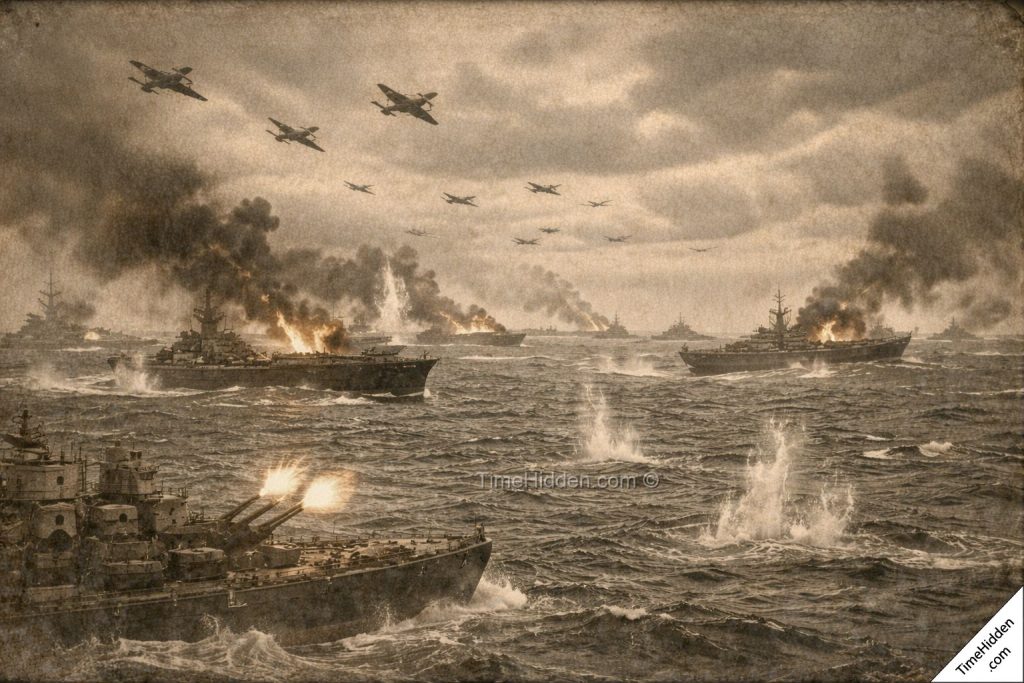
World War II Battles: Battle of Leyte Gulf
Introduction
The Battle of Leyte Gulf, fought from October 23 to October 26, 1944, is widely regarded as the largest naval battle in history and a decisive turning point in the Pacific Theater of World War II. Taking place in the waters surrounding the Philippine island of Leyte, the battle marked the final, desperate attempt by the Imperial Japanese Navy to stop the Allied advance toward Japan. By late 1944, Allied forces had gained momentum across the Pacific, steadily reclaiming territory and isolating Japanese strongholds. The return to the Philippines, promised by General Douglas MacArthur, carried immense strategic and symbolic importance.
Leyte Gulf was not a single, unified engagement but a complex series of interrelated naval battles fought simultaneously across vast distances. It involved hundreds of warships, thousands of aircraft, and commanders on both sides making rapid decisions under immense pressure. The outcome would determine control of sea lanes, the fate of Japanese naval power, and the pace of the Allied advance toward the Japanese home islands. The battle showcased the evolution of naval warfare, where aircraft carriers and air power proved decisive, signaling the end of the battleship-dominated era.
Historical Background
By mid-1944, the strategic balance in the Pacific had shifted decisively in favor of the Allies. After major victories at Midway in 1942 and during the island-hopping campaigns across the central and southwestern Pacific, the United States and its allies had severely weakened Japan’s ability to wage a prolonged naval war. Japanese shipbuilding and pilot training could not keep pace with Allied production and experience.
The Philippines occupied a critical position in Japan’s defensive perimeter. Control of the islands allowed Japan to protect vital supply routes carrying oil and raw materials from Southeast Asia. Losing the Philippines would effectively sever these lifelines, crippling Japan’s economy and military operations. For the Allies, retaking the Philippines would provide advanced bases for air and naval forces, bringing Japan within closer reach.
On October 20, 1944, Allied forces began landing on Leyte under the command of General Douglas MacArthur. In response, the Japanese high command devised an ambitious and risky plan, known as Operation Shō-Gō. The plan aimed to lure the main Allied naval forces away from the invasion beaches and then destroy the vulnerable transport and support ships. Despite limited resources and declining naval strength, Japanese leaders hoped that a decisive blow could alter the course of the war.
Main Events
Prelude: October 23–24, 1944
The battle began as Japanese naval forces moved toward the Philippines from multiple directions. The Japanese plan involved three main forces: a Center Force advancing through the Sibuyan Sea, a Southern Force moving through the Surigao Strait, and a Northern Force acting as a decoy to draw Allied aircraft carriers away.
On October 23, American submarines detected and attacked the Japanese Center Force in the Palawan Passage, sinking key ships and alerting Allied commanders to the approaching threat. The following day, the Center Force came under intense air attack in the Sibuyan Sea from aircraft launched by U.S. carriers. Although the Japanese force suffered losses and temporarily turned back, it later resumed its advance.
Battle of the Sibuyan Sea: October 24
The engagement in the Sibuyan Sea demonstrated the growing dominance of air power. Repeated waves of Allied aircraft targeted Japanese ships, forcing them to maneuver defensively. Although the Center Force endured heavy pressure, it was not completely stopped, contributing to confusion among Allied commanders regarding Japanese intentions.
Battle of Surigao Strait: Night of October 24–25
In the southern approach to Leyte Gulf, the Japanese Southern Force attempted to pass through the narrow Surigao Strait. Here, U.S. and Allied naval units executed a classic defensive maneuver, positioning battleships and cruisers to intercept the advancing Japanese ships. This engagement marked one of the last battleship-to-battleship confrontations in history. The Japanese force was decisively defeated, eliminating one element of the overall threat to the invasion.
Battle off Cape Engaño: October 25
Meanwhile, the Japanese Northern Force, composed primarily of aircraft carriers with limited aircraft, moved northward to act as bait. Admiral William F. Halsey Jr., commanding the U.S. Third Fleet, took the decoy and pursued it with his powerful carrier task forces. The ensuing battle off Cape Engaño resulted in the destruction of Japan’s remaining carriers. While tactically successful, Halsey’s decision left the invasion forces temporarily exposed.
Battle off Samar: October 25
The most dramatic and unexpected phase of the battle occurred off the island of Samar. Elements of the Japanese Center Force encountered a small group of U.S. escort carriers and destroyers protecting the landing operations. Despite being outmatched in size and firepower, the Allied ships launched aggressive maneuvers and air attacks. Their determined resistance created confusion and hesitation within the Japanese command, ultimately causing the Center Force to withdraw. This action became one of the most remarkable defensive stands in naval history.
Conclusion of the Battle: October 26
By October 26, the Japanese fleet was in full retreat. Although the battle had involved multiple engagements spread over hundreds of miles, its outcome was clear. The Imperial Japanese Navy had failed to disrupt the Leyte landings and had suffered losses it could not replace. From this point onward, Japan would no longer be able to conduct large-scale naval operations.
Key Figures Involved
General Douglas MacArthur
As Supreme Commander of Allied Forces in the Southwest Pacific, MacArthur oversaw the return to the Philippines. While not directly commanding naval forces, his strategic vision and determination to liberate the Philippines set the stage for the battle.
Admiral Chester W. Nimitz
Commander in Chief of the U.S. Pacific Fleet, Nimitz coordinated overall naval strategy in the Pacific. His leadership ensured effective cooperation between different fleets operating in the Leyte Gulf region.
Admiral William F. Halsey Jr.
Leading the U.S. Third Fleet, Halsey played a central role during the battle. His decision to pursue the Japanese decoy force remains one of the most debated command choices of the war, highlighting the challenges of decision-making in complex operations.
Admiral Takeo Kurita
Commander of the Japanese Center Force, Kurita led the most powerful element of Japan’s plan. His withdrawal during the Battle off Samar, despite having an apparent advantage, reflected the uncertainty and strain faced by Japanese commanders.
Admiral Jisaburō Ozawa
Commander of the Japanese Northern Force, Ozawa carried out the decoy mission. Although his carriers were lost, his actions succeeded in drawing away Allied forces, partially fulfilling his role in the overall plan.
Significance and Impact
The Battle of Leyte Gulf had profound consequences for the remainder of World War II in the Pacific. Strategically, it marked the effective destruction of the Imperial Japanese Navy as a fighting force. Without sufficient ships, fuel, or trained personnel, Japan could no longer contest Allied control of the seas.
The battle confirmed the dominance of aircraft carriers and naval aviation over traditional surface fleets. Although battleships played important roles, air power proved decisive in detecting, engaging, and neutralizing enemy forces across vast distances.
Politically and psychologically, the victory strengthened Allied resolve and validated the decision to return to the Philippines. It also fulfilled a major promise made to the Filipino people, reinforcing Allied credibility in the region. For Japan, the defeat underscored the increasingly defensive and desperate nature of its war effort.
Conclusion
The Battle of Leyte Gulf stands as a landmark event in naval history and a decisive moment in World War II. Fought across multiple seas and involving unprecedented numbers of ships and aircraft, it demonstrated the complexity of modern warfare and the importance of coordination, intelligence, and leadership.
By securing victory at Leyte Gulf, the Allies ensured the success of the Philippine campaign and eliminated Japan’s ability to challenge Allied naval dominance. The battle not only hastened the end of the war in the Pacific but also reshaped naval strategy for generations to come. Its legacy endures as a testament to the strategic importance of sea power and the decisive impact of turning points in global conflict.