
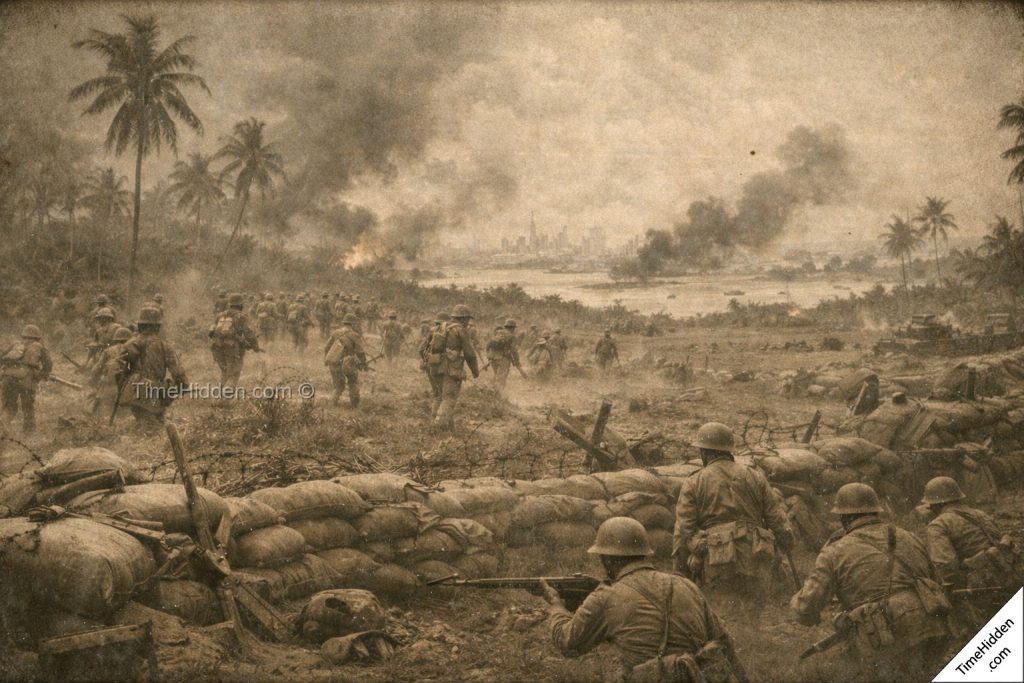
World War II Battles: Battle of Singapore
Introduction
The Battle of Singapore was one of the most significant and consequential campaigns of World War II in the Asia–Pacific region. Fought between December 1941 and February 1942, it culminated in the fall of Singapore, Britain’s most important military and naval base in Southeast Asia. Often described as the “Gibraltar of the East,” Singapore was considered a cornerstone of British imperial defense and a symbol of Western power in Asia.
The rapid Japanese advance down the Malay Peninsula and the eventual surrender of Singapore shocked the Allied world. British leaders had long believed the fortress to be nearly impregnable, protected by naval strength, modern defenses, and the assumption of Allied control of the seas. Instead, the battle revealed serious weaknesses in planning, coordination, and preparedness.
The fall of Singapore marked a dramatic shift in the balance of power in the Pacific. It demonstrated the effectiveness of Japanese operational planning and challenged long-standing assumptions about European military superiority. The campaign remains a defining episode of World War II, illustrating how speed, strategy, and adaptability could overturn established defenses and reshape the course of the war.
Historical Background
Before World War II, Singapore was a vital hub of the British Empire in Asia. Its strategic location at the southern tip of the Malay Peninsula made it a key naval base controlling sea lanes between the Indian Ocean and the Pacific. British defense planning centered on the idea that Singapore could be held against any attack until reinforcements arrived from Europe.
However, these plans were built on assumptions that proved flawed. British strategy emphasized naval defense, but the outbreak of war in Europe limited the ability to deploy a strong fleet to the Far East. Air and ground defenses in Malaya were underdeveloped, and training was often inadequate for jungle warfare.
Japan, seeking to secure resources and expand its influence, viewed Southeast Asia as essential to its war aims. The capture of Malaya and Singapore would eliminate a major Allied base and open routes to resource-rich territories in the Dutch East Indies. Japanese planners recognized the importance of speed and surprise, aiming to neutralize Allied forces before they could regroup.
By late 1941, tensions in the Pacific escalated rapidly. On December 8, 1941, following the opening of hostilities across the region, Japanese forces began their invasion of Malaya. The campaign toward Singapore had begun.
Main Events
Japanese Landings in Malaya (December 1941)
The campaign opened with Japanese landings on the eastern and western coasts of northern Malaya. Utilizing well-coordinated infantry, air support, and rapid movement, Japanese forces advanced southward with remarkable speed. They exploited their superiority in air power, quickly gaining control of the skies and disrupting Allied communications and supply lines.
Allied forces, composed mainly of British, Australian, Indian, and local units, attempted to slow the advance through a series of defensive actions. However, poor coordination and limited experience in jungle combat hampered their efforts. Japanese units frequently outmaneuvered defenders by using unexpected routes through dense terrain.
Retreat Down the Malay Peninsula (December 1941 – January 1942)
As Japanese forces pushed south, the Allied command ordered a gradual withdrawal toward Singapore. Key towns and airfields fell one by one, reducing Allied ability to contest the advance. The loss of air superiority proved decisive, as Japanese aircraft operated freely, supporting ground operations and disrupting movement.
Despite isolated acts of resistance, the retreat continued. The speed of the Japanese advance surprised Allied commanders, who struggled to establish a stable defensive line. By late January 1942, Japanese forces had reached the Johor Strait, the narrow body of water separating Malaya from Singapore Island.
Crossing to Singapore Island (February 1942)
On February 8, 1942, Japanese forces launched their assault across the Johor Strait. They targeted sectors defended by Australian units, using artillery and coordinated attacks to establish beachheads. Once ashore, Japanese troops expanded their positions and advanced inland.
Allied defenders attempted to contain the landings, but communication difficulties and limited reserves made coordinated counterattacks difficult. The battle quickly spread across the island, with Japanese forces pressing toward key installations and supply areas.
The Final Days and Surrender (February 1942)
As the fighting continued, conditions within Singapore deteriorated. Water supplies became a critical concern, and civilian areas faced increasing disruption. Allied commanders faced the prospect of continued resistance with diminishing resources and little hope of reinforcement.
On February 15, 1942, Lieutenant General Arthur Percival, the Allied commander, made the decision to surrender Singapore to Japanese forces under Lieutenant General Tomoyuki Yamashita. The surrender marked the end of the battle and one of the largest capitulations of British-led forces in history.
Key Figures
Arthur Percival
As the Allied commander in Malaya and Singapore, Percival faced immense challenges, including limited resources and strategic constraints. His decision to surrender remains a subject of historical debate, reflecting the difficult circumstances of the campaign.
Tomoyuki Yamashita
Commander of Japanese forces during the campaign, Yamashita demonstrated effective use of speed, maneuver, and psychological pressure. His leadership was instrumental in the rapid advance and ultimate capture of Singapore.
Archibald Wavell
Commander-in-Chief of Allied forces in the region, Wavell was responsible for overseeing the broader defense of Southeast Asia. He struggled to coordinate forces across vast distances and under severe resource limitations.
Henry Pownall
A senior British officer involved in planning and coordination, Pownall’s role highlights the complexities and challenges of Allied command structures during the campaign.
Gordon Bennett
An Australian commander during the defense of Malaya and Singapore, Bennett’s actions and decisions during the retreat and final stages of the battle remain a significant aspect of the campaign’s legacy.
Significance and Impact
The fall of Singapore had profound strategic and psychological consequences. It represented a major blow to British prestige and shattered the perception of European invincibility in Asia. For Japan, the victory secured a key strategic position and demonstrated the effectiveness of its military doctrine during the early stages of the war.
The battle exposed serious shortcomings in Allied planning, including overreliance on static defenses, underestimation of the enemy, and insufficient preparation for jungle warfare. These lessons influenced later Allied operations in the Pacific, leading to changes in training, tactics, and command structures.
Internationally, the defeat accelerated shifts in regional power dynamics and encouraged resistance movements across Asia. The campaign also underscored the global nature of World War II, linking events in Europe with decisive battles in the Pacific.
Conclusion
The Battle of Singapore stands as one of the most dramatic and instructive episodes of World War II. In a matter of weeks, a fortress believed to be secure fell to a determined and well-prepared opponent. The campaign highlighted the importance of adaptability, intelligence, and realistic strategic planning in modern warfare.
From the initial landings in Malaya to the surrender in February 1942, the battle unfolded as a clear narrative of momentum, decision-making, and consequence. Its outcome reshaped the course of the war in the Asia–Pacific region and left a lasting mark on military history.
Today, the Battle of Singapore is remembered not only for its outcome but also for the lessons it offers about leadership, preparedness, and the dangers of complacency. It remains a powerful reminder that in war, assumptions can be as decisive as weapons, and strategy can determine the fate of nations.