
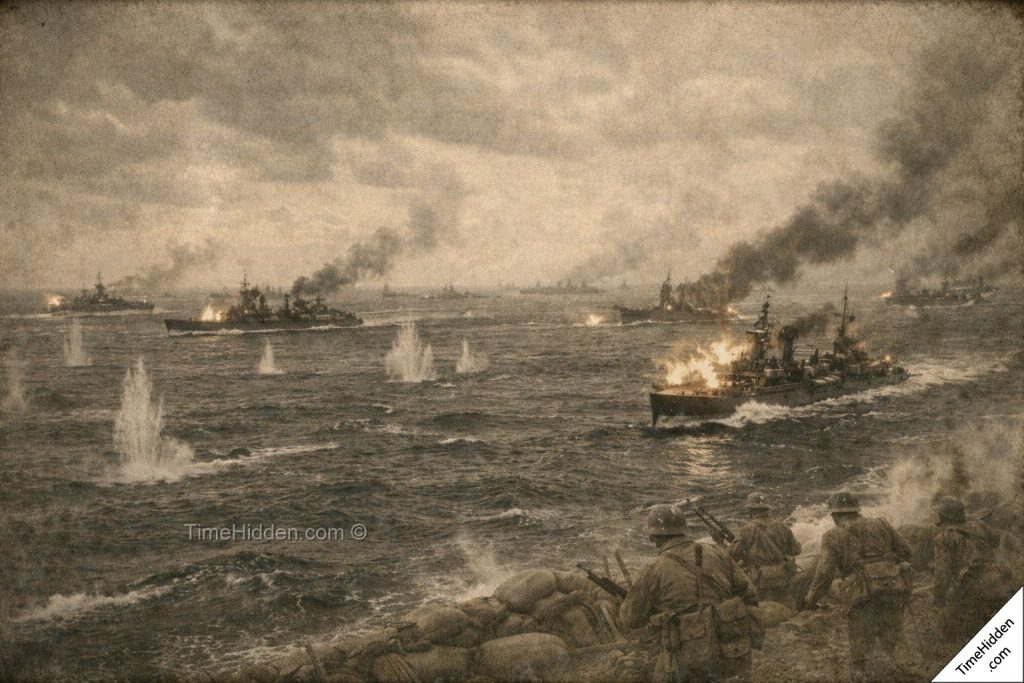
World War II Battles: The Battle of the Java Sea
Introduction
The Battle of the Java Sea, fought on 27 February 1942, was one of the most decisive naval engagements of the early Pacific War. Taking place during Japan’s rapid expansion across Southeast Asia, the battle marked the collapse of Allied naval resistance in the Dutch East Indies. For the Allies, the loss of control over the Java Sea effectively sealed the fate of Java itself, opening the way for Japanese occupation and removing a critical barrier to Japan’s access to vital natural resources.
This battle was notable not only for its outcome but also for the multinational character of the Allied forces involved. Ships and sailors from the Netherlands, Britain, the United States, and Australia fought together under a unified command, attempting to halt a powerful and well-coordinated Japanese invasion fleet. Despite determination and courage, the Allies faced overwhelming challenges, including inferior coordination, outdated equipment, and a lack of air support. The Battle of the Java Sea stands as a clear example of how strategic imbalance, rather than lack of resolve, can determine the outcome of a major naval confrontation.
Historical Background
Following the Attack on Pearl Harbor in December 1941, Japan launched a series of coordinated offensives across the Pacific and Southeast Asia. Within weeks, Japanese forces had captured key territories including Hong Kong, Guam, Wake Island, and much of the Philippines. The next major objective was the Dutch East Indies, a region of immense strategic importance due to its rich oil fields, rubber plantations, and other critical raw materials.
The Dutch East Indies, present-day Indonesia, were lightly defended and geographically vast. While the Netherlands had been occupied by Germany since 1940, Dutch colonial authorities continued to administer the islands with limited military resources. Recognizing the threat posed by Japan, Allied powers attempted to organize a joint defense of the region. This effort resulted in the formation of the American-British-Dutch-Australian Command, commonly known as ABDACOM.
ABDACOM was intended to coordinate land, sea, and air forces across Southeast Asia, but it faced serious challenges from the outset. Differences in language, doctrine, equipment, and command structure hindered effective cooperation. Meanwhile, Japanese naval forces were highly experienced, well-trained, and supported by strong air power. By February 1942, Japanese troops were advancing toward Java from multiple directions, making a decisive naval engagement increasingly likely.
Main Events
Timeline of the Battle of the Java Sea
-
December 1941: Japan begins its rapid expansion across Southeast Asia.
-
January 1942: Japanese forces capture key territories in Borneo and the Celebes.
-
Early February 1942: ABDACOM naval forces concentrate around Java.
-
25–26 February 1942: Japanese invasion convoys approach Java from the north.
-
27 February 1942: The Battle of the Java Sea is fought.
-
28 February – 1 March 1942: Follow-up engagements occur; Allied naval resistance collapses.
-
Early March 1942: Java falls to Japanese forces.
The Allied Naval Plan
As Japanese invasion convoys moved toward Java, Allied naval commanders recognized that stopping these forces at sea was the last chance to defend the island. Rear Admiral Karel Doorman of the Royal Netherlands Navy was placed in command of a combined Allied strike force. His task was to intercept and disrupt the Japanese transports before they could land troops.
The Allied fleet consisted of a mix of cruisers and destroyers from different nations. While numerically respectable, the force suffered from several weaknesses. Communication systems were not fully compatible, tactical doctrines varied, and many ships were already worn down from previous operations. In contrast, the Japanese escort force was highly coordinated, equipped with advanced torpedoes, and supported by excellent reconnaissance.
The Battle Begins
On the afternoon of 27 February 1942, the opposing fleets made contact in the Java Sea. Admiral Doorman ordered his ships to engage the Japanese escorts in an attempt to break through and reach the transport vessels. The engagement unfolded over several hours and involved long-range gunfire, maneuvering, and repeated course changes.
The Japanese navy maintained a disciplined formation and made effective use of its weapons. Allied ships attempted to press forward, but coordination problems and limited intelligence made it difficult to concentrate their efforts. As the battle continued into the evening, the Allied force became increasingly disorganized.
Prolonged Engagement and Withdrawal
Throughout the engagement, Admiral Doorman repeatedly signaled his determination to continue the attack. However, fuel shortages, ammunition depletion, and mounting damage forced difficult decisions. Several Allied ships were forced to withdraw, reducing the strength of the striking force.
As night fell, the Japanese maintained control of the situation. Their transports remained protected, and the Allied fleet failed to achieve its primary objective. Eventually, Doorman ordered a withdrawal in an attempt to regroup and continue operations later. This decision effectively ended the main phase of the Battle of the Java Sea.
Aftermath at Sea
The consequences of the battle unfolded rapidly over the next two days. Isolated Allied ships attempting to escape or continue resistance were intercepted and defeated in subsequent engagements. By early March 1942, the remaining Allied naval forces in the region were destroyed or forced to retreat. With no effective naval defense remaining, Java was left exposed to invasion.
Key Figures
Allied Commanders
-
Rear Admiral Karel Doorman: Dutch naval officer and commander of the Allied strike force. He symbolized Allied determination despite overwhelming odds.
-
Captain John A. Collins: Senior Australian naval officer involved in the engagement, representing one of the key Allied contributors.
-
Various British and American officers: Played important roles in commanding individual ships within the Allied fleet.
Japanese Commanders
-
Vice Admiral Takeo Takagi: Overall commander of the Japanese covering force protecting the invasion convoys.
-
Rear Admiral Shoji Nishimura: Commander of a key Japanese cruiser division during the battle.
Broader Participants
Beyond senior commanders, the battle involved thousands of sailors from multiple nations. Their cooperation under difficult circumstances reflected the early efforts at multinational warfare that would later become more effective as the war progressed.
Significance and Impact
The Battle of the Java Sea had profound strategic consequences. It effectively ended organized Allied naval resistance in the Dutch East Indies, clearing the way for Japan to occupy Java and secure access to critical natural resources. This success strengthened Japan’s ability to sustain its war effort during the early years of the conflict.
For the Allies, the defeat exposed serious weaknesses in coordination, communication, and preparedness. The limitations of ABDACOM became clear, leading to its eventual dissolution. However, the lessons learned from these early setbacks contributed to improvements in Allied joint operations later in the war, particularly in the Pacific.
The battle also demonstrated the importance of air superiority and intelligence in modern naval warfare. The Japanese ability to protect their invasion forces without direct air engagement highlighted the effectiveness of integrated planning and experienced leadership. In contrast, Allied forces operated with limited air cover and incomplete information, placing them at a significant disadvantage.
In the broader context of World War II, the Battle of the Java Sea marked the high point of Japanese expansion. Although Japan continued to advance in the months that followed, the resources and territory gained during this period would soon be challenged by a reorganized and increasingly powerful Allied response.
Conclusion
The Battle of the Java Sea stands as a decisive and sobering chapter in the history of World War II. It represented the final attempt by Allied naval forces to defend the Dutch East Indies and highlighted both the courage of those involved and the strategic realities they faced. Despite determined resistance, the imbalance in preparation, coordination, and resources proved decisive.
While the battle ended in defeat for the Allies, it also served as a catalyst for change. The experience underscored the necessity of unified command, effective communication, and long-term strategic planning in modern warfare. As such, the Battle of the Java Sea remains an important lesson in naval history and a key moment in the wider story of the Pacific War.