
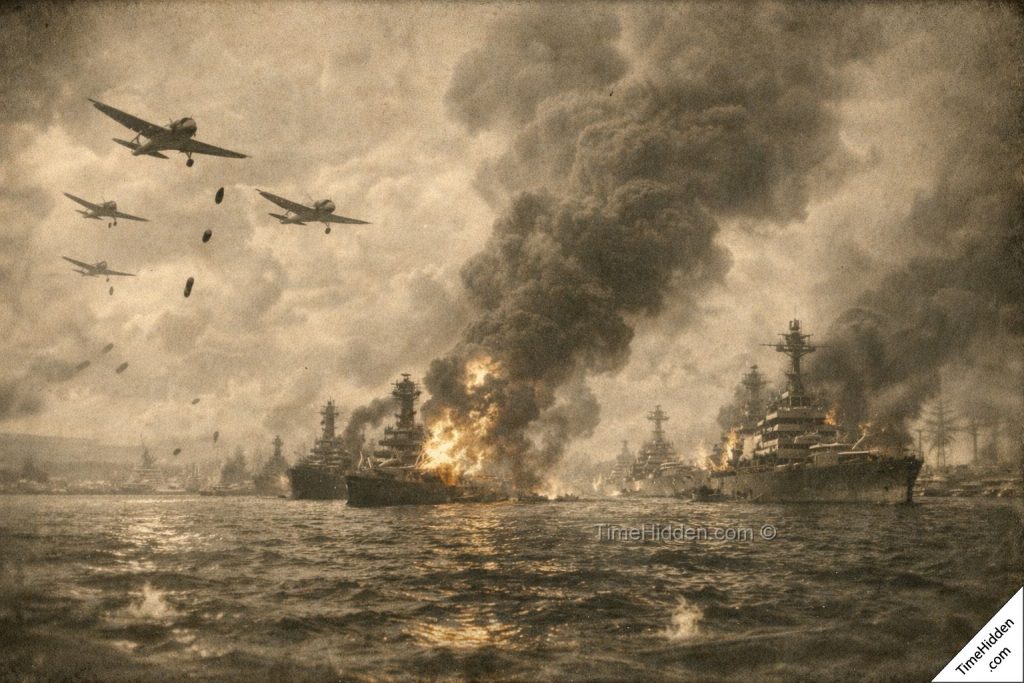
World War II Battles: The Attack on Pearl Harbor
Introduction
The Attack on Pearl Harbor stands as one of the most pivotal moments of the twentieth century, marking the dramatic entry of the United States into World War II. On the morning of 7 December 1941, a surprise aerial assault by the Imperial Japanese Navy targeted the American naval base at Pearl Harbor in Hawaii. Within hours, the strategic balance of power in the Pacific was irrevocably altered. What had previously been a global conflict largely centered on Europe and Asia suddenly became a truly worldwide war involving the full industrial and military strength of the United States.
The attack was not an isolated event but the culmination of years of rising tension between Japan and the United States. It reflected clashing strategic interests, economic pressures, and competing visions for dominance in the Asia-Pacific region. Although the operation achieved short-term tactical success for Japan, it failed to accomplish its long-term objectives. Instead, it unified American public opinion, galvanized national resolve, and set in motion a massive mobilization that would ultimately reshape the outcome of the war. The Attack on Pearl Harbor remains a defining example of how a single day can alter the course of history.
Historical Background
The roots of the Attack on Pearl Harbor can be traced back to Japan’s expansionist policies in East Asia during the early twentieth century. Following victories in earlier conflicts, Japan emerged as a major regional power with ambitions to secure resources and markets to fuel its growing industrial economy. By the 1930s, Japan had expanded into Manchuria and later launched a full-scale war against China in 1937.
These actions brought Japan into conflict with Western powers, particularly the United States, which had significant political and economic interests in the Pacific. The United States opposed Japan’s expansion and increasingly used economic measures to apply pressure. By 1940 and 1941, Washington imposed restrictions on the export of key materials to Japan, including oil, scrap metal, and aviation fuel. These measures threatened Japan’s ability to sustain its military operations.
Diplomatic negotiations between Japan and the United States continued throughout 1941, but fundamental differences remained unresolved. Japanese leaders believed that securing access to resources in Southeast Asia was essential for national survival. However, any move southward risked confrontation with American and British forces. To Japanese military planners, neutralizing the United States Pacific Fleet became a necessary step to ensure freedom of action.
Pearl Harbor, located on the island of Oahu, served as the primary base of the United States Pacific Fleet. Although well defended, it was considered relatively safe from direct attack due to its distance from Japan. This perception of security would prove to be a critical vulnerability.
Main Events
Timeline of the Attack on Pearl Harbor
-
Early 1941: Japan begins detailed planning for a potential strike against the United States Pacific Fleet.
-
September–November 1941: Japanese carrier forces conduct training and final preparations.
-
26 November 1941: Japanese strike force departs from northern Japan under strict radio silence.
-
7 December 1941, early morning: Japanese aircraft approach Pearl Harbor undetected.
-
7 December 1941, 7:48 a.m.: First wave of the attack begins.
-
7 December 1941, approximately 9:45 a.m.: Second wave concludes; Japanese forces withdraw.
-
8 December 1941: United States declares war on Japan.
Planning and Preparation
The plan to attack Pearl Harbor was largely driven by Admiral Isoroku Yamamoto, commander of the Japanese Combined Fleet. Yamamoto understood that Japan could not win a prolonged war against the industrial power of the United States. His strategy aimed to deliver a decisive blow that would cripple American naval strength and shock the United States into negotiating a settlement.
The Japanese plan relied on secrecy, speed, and coordination. A task force of six aircraft carriers formed the core of the strike group, supported by escort vessels and submarines. Pilots were trained extensively for long-range carrier operations, and specialized equipment was developed to operate effectively in Pearl Harbor’s shallow waters.
The attack force sailed across the North Pacific using a remote route to avoid detection. Strict radio silence was maintained, and weather conditions helped conceal the fleet’s movement. Meanwhile, diplomatic talks in Washington continued, further contributing to the element of surprise.
The Day of the Attack
On the morning of 7 December 1941, Japanese aircraft launched in two waves toward Pearl Harbor. The first wave focused on airfields and battleships, aiming to neutralize American aircraft and prevent an effective response. The second wave targeted remaining naval assets and infrastructure.
The surprise was nearly complete. Many American personnel initially believed the aircraft overhead were friendly or part of a training exercise. Within minutes, however, it became clear that the base was under attack. Despite confusion, American forces responded quickly, bringing anti-aircraft defenses into action and attempting to launch available aircraft.
Although the attack caused extensive damage to ships and facilities, several key objectives were not achieved. American aircraft carriers, the primary targets of the operation, were not present in the harbor at the time. Fuel storage facilities, repair docks, and submarine bases were also left largely intact. After less than two hours, Japanese aircraft withdrew, having achieved tactical success but leaving significant American capabilities untouched.
Immediate Aftermath
In the hours following the attack, rescue and recovery efforts began across Pearl Harbor. Damage assessments revealed the scale of destruction, but also highlighted the resilience of the base. Many damaged ships were later repaired and returned to service, demonstrating the industrial and logistical strength of the United States.
News of the attack spread rapidly across the United States. Public reaction was immediate and intense. What had been a nation divided over involvement in the war was suddenly united by a sense of shock and determination. The following day, President Franklin D. Roosevelt addressed Congress, leading to a formal declaration of war against Japan.
Key Figures
Japanese Leaders and Commanders
-
Admiral Isoroku Yamamoto: Architect of the Pearl Harbor attack and commander of the Japanese Combined Fleet.
-
Vice Admiral Chuichi Nagumo: Commander of the carrier strike force that executed the attack.
-
Commander Mitsuo Fuchida: Air officer who led the first wave of the attack.
American Leaders and Commanders
-
President Franklin D. Roosevelt: President of the United States, who led the nation into war following the attack.
-
Admiral Husband E. Kimmel: Commander of the United States Pacific Fleet at Pearl Harbor.
-
Lieutenant General Walter Short: Commander of U.S. Army forces in Hawaii.
Broader Participants
Beyond senior commanders, thousands of sailors, soldiers, airmen, and civilians experienced the events of Pearl Harbor firsthand. Their actions during and after the attack played a crucial role in stabilizing the situation and preparing for the conflict that followed.
Significance and Impact
The Attack on Pearl Harbor had consequences that extended far beyond the immediate military damage. Strategically, it brought the United States fully into World War II, transforming the conflict into a global struggle involving unprecedented levels of manpower and industrial output. The United States quickly mobilized its economy, converting factories, expanding shipbuilding programs, and training millions of service members.
For Japan, the attack achieved short-term operational success but failed strategically. By not destroying American aircraft carriers or critical infrastructure, Japan allowed the United States to recover more quickly than anticipated. Moreover, the attack hardened American resolve rather than weakening it, ensuring a long and determined effort to defeat Japan.
The event also reshaped alliances. Following the American declaration of war, Germany and Italy declared war on the United States, further unifying the Allied powers. The Pacific War became a central theater of World War II, characterized by island campaigns, naval battles, and air operations that would last until 1945.
From a historical perspective, Pearl Harbor underscored the importance of intelligence, preparedness, and strategic foresight. It demonstrated how surprise could temporarily shift the balance of power, but also how industrial capacity and national unity could ultimately determine the outcome of a prolonged war.
Conclusion
The Attack on Pearl Harbor remains one of the most significant military events in modern history. It was a moment of profound shock that altered the trajectory of World War II and reshaped global politics for decades to come. While Japan succeeded in delivering a dramatic and unexpected strike, it underestimated the capacity of the United States to recover, adapt, and mobilize on an unprecedented scale.
In the broader context of the war, Pearl Harbor served as the catalyst for American involvement and the beginning of a long and decisive campaign in the Pacific. The lessons of the attack continue to resonate, emphasizing the consequences of strategic decisions, the risks of miscalculation, and the enduring impact of a single day on the course of world history.