
World War II Battles: Battle of the Bulge
Introduction
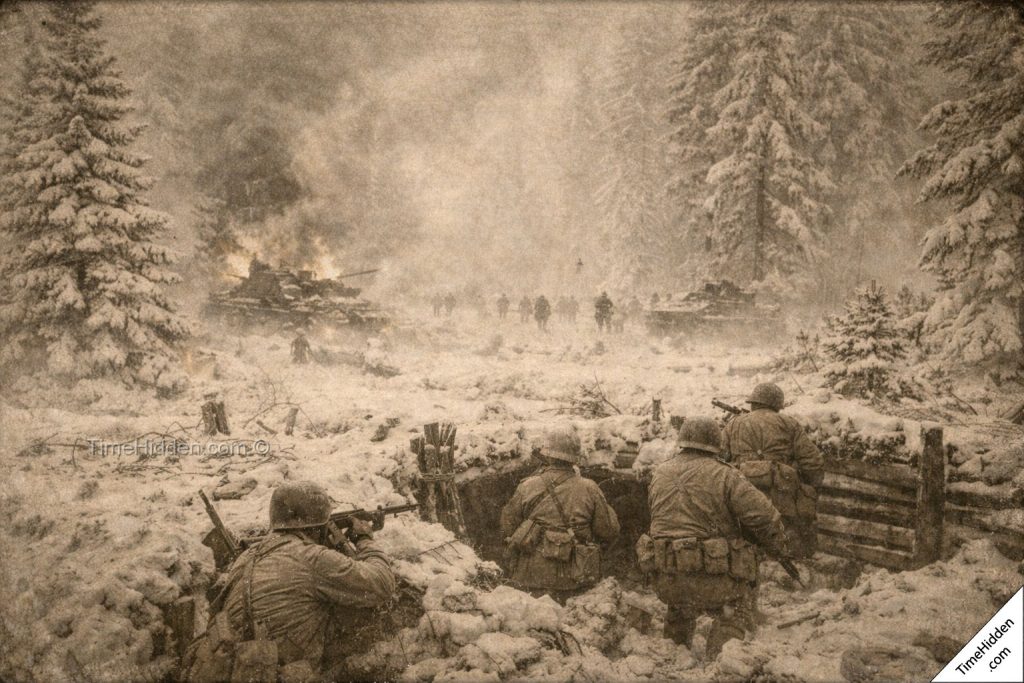
The Battle of the Bulge was the largest and most dramatic land battle fought by the Western Allies during World War II. Taking place between December 1944 and January 1945, it represented Nazi Germany’s final major offensive on the Western Front. Launched through the densely forested Ardennes region of Belgium and Luxembourg, the attack aimed to split Allied forces, capture the vital port of Antwerp, and force a negotiated peace in the west.
At this late stage of the war, many Allied commanders believed Germany was close to defeat. Paris had been liberated, Allied armies were advancing toward the Rhine, and German resources were increasingly strained. Yet Adolf Hitler sought to reverse the situation through a bold and risky gamble. By exploiting poor weather and the element of surprise, German forces initially achieved significant breakthroughs, creating a large “bulge” in the Allied front lines that gave the battle its name.
The Battle of the Bulge became a severe test of leadership, coordination, and endurance for both sides. It unfolded amid harsh winter conditions and demanded rapid decision-making under pressure. Ultimately, the failure of the German offensive confirmed that the balance of power in Western Europe had decisively shifted in favor of the Allies.
Historical Background
By the autumn of 1944, Allied forces had made rapid progress following the Normandy landings in June. Germany had been pushed out of much of France and Belgium, and Allied armies stood near the German border. Despite these successes, logistical challenges slowed the advance. Supply lines stretched across liberated territory, and key ports had yet to be fully secured.
German leadership recognized that time was running out. The Eastern Front was collapsing under Soviet pressure, while Allied air superiority dominated Western Europe. Nevertheless, Adolf Hitler believed that a decisive strike in the west could still change the course of the war. His plan called for a surprise offensive through the Ardennes, a region previously used in the 1940 invasion of France and considered unlikely terrain for a major attack.
The German objective was ambitious. By breaking through Allied lines and advancing to Antwerp, German forces hoped to cut off British and Canadian armies in the north from American forces in the south. Such a success, Hitler believed, would undermine Allied unity and force political negotiations.
On the Allied side, the Ardennes sector was lightly defended, held mainly by inexperienced or resting units. While intelligence reports hinted at German troop movements, Allied commanders did not anticipate a large-scale offensive. This combination of German desperation and Allied complacency set the stage for one of the most intense battles of the war.
Main Events
The Surprise Offensive Begins (December 16, 1944)
In the early hours of December 16, 1944, German forces launched their offensive under the cover of poor weather, which grounded Allied aircraft. A heavy artillery bombardment marked the opening of the attack, followed by armored and infantry units advancing through the Ardennes.
German troops achieved surprise and quickly penetrated Allied positions. Several American units were pushed back, and confusion spread as communication lines were disrupted. The rapid advance created a deep bulge in the Allied front, alarming commanders and forcing immediate reassessment of strategy.
Despite initial success, German progress was uneven. Strong resistance at key points slowed the advance and prevented a complete collapse of Allied defenses.
Defense and Delay (Mid-December 1944)
As the German offensive expanded, Allied commanders focused on delaying actions to buy time. Small units held critical road junctions and towns, slowing German movement and disrupting supply routes. One of the most important defensive efforts took place at Bastogne, a vital crossroads in Belgium.
American forces in Bastogne were surrounded but refused to surrender. Their resistance tied down German units and disrupted the offensive timetable. Meanwhile, Allied reinforcements rushed toward the Ardennes, including armored divisions redeployed from other sectors.
Leadership at all levels proved decisive during this phase. Allied commanders emphasized flexibility and rapid response, stabilizing the front and preventing the Germans from achieving their strategic objectives.
Allied Countermeasures and Improved Conditions (Late December 1944)
As December progressed, weather conditions improved, allowing Allied air power to return. Allied aircraft targeted German supply lines, fuel depots, and transportation routes, exacerbating shortages that already plagued the German offensive.
General Dwight D. Eisenhower, Supreme Allied Commander, coordinated a unified response, shifting forces to contain and eventually counter the bulge. British and American units worked closely to seal off German advances and prepare for a counteroffensive.
The German advance slowed significantly as fuel shortages and mounting resistance took their toll. The momentum that had initially favored Germany began to fade.
Allied Counteroffensive (January 1945)
In early January 1945, Allied forces launched a coordinated counteroffensive aimed at eliminating the bulge and restoring the original front line. Attacks from the north and south gradually compressed the German salient.
German units, now on the defensive, attempted to withdraw in an orderly fashion. However, continuous pressure and Allied control of the air made retreat difficult. By mid-January, the bulge had largely been erased, and German forces were pushed back toward their starting positions.
On January 25, 1945, Allied commanders declared the Battle of the Bulge effectively over. The Western Front had been stabilized, and German hopes of regaining the initiative were permanently dashed.
Key Figures
Adolf Hitler
As Germany’s leader, Hitler conceived and insisted upon the Ardennes offensive despite objections from his generals. His decision reflected both strategic desperation and a belief in decisive action.
Dwight D. Eisenhower
Supreme Allied Commander in Western Europe, Eisenhower coordinated the Allied response to the German attack. His ability to manage multinational forces and maintain cohesion was crucial to Allied success.
George S. Patton
Commander of the U.S. Third Army, Patton executed a rapid and decisive maneuver to relieve Bastogne. His flexibility and speed became one of the most notable aspects of the Allied response.
Omar Bradley
Commander of the U.S. 12th Army Group, Bradley played a key role in stabilizing the American front and coordinating defensive and counteroffensive operations.
Walter Model
A senior German field marshal, Model was responsible for directing German forces during the offensive. He faced severe constraints in resources and was unable to achieve the ambitious objectives set by Hitler.
Significance and Impact
The Battle of the Bulge had major strategic and psychological consequences. For Germany, it represented the last significant offensive capability on the Western Front. The failure of the operation depleted critical reserves of manpower, fuel, and equipment that could not be replaced.
For the Allies, the battle tested resilience and command effectiveness. Despite initial setbacks, Allied forces demonstrated their ability to respond quickly to crisis, coordinate across national lines, and sustain pressure under difficult conditions. The successful defense and counterattack reinforced confidence in Allied leadership and planning.
The battle also delayed the Allied advance into Germany but did not alter the final outcome of the war. Instead, it accelerated Germany’s defeat by exhausting its remaining resources. Within months, Allied forces crossed the Rhine, while Soviet armies advanced from the east.
In broader terms, the Battle of the Bulge highlighted the importance of intelligence, logistics, and adaptability in modern warfare. It underscored how even a powerful and well-coordinated alliance could face serious challenges if surprised, but also how recovery and unity could overcome them.
Conclusion
The Battle of the Bulge stands as one of the most significant engagements of World War II. It was a dramatic clash born of German desperation and Allied determination, unfolding at a moment when the outcome of the war was approaching its final stage. Through surprise and boldness, Germany briefly threatened Allied progress, but ultimately failed to achieve its ambitious goals.
From the opening assault in December 1944 to the Allied counteroffensive in January 1945, the battle revealed the shifting balance of power in Western Europe. Allied forces absorbed the shock, adapted quickly, and emerged stronger, while German forces expended their last major reserves.
In the history of World War II, the Battle of the Bulge symbolizes both the dangers of complacency and the strength of resilience. It confirmed that the Allies would not be turned back and that the defeat of Nazi Germany was no longer a question of possibility, but of time.