
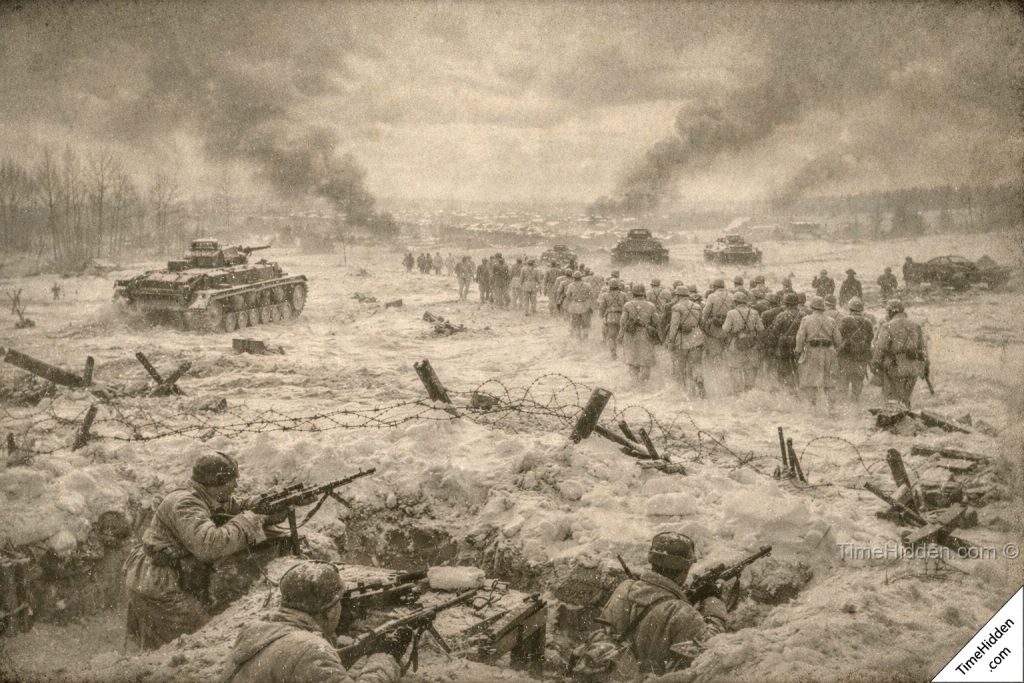
World War II Battles: Battle of Moscow
Introduction
The Battle of Moscow was one of the most decisive confrontations of World War II and a critical turning point on the Eastern Front. Fought between October 1941 and January 1942, it marked the first major failure of Nazi Germany’s campaign against the Soviet Union. Following months of rapid advances under Operation Barbarossa, German forces stood at the gates of the Soviet capital, convinced that the capture of Moscow would bring political collapse and military victory.
Moscow was not only the administrative heart of the Soviet Union but also a vital center of transportation, industry, and communication. Its fall was expected to cripple Soviet command and control and shatter morale. For the Soviet leadership, defending Moscow became a matter of national survival. The battle unfolded as a complex sequence of offensives and counteroffensives, shaped by logistics, leadership decisions, weather, and the mobilization of vast human and industrial resources.
Rather than ending the war in the east, the Battle of Moscow exposed the limits of German power and demonstrated the Soviet Union’s capacity to absorb, adapt, and respond. It set the stage for a prolonged and brutal conflict that would ultimately determine the outcome of World War II in Europe.
Historical Background
On June 22, 1941, Nazi Germany launched Operation Barbarossa, invading the Soviet Union along a front hundreds of miles wide. German strategy relied on speed, coordination, and the belief that the Red Army would collapse before winter. Army Group Center, commanded initially by Field Marshal Fedor von Bock, was tasked with advancing toward Moscow through Belarus and western Russia.
Early successes reinforced German confidence. Large Soviet formations were encircled, and key cities fell in rapid succession. By late summer 1941, German forces had advanced deep into Soviet territory. However, the campaign was already showing signs of strain. Supply lines stretched over vast distances, equipment wore down, and resistance proved more resilient than anticipated.
Strategic disagreements within the German high command further complicated matters. Adolf Hitler diverted armored units away from the central axis to support operations in Ukraine and Leningrad. While these moves yielded short-term gains, they delayed the advance on Moscow and gave the Soviet Union valuable time to reorganize its defenses.
By September 1941, German leadership returned its focus to Moscow, launching Operation Typhoon. The objective was clear: encircle and capture the Soviet capital before winter. The Soviet High Command, or Stavka, fully understood the stakes and prepared for a decisive struggle that would determine the future of the war in the east.
Main Events
Operation Typhoon Begins (October 1941)
Operation Typhoon commenced on October 2, 1941, with a massive German offensive aimed at encircling Soviet forces west of Moscow. Utilizing armored spearheads and air support, German units achieved significant breakthroughs. Several Soviet armies were surrounded near Vyazma and Bryansk, opening the road to the capital.
Despite these advances, resistance remained determined. Soviet units delayed the German advance through defensive actions and the destruction of infrastructure. Roads, railways, and bridges were sabotaged to slow movement. As German forces pressed forward, logistical difficulties intensified, and the pace of the offensive began to slow.
Defense of Moscow (October–November 1941)
As German troops approached the outer defensive lines of Moscow, the Soviet government declared a state of siege. Civilian volunteers, militia units, and regular army formations were mobilized to construct fortifications, dig trenches, and establish anti-tank obstacles around the city.
The Soviet leadership made the crucial decision to keep the government and key institutions operating in Moscow, reinforcing the symbolic importance of the defense. Troops were redeployed from other regions, including divisions transferred from Siberia and the Far East after intelligence assessments suggested no immediate threat from Japan.
Fighting intensified along multiple approaches to the city, particularly near Mozhaisk, Kalinin, and Tula. German forces came within sight of Moscow’s outskirts, but their momentum weakened as resistance stiffened and supply shortages worsened.
Winter and Stalemate (November 1941)
By November, weather conditions deteriorated. Autumn rains turned roads into mud, severely hindering movement and resupply. Soon after, temperatures dropped sharply, marking the onset of winter. German troops, unprepared for prolonged cold-weather operations, faced mounting difficulties in maintaining vehicles and equipment.
Despite these challenges, German command continued to push for a final effort to capture Moscow. Several assaults were launched against Soviet defensive positions, but progress was limited. Soviet forces, benefiting from interior lines and growing reserves, held their ground.
Soviet Counteroffensive (December 1941)
On December 5, 1941, the Red Army launched a large-scale counteroffensive along the Moscow front. Fresh Soviet units, including well-trained and well-equipped formations, struck German positions with coordinated attacks. The objective was not only to relieve pressure on the capital but also to drive German forces back and disrupt their operational plans.
The counteroffensive achieved significant results. German units, exhausted and overextended, were forced into retreat across wide sectors. Soviet advances liberated key towns and pushed the front line westward. Although the retreat was conducted in an organized manner, it marked a dramatic shift in momentum.
Stabilization of the Front (January 1942)
By January 1942, the Soviet advance slowed as logistical challenges and winter conditions affected both sides. The front stabilized at a considerable distance from Moscow. While the Red Army did not achieve a complete breakthrough, the immediate threat to the capital had been eliminated.
The Battle of Moscow concluded with the failure of Germany’s attempt to deliver a decisive blow. The Eastern Front entered a new phase, characterized by prolonged fighting and escalating commitments from both sides.
Key Figures
Adolf Hitler
As Germany’s leader, Hitler played a central role in shaping strategy. His insistence on holding ground and his interference in operational decisions limited German flexibility during the battle.
Fedor von Bock
Commander of Army Group Center during the early phases of the battle, von Bock oversaw Operation Typhoon. Despite initial successes, he struggled with logistical constraints and strategic disagreements.
Georgy Zhukov
One of the most capable Soviet commanders, Zhukov was appointed to oversee the defense of Moscow. His leadership was instrumental in organizing defensive lines and planning the December counteroffensive.
Joseph Stalin
As head of the Soviet state, Stalin made the critical decision to remain in Moscow during the crisis. His presence reinforced political resolve and centralized control over military and civilian efforts.
Ivan Konev
Commander of the Kalinin Front, Konev played an important role in Soviet operations north of Moscow, contributing to the broader counteroffensive that pushed German forces back.
Significance and Impact
The Battle of Moscow had profound strategic and psychological consequences. It shattered the myth of German invincibility and demonstrated that the Wehrmacht could be halted and pushed back. The failure to capture Moscow undermined Germany’s goal of a quick victory in the Soviet Union and forced a reevaluation of strategy.
For the Soviet Union, the successful defense of the capital was a major morale booster. It validated reforms within the Red Army, improved coordination between fronts, and strengthened confidence in Soviet leadership and planning. The battle also highlighted the importance of logistics, intelligence, and preparation for environmental conditions.
On a broader scale, the battle influenced Allied perceptions of the Eastern Front. It confirmed that the Soviet Union would remain a major force in the war, capable of sustaining large-scale operations. The prolonged conflict that followed drained German resources and set the conditions for later Soviet offensives at Stalingrad and beyond.
Conclusion
The Battle of Moscow was a defining moment in World War II. It represented the first major strategic defeat of Nazi Germany and marked the transition from rapid conquest to prolonged, attritional warfare on the Eastern Front. The defense of the Soviet capital was achieved through a combination of military resilience, strategic adaptation, and national mobilization.
From the launch of Operation Typhoon to the Soviet counteroffensive in winter, the battle revealed the complexity of modern warfare, where success depended not only on battlefield tactics but also on leadership decisions, logistics, and the ability to endure adversity. Moscow’s survival ensured the continuity of Soviet command and preserved the political and symbolic heart of the nation.
In the broader context of the war, the Battle of Moscow set the stage for Germany’s eventual defeat. It demonstrated that the conflict in the east would be long and costly, reshaping the course of World War II and leaving a lasting legacy in military history.