
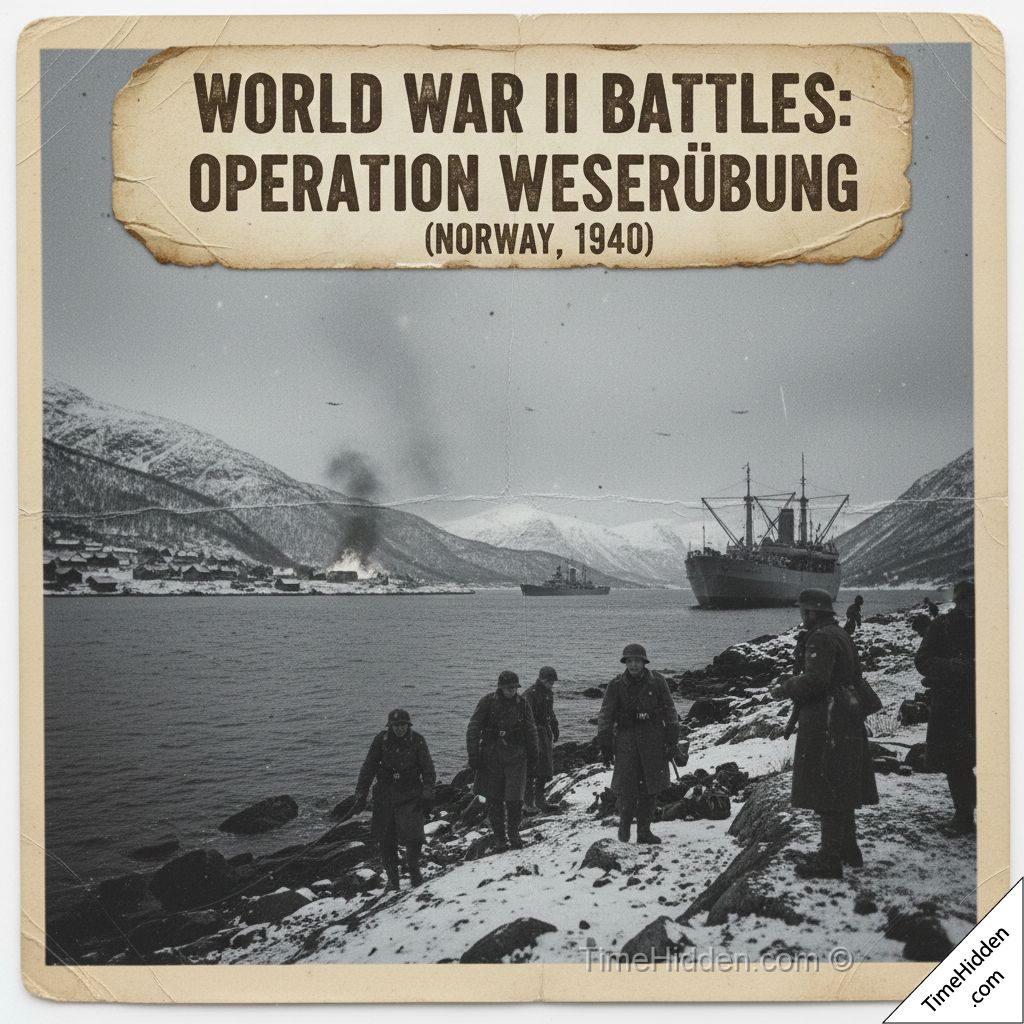
Operation Weserübung (Norway)
Introduction
Operation Weserübung, launched in April 1940, marked Nazi Germany’s bold and unexpected military invasion of Denmark and Norway. Though not the first act of aggression in Europe during World War II, Weserübung represented a new stage of strategic calculation, combining air, sea, and land forces in a coordinated campaign to secure northern Europe. The operation aimed to protect Germany’s iron-ore supply from Sweden, safeguard naval routes, and prevent the Allies from establishing bases in Scandinavia. Norway’s rugged geography, harsh climate, and political neutrality made the campaign both challenging and controversial.
From the outset, the operation demonstrated Germany’s growing confidence in Blitzkrieg-style warfare, albeit adapted to mountainous terrain and icy fjords rather than open plains. The invasion triggered a series of fast-moving engagements—naval battles in narrow waters, airborne landings at key airfields, and infantry advances toward major urban centers. Weserübung ultimately reshaped Allied and Axis strategy, drawing Britain and France into their first major ground campaign of the war and exposing weaknesses that would echo throughout 1940.
The Siege and occupation of Norway became an important prelude to the wider conflict that soon engulfed Western Europe, revealing how geopolitical resources and strategic geography could determine wartime priorities.
Historical Background
Norway and Denmark had maintained strict neutrality during the First World War and sought to follow the same path in the late 1930s. However, the strategic importance of Scandinavia had dramatically increased. Germany relied heavily on Swedish iron ore to fuel its armament production, especially during winter, when the iron ore was transported through the ice-free Norwegian port of Narvik. British naval planners understood this vulnerability and considered mining Norwegian coastal waters or landing troops to cut the ore route.
By early 1940, the “Phoney War” held Western Europe in uneasy suspense. Germany had conquered Poland but avoided confrontation with France and Britain on land. Meanwhile, Winston Churchill, First Lord of the Admiralty, urged aggressive action in Scandinavia to weaken Germany’s industrial power. The British government hesitated, not wanting to violate Norwegian neutrality, but pressure grew.
Adolf Hitler, aware of Allied deliberations and suspicious of any British intervention in Scandinavia, sought to pre-empt Allied moves. Late in 1939, the German Navy proposed a daring invasion of Norway and Denmark. Control of Norwegian fjords would provide naval bases for U-boats and surface raiders, extending German reach into the North Atlantic. Denmark, close to Germany, was essential as a stepping stone for logistics and air support. Hitler approved the plan, naming it Operation Weserübung. The goal was swift occupation to secure strategic resources and deny the Allies a foothold in the region.
Main Events
Prelude: The Altmark Incident (February 1940)
British destroyers entered Norwegian waters to rescue prisoners aboard the German tanker Altmark. The incident outraged Germany and signaled the vulnerability of Norwegian neutrality. Hitler accelerated plans for Weserübung.
The Launch of the Operation (April 9, 1940)
On the early morning of April 9, German forces simultaneously invaded Denmark and Norway.
In Denmark, the attack lasted only six hours. Overwhelmed and recognizing their military disadvantage, Danish leaders surrendered quickly. Airfields and staging areas in Denmark allowed Germany to support its operations farther north.
In Norway, Germany executed a complex assault involving:
-
Naval task forces sailing into key ports
-
Paratrooper landings at strategic airfields
-
Infantry advances supported by the Luftwaffe
German forces targeted six major objectives:
-
Oslo
-
Kristiansand
-
Stavanger
-
Bergen
-
Trondheim
-
Narvik
Each location held strategic value—ports, airfields, or transport centers essential for controlling Norway.
The Battle for Oslo
German ships attempted a direct assault on the capital. However, the fortress at Oscarsborg unexpectedly sank the heavy cruiser Blücher, delaying the German advance. Norway’s government and royal family escaped northward, refusing to surrender. Though Oslo eventually fell, the delay allowed Norwegian and Allied forces to mobilize.
Operations in Western Norway
Bergen and Kristiansand
German troops landed almost unopposed at Bergen and quickly secured the city. At Kristiansand, fog and confusion caused delays, but the Germans ultimately captured the port after several hours of resistance.
Stavanger
The airfield at Sola, near Stavanger, became the site of one of history’s first major airborne assaults. German paratroopers captured it intact, allowing transport planes to land reinforcements.
The Struggle for Trondheim
Trondheim, a major logistical hub, fell on April 9. However, Allied forces attempted a counteroffensive, landing troops at Namsos and Åndalsnes. Difficult terrain, poor communication, and constant Luftwaffe bombing crippled their efforts, leading to eventual evacuation.
The Battles for Narvik
Narvik became the focal point of the northern campaign. German destroyers delivered mountain troops to seize the port, but British warships soon entered the fjords, resulting in two separate naval battles. The Allies temporarily gained control of the sea, destroying most of Germany’s destroyer force in the region.
In late April and early May, British, French, and Polish troops joined Norwegian forces in retaking Narvik. This marked the first significant Allied land victory of World War II.
However, the triumph was short-lived. In early June, with Germany preparing to invade France, the Allies withdrew from Norway to reinforce the Western Front. Without support, Norwegian forces surrendered on June 10, 1940.
Key Figures Involved
Germany
-
Adolf Hitler – Supreme decision-maker who approved the invasion to secure strategic resources and outmaneuver the Allies.
-
General Nikolaus von Falkenhorst – Commander of German ground forces in Norway; oversaw planning and execution of the campaign.
-
Grand Admiral Erich Raeder – Head of the German Navy, advocate for occupying Norway to strengthen naval operations.
-
General Eduard Dietl – Commander at Narvik, leading mountain troops in some of the most difficult fighting of the campaign.
Norway
-
King Haakon VII – Symbol of Norwegian resistance; refused to capitulate and escaped before Oslo fell.
-
Johan Nygaardsvold – Prime Minister leading the legitimate government-in-exile after fleeing north.
-
Colonel Birger Eriksen – Commander of the Oscarsborg Fortress whose decision to fire on the Blücher delayed the German capture of Oslo.
Allies
-
Winston Churchill – First Lord of the Admiralty who strongly supported intervention in Norway.
-
General Claude Auchinleck and Admiral William Whitworth – Commanders in the Allied naval and land operations at Narvik.
-
French General Marie Béthouart – Led French alpine troops during the recapture of Narvik.
Significance and Impact
Operation Weserübung had far-reaching consequences for World War II:
1. Strategic Resources Secured
Germany safeguarded the vital iron-ore shipments from Sweden, ensuring uninterrupted armament production. This strengthened Germany’s capacity to wage war throughout 1940 and 1941.
2. Expanded German Naval Reach
Control of Norwegian fjords offered bases for U-boats and surface raiders, extending German naval operations deep into the North Atlantic. Although naval losses during the campaign were significant, the strategic benefit was still substantial.
3. Allied Failures and Political Consequences
The Norwegian campaign exposed Allied weaknesses in coordination, logistics, and rapid deployment. It contributed to the fall of British Prime Minister Neville Chamberlain, paving the way for Winston Churchill to become Prime Minister on May 10, 1940.
4. Lessons in Joint Operations
Weserübung showcased Germany’s ability to coordinate air, sea, and land forces in complex terrain. This operational flexibility influenced future campaigns, including the invasions of the Low Countries and France.
5. Occupation of Norway
Norway endured five years of German occupation, marked by economic exploitation, resistance movements, and political repression under the collaborationist Quisling regime.
Conclusion
Operation Weserübung stands as one of the most daring and strategically significant campaigns of early World War II. In a single coordinated assault, Germany secured Denmark and Norway, strengthened its industrial lifeline, and denied the Allies a crucial foothold in Scandinavia. The rapid success of the operation demonstrated the effectiveness of German combined-arms strategy, even in environments far removed from traditional Blitzkrieg settings. Though the Allies briefly achieved victory at Narvik, their broader failure in Norway severely undermined their credibility and contributed to political upheaval in Britain.
For Germany, the operation was both a triumph and a warning. While securing Norway provided strategic advantages, the heavy naval losses ultimately weakened Germany’s fleet before major confrontations with Britain. Nevertheless, Weserübung reshaped the geopolitical landscape of northern Europe, influencing the direction and tempo of the war that soon engulfed the continent.