
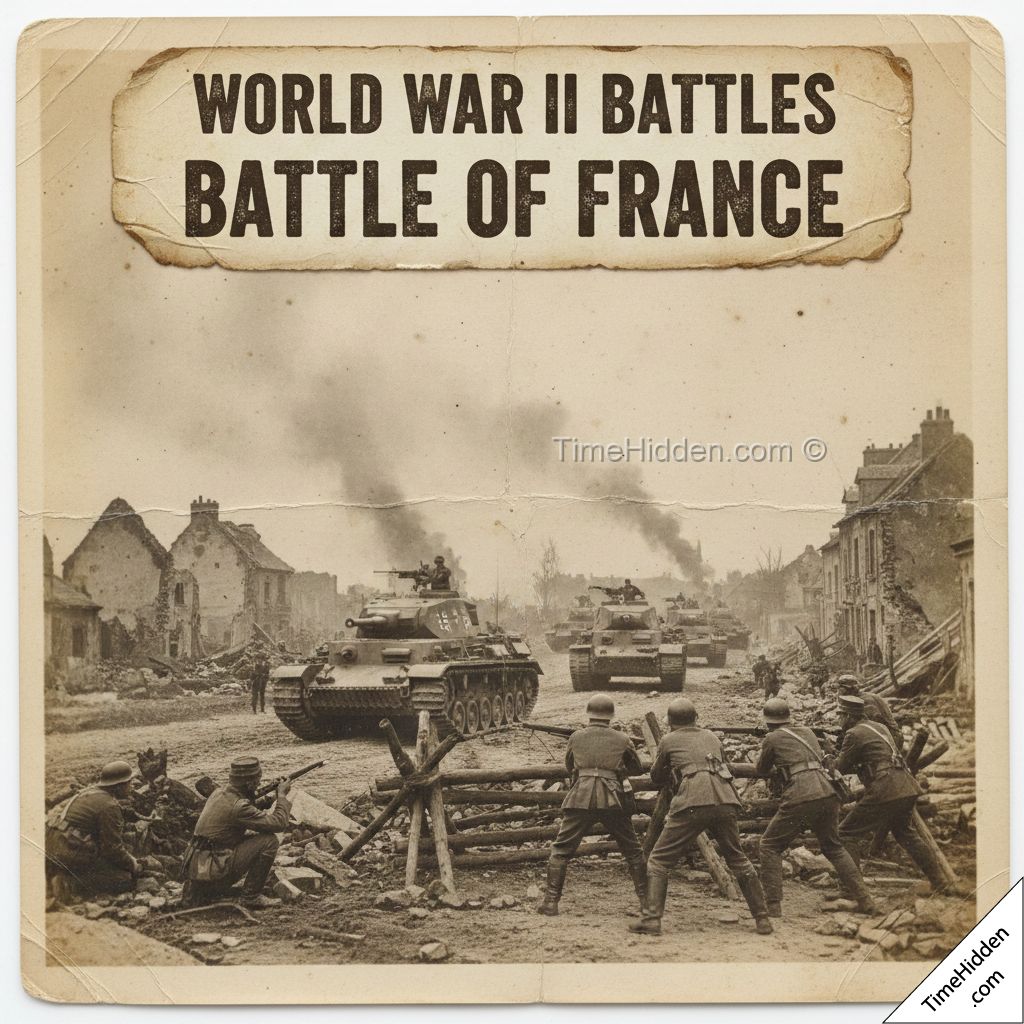
World War II Battles: Battle of France
Introduction
The Battle of France, fought from May to June 1940, stands as one of the most dramatic and decisive campaigns of World War II. In just six weeks, Nazi Germany achieved a stunning victory over France, the United Kingdom’s British Expeditionary Force (BEF), Belgium, Luxembourg, and the Netherlands. This rapid collapse shocked the world and permanently reshaped the strategic balance of the war. The campaign demonstrated the brutal effectiveness of Germany’s newly developed Blitzkrieg doctrines—fast-moving armored assaults supported by close air support—contrasting starkly with the static, World War I–style defenses that France still heavily relied upon. The fall of France had far-reaching consequences: it left Britain standing alone in Western Europe, enabled Germany to dominate the continent, and set the stage for future battles, including the Battle of Britain and Operation Barbarossa.
Historical Background
After the end of World War I, both France and Germany emerged deeply transformed. France, having suffered enormous casualties, built its postwar strategy around defense. Central to this strategy was the Maginot Line, a vast system of fortifications along the German border designed to prevent a repeat of Germany’s 1914 invasion.
Meanwhile, Germany—humiliated by the Treaty of Versailles—saw the rise of Adolf Hitler and the Nazi Party, who sought to rebuild national pride through rearmament and territorial expansion. Key to Hitler’s strategy was the development of fast, concentrated armored units (Panzer divisions) and coordinated air-ground operations. This doctrinal shift laid the foundation for Blitzkrieg.
By 1939, after the invasion of Poland and the outbreak of World War II, Europe entered the so-called Phoney War, a period of military inactivity along the Western Front. France and Britain mobilized their armies but avoided major operations, believing that time favored them. Germany, however, used this time to prepare an unexpected assault through the Ardennes—a forested region the Allies wrongly viewed as impassable to large mechanized forces.
Timeline of Key Events
May 10, 1940 – German Offensive Begins
Germany launched Fall Gelb (Case Yellow), striking simultaneously at the Netherlands, Belgium, and Luxembourg. Paratroopers seized key bridges in the Low Countries, while armored columns pushed forward with unprecedented speed.
May 12–14 – Breakthrough at the Ardennes
Panzer divisions under Generals Guderian and Rommel advanced through the Ardennes, overwhelming small French units assigned to defend the area. The Germans reached the Meuse River and prepared a decisive crossing.
May 13–15 – The Meuse Crossing and Sedan Breakthrough
At Sedan, German forces broke through French defenses despite heavy resistance. The Luftwaffe provided relentless air support, disorienting French troops and collapsing the defensive line. This became the critical breakthrough that doomed the entire Allied front.
May 20 – Panzers Reach the English Channel
Guderian’s armored columns reached Abbeville, effectively slicing the Allied forces in two—isolating the BEF and northern French armies in Belgium from the rest of France.
May 26 – June 4 – Dunkirk Evacuation (Operation Dynamo)
Facing encirclement, the British launched a massive evacuation from Dunkirk. Over 338,000 British and Allied soldiers escaped across the English Channel, preserving the core of Britain’s army.
June 5 – Fall Rot (Case Red) Begins
After defeating the northern Allied forces, Germany launched the second phase of the campaign, pushing deep into central and southern France. French defenses collapsed rapidly.
June 14 – Germans Enter Paris
Paris was declared an open city to avoid destruction. German troops entered without resistance.
June 22 – France Signs Armistice
France formally surrendered, leading to the establishment of the Vichy regime in the unoccupied southern zone. The remainder of France fell under direct German control.
Major Events and Operations
The Fall Gelb Plan and German Strategy
Hitler accepted a bold plan proposed by General Erich von Manstein: instead of repeating the Schlieffen-style attack through northern Belgium, Germany would send its main thrust through the Ardennes. The Allies expected the primary German attack to come through central Belgium, so they moved their best armies northward, falling directly into Germany’s trap.
The Low Countries Campaign
Germany attacked the Netherlands and Belgium to lure Allied forces away from the true point of attack. Paratroopers captured the Belgian fortress Eben-Emael, one of the strongest forts in Europe, in a daring glider-borne operation.
The Meuse Crossing and Air Power
At Sedan, German engineers and infantry crossed the Meuse under massive Luftwaffe bombardment. French units, facing intense air attacks, broke under pressure. This decisive moment opened the path for the Panzers to rush westward.
Encirclement of Allied Forces
As Panzers reached the Channel, they trapped about 1 million Allied soldiers in northern Belgium and Flanders. Though many were evacuated at Dunkirk, all heavy equipment was lost.
Fall Rot and Final Collapse
With France’s best armies destroyed or captured, the Germans launched the final phase of the offensive. Despite valiant resistance in places like the Somme and Aisne, French morale and communication systems were collapsing. German mechanized units exploited gaps, flanking defenses repeatedly.
Key Figures Involved
German Leadership
-
Adolf Hitler – Dictator of Nazi Germany; approved Manstein’s plan.
-
Erich von Manstein – Architect of the Ardennes breakthrough plan.
-
Heinz Guderian – Panzer commander whose rapid advance reached the English Channel.
-
Erwin Rommel – Led the 7th Panzer Division (“Ghost Division”), known for its speed and bold maneuvers.
-
Hermann Göring – Commander of the Luftwaffe, which played a crucial role in breaking French defenses.
Allied Leadership
-
Maurice Gamelin – Supreme Commander of French forces; his slow communication and outdated strategies contributed to the defeat.
-
Lord Gort – Commander of the British Expeditionary Force; his decision to withdraw to Dunkirk saved the British Army.
-
King Leopold III of Belgium – Surrendered Belgian forces on May 28, complicating Allied defense.
-
Paul Reynaud – French Prime Minister during the battle; resigned shortly before the armistice.
Significance and Impact
1. Strategic Shift in Europe
The fall of France left Germany in control of Western Europe. Only Britain remained as a major opponent in the West, leading directly to the Battle of Britain.
2. Rise of Blitzkrieg Doctrine
Germany’s rapid victory demonstrated the effectiveness of mechanized warfare. Blitzkrieg became the dominant military doctrine of the early war and influenced strategies across the world.
3. Political Consequences
France was divided into:
-
Occupied France, controlled directly by Germany
-
Vichy France, a collaborationist regime under Marshal Philippe Pétain
This division shaped French politics for years and contributed to internal conflict and resistance movements.
4. Psychological Shock
The speed of the defeat stunned the world. France had been considered one of the strongest military powers; its collapse undermined confidence in traditional defensive strategy and signaled a new, mechanized era of warfare.
5. Impact on the United States and Global Policy
France’s defeat increased U.S. concern over German expansion. It contributed to the eventual passing of the Lend-Lease Act and a growing alignment with Britain.
Conclusion
The Battle of France stands as one of the most significant campaigns of World War II. In just six weeks, Germany’s innovative use of mechanized warfare overturned decades of military assumptions and reshaped the global balance of power. The campaign demonstrated the devastating potential of Blitzkrieg, the importance of mobility and communication, and the catastrophic consequences of misjudging an enemy’s capabilities. The fall of France not only positioned Germany as the dominant power in Europe but also set the stage for the next phases of the war—from the beaches of Dunkirk to the skies over Britain and, ultimately, to the vast conflicts on the Eastern Front. The Battle of France remains a critical study in strategy, leadership, and the evolution of modern warfare.