
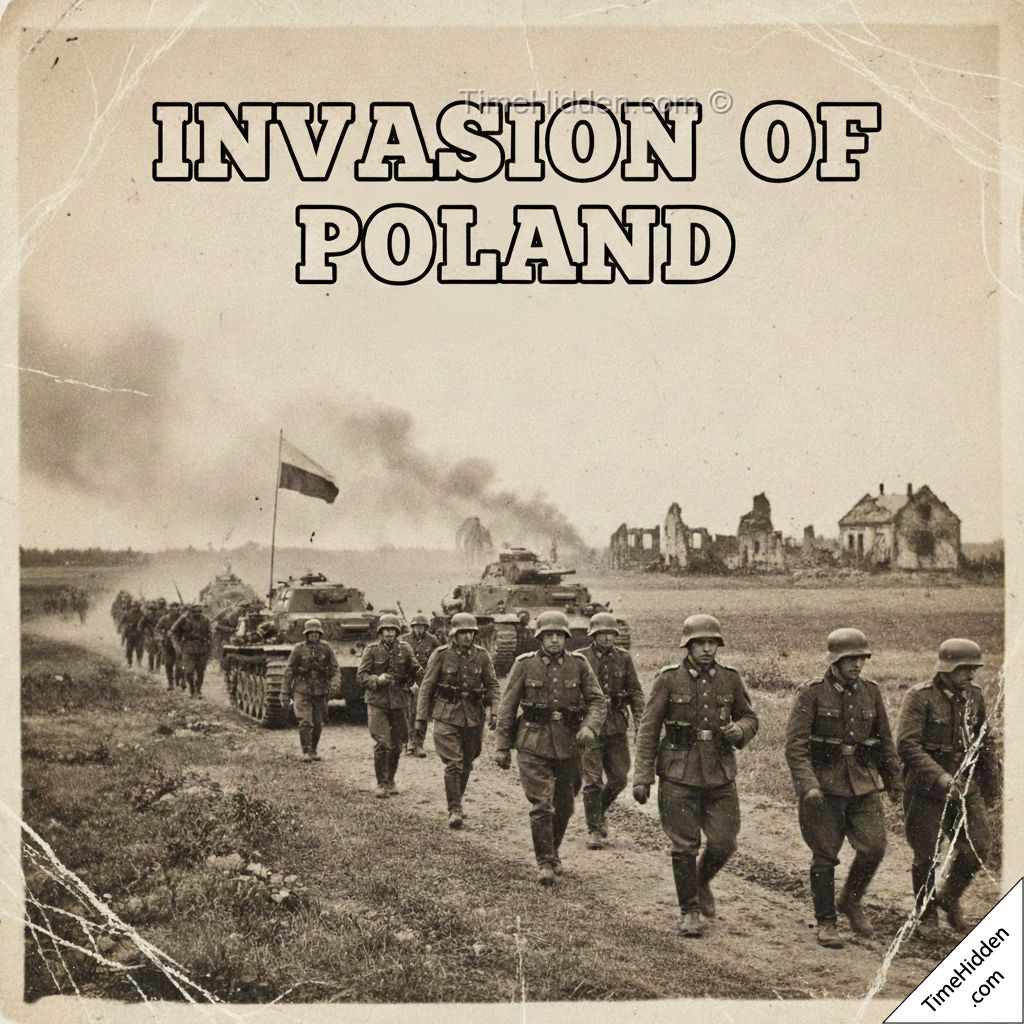
Invasion of Poland (1939)
Introduction
The Invasion of Poland in September 1939 marked one of the most consequential turning points in modern history: the beginning of the Second World War. Although tensions had been escalating across Europe for years, the German attack on Poland on September 1, 1939, shattered any remaining hopes for a diplomatic solution. It was a campaign defined by rapid movement, overwhelming firepower, and a carefully orchestrated plan known as Blitzkrieg—“lightning war.” Over the course of just five weeks, Poland faced invasion not only from Nazi Germany but, later, from the Soviet Union as well, sealing the nation’s fate and forcing France and the United Kingdom to declare war on Germany. The conflict was brutal, swift, and strategically significant, reshaping European borders and launching the world into a global conflict that would last six devastating years. The invasion provides a clear window into Hitler’s ambitions, the weaknesses of interwar diplomacy, and the tragic consequences of totalitarian expansion.
Historical Background
The origins of the Invasion of Poland trace back to the political and territorial upheavals following World War I. The Treaty of Versailles had dramatically reduced Germany’s military strength, territorial size, and economic stability, creating deep resentment among German nationalists. One of the most symbolic outcomes of the treaty was the creation of the Polish Corridor, which granted Poland access to the Baltic Sea but split Germany into two parts. The Free City of Danzig (Gdańsk), a semi-autonomous territory under League of Nations protection, became another major point of contention.
Adolf Hitler, who had risen to power in 1933, viewed the restoration of German strength and territorial expansion as essential pillars of Nazi ideology. The annexation of Austria (Anschluss) in March 1938 and the dismemberment of Czechoslovakia in the Munich Agreement demonstrated both German ambition and the willingness of European powers to appease Hitler. By early 1939, however, Britain and France recognized that appeasement had failed and guaranteed Poland’s independence as a deterrent against further German aggression.
Nevertheless, Hitler was determined to invade Poland. In August 1939, Germany signed the Molotov–Ribbentrop Pact with the Soviet Union. Far from a simple non-aggression agreement, the pact included a secret protocol dividing Eastern Europe into German and Soviet spheres of influence. Poland was to be partitioned between the two powers. With the threat of a two-front war removed, Hitler had every assurance he needed to attack.
Tensions sharply escalated in late August. Germany issued increasingly aggressive demands over Danzig and the Polish Corridor, while staging false-flag operations—most notoriously the Gleiwitz incident—to fabricate a justification for war. Diplomatic options evaporated. Europe stood on the brink.
Main Events
Timeline Overview
-
August 31, 1939: Gleiwitz incident staged by Germany to justify invasion.
-
September 1, 1939: German forces invade Poland from the north, west, and south.
-
September 3, 1939: Britain and France declare war on Germany.
-
September 8–10, 1939: German forces reach the outskirts of Warsaw.
-
September 17, 1939: Soviet Union invades eastern Poland.
-
September 28, 1939: Warsaw surrenders.
-
October 6, 1939: Final organized Polish resistance ends.
The German Assault
At dawn on September 1, 1939, without a formal declaration of war, German forces launched a massive and coordinated assault. This attack showcased a revolutionary approach to warfare: Blitzkrieg. It relied on fast-moving tanks, mechanized infantry, and close air support working together to overwhelm defenders through speed and surprise.
The invasion began with an airstrike on the city of Wieluń, often considered the first major act of the war. Simultaneously, the battleship Schleswig-Holstein opened fire on the Polish garrison at Westerplatte, initiating one of the most iconic early battles of the conflict.
Polish defenders, though courageous, were outmatched. Germany employed over 1.5 million soldiers, nearly 2,500 tanks, and more than 2,000 aircraft. The Polish Air Force, though not destroyed on the ground as Nazi propaganda later claimed, could not match the Luftwaffe’s technological superiority. Key Polish defensive positions, such as those at the Corridor and Upper Silesia, were quickly overrun.
The Race to Warsaw
Within a week, German armored divisions had penetrated deep into Polish territory. Their movements were swift and coordinated, bypassing fortified positions and surrounding entire units. The Polish Army attempted to regroup around the Vistula River, planning a counteroffensive along the Bzura River. The Battle of the Bzura, which began on September 9, became the largest Polish counterattack of the campaign. Though briefly successful, it was eventually crushed by overwhelming German firepower and air support.
By September 8, German forces had reached the outskirts of Warsaw. The city, defended by soldiers and civilians alike, faced relentless bombing. Fires raged throughout the capital, but resistance remained fierce.
Soviet Invasion
On September 17, as Poland struggled to defend itself against Germany, the Soviet Union invaded from the east. Justifying its actions by claiming to protect Belarusians and Ukrainians, the USSR quickly captured cities such as Lwów and Wilno. The double invasion sealed Poland’s fate. Surrounded and outnumbered, many Polish units withdrew to Romania and Hungary, hoping to continue the fight from abroad.
Fall of Warsaw
Despite intense bombing and shortages of food, ammunition, and medical supplies, Warsaw held out until September 28. The city’s defenders agreed to surrender only after being reduced to exhaustion. By October 6, all remaining Polish resistance had been suppressed, bringing the invasion to an end.
Key Figures
Adolf Hitler
The mastermind behind the invasion, Hitler sought territorial expansion, ideological domination, and Lebensraum—“living space”—for the German people. His decisions directly triggered the war.
Heinrich Himmler & Reinhard Heydrich
Responsible for security operations, propaganda actions such as the Gleiwitz provocation, and early occupation policies that targeted Polish elites and Jewish communities.
Heinz Guderian
A leading architect of Blitzkrieg, Guderian commanded armored units that cut rapidly through Polish defenses, demonstrating the effectiveness of modern mechanized warfare.
Edward Rydz-Śmigły
Commander-in-Chief of Polish forces. Though he anticipated German aggression, Poland’s limited resources and geography made effective defense extremely difficult.
Joseph Stalin
By authorizing the Soviet invasion on September 17, Stalin ensured Poland’s collapse and gained control of its eastern territories, fulfilling the terms of the Molotov–Ribbentrop Pact.
Significance and Impact
Beginning of the Second World War
The invasion set off a chain reaction that ignited global war. On September 3, Britain and France declared war on Germany, fulfilling their guarantees to Poland. Although they did not launch a major offensive to relieve Polish forces, their declarations transformed the regional conflict into a world-shaping event.
Demonstration of Blitzkrieg
The campaign displayed the effectiveness of Blitzkrieg tactics, shocking military observers worldwide. The rapid collapse of Poland convinced many nations—correctly or not—that Germany’s military machine was unstoppable, influencing strategies throughout early World War II.
Partition and Occupation
Following victory, Germany and the Soviet Union partitioned Poland. Under German occupation, terror became systematic. The Nazis closed universities, arrested political leaders, and began large-scale persecution of Jews and intellectuals. Many historians consider the campaign the first step toward the Holocaust.
The Polish Contribution to Allied Efforts
Though defeated, Poland continued fighting. Tens of thousands of Polish troops escaped to France and Britain, forming new units. Polish pilots, notably in the Royal Air Force’s No. 303 Squadron, became some of the highest-scoring fighter aces in the Battle of Britain. Polish intelligence also played a crucial role, particularly in sharing early Enigma decryption work with the Allies.
Geopolitical Repercussions
The joint German–Soviet victory reshaped Eastern Europe. It strengthened Hitler’s confidence and fueled further aggression in Scandinavia, France, and the Balkans. For the Soviet Union, it expanded territory and positioned Stalin strategically for the future—until Germany invaded the USSR in 1941.
Conclusion
The Invasion of Poland in 1939 stands as one of the defining events of the twentieth century. It did not occur in isolation but rather emerged from decades of political tension, territorial disputes, and ideological extremism. The German assault, amplified by the Soviet invasion, demonstrated the devastating potential of modern mechanized warfare and the ruthlessness of totalitarian regimes. The campaign was not only the opening chapter of World War II but also a tragedy that reshaped Europe’s borders and unleashed horrors that would escalate in the years to come. Despite facing overwhelming odds, the Polish resistance—both military and civilian—left a legacy of courage and determination that would endure throughout the war. The invasion serves today as a solemn reminder of the consequences of unchecked aggression and the fragility of peace when diplomacy fails.