
Introduction
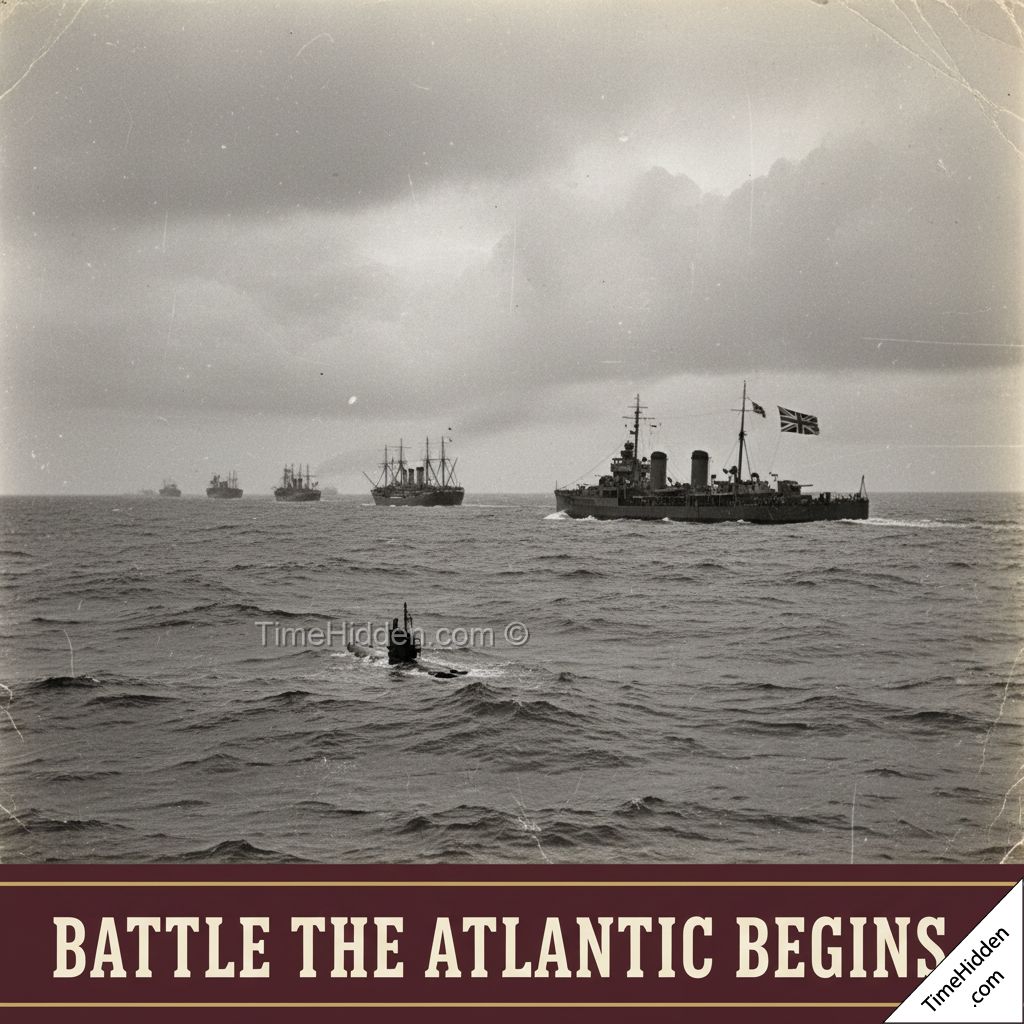
The Battle of the Atlantic, which began in 1939 and endured until 1945, was the longest continuous military campaign of World War II. It was a vast struggle for control over the shipping lanes between North America and Europe—routes that carried vital supplies of food, troops, weapons, and fuel to the United Kingdom. From the very first days after Germany invaded Poland, the Atlantic Ocean became a deadly arena where Allied merchant ships tried to cross safely while German U-boats, surface raiders, and aircraft attempted to cut Britain off from the world. The opening phase of the battle set the tone for what would become a brutal war of attrition at sea.
The beginning of the Battle of the Atlantic was shaped by rapid technological changes, shifting naval strategies, and the high stakes of keeping Britain alive. With no direct land route for supplies, the United Kingdom depended almost entirely on maritime convoys. Germany, aware of this weakness, sought to starve the island nation into submission. As the campaign unfolded, the early months witnessed daring attacks, rising losses, and the gradual formation of convoy systems that would define the strategic contest. This opening chapter created the foundations for one of the most decisive battles of the entire war.
Historical Background
Before World War II officially began, both Allied and German strategists understood that control of the Atlantic would be crucial. For centuries, the British Empire relied on sea power to maintain its global connections. By 1939, the United Kingdom imported nearly 70 percent of its food and essential goods. Without secure shipping lanes, Britain could not sustain its population or its military forces. Germany, under Adolf Hitler, recognized that if these lifelines could be severed, Britain would be forced to negotiate or collapse.
During World War I, German U-boats had nearly succeeded in starving Britain. Although anti-submarine defenses improved by 1918, memories of merchant ships sinking in the cold Atlantic remained fresh in British naval planning. This time, however, the Kriegsmarine entered the conflict with a more advanced submarine fleet, new torpedoes, and improved tactics developed by Admiral Karl Dönitz. He envisioned U-boats operating in coordinated “wolf packs,” overwhelming convoys at night.
When Germany invaded Poland on September 1, 1939, and Britain declared war two days later, the Royal Navy immediately faced the challenge of protecting thousands of merchant vessels across an enormous ocean. At the same time, British codebreakers at Bletchley Park began preparations for intercepting German naval communications—an effort that would later prove vital, though its early contributions were limited. The opening months of the conflict were therefore defined by uncertainty, adaptation, and the rapid escalation of German submarine warfare.
Main Events (Timeline)
September 1939: War Breaks Out
The Battle of the Atlantic unofficially began on September 3, 1939, when the German U-boat U-30 torpedoed the passenger liner SS Athenia, killing more than 100 civilian passengers. Although Germany initially denied responsibility, the sinking sent a clear signal that U-boats would attack targets far beyond military vessels. The British Admiralty immediately reinstated convoy systems, recalling lessons from World War I.
Late 1939: The First Convoys and Surface Raiders
In the following weeks, Britain organized Convoy HX-1, the first transatlantic convoy of the war, escorted by Royal Navy warships. Meanwhile, German surface raiders such as the pocket battleship Admiral Graf Spee roamed the South Atlantic, sinking merchant ships and creating panic among Allied naval forces. The chase for the Graf Spee ended dramatically in December 1939 at the Battle of the River Plate, when the damaged German ship was scuttled by its captain.
At the same time, U-boats operating in the North Sea and Western Approaches began claiming increasing numbers of merchant vessels. The early months of the conflict were marked by scattered attacks, limited coordination, and the rapid expansion of naval operations across the Atlantic.
Early 1940: Expansion of the U-boat Threat
Germany intensified its U-boat campaign after securing bases along the North Sea. Submarines operating from German ports challenged British patrols near the British Isles. The sinking of the armed merchant cruiser HMS Rawalpindi by the German battleships Scharnhorst and Gneisenau demonstrated the vulnerability of Allied ships to surface raiders as well as submarines.
The British experimented with new detection technologies such as ASDIC (early sonar), but equipment remained unreliable and required ships to move slowly to be effective—unsuitable for fast convoy operations.
Spring–Summer 1940: The Fall of France Changes Everything
The turning point in the early phase of the Battle of the Atlantic came in June 1940, when France surrendered to Germany. The fall of France provided the Kriegsmarine with access to Atlantic ports such as Lorient, Brest, and Saint-Nazaire. These bases dramatically reduced the travel time for U-boats entering the Atlantic, increasing the duration of their patrols and boosting their effectiveness.
With Britain now standing alone against Germany, the lifeline across the Atlantic became more crucial than ever. German U-boats began operating in coordinated wolf packs, guided by radio communications and intelligence reports. Sinkings increased sharply, and Allied losses grew.
Late 1940: The First “Happy Time” for U-boats
From late 1940 to early 1941, U-boats enjoyed what they later called their First Happy Time, sinking hundreds of thousands of tons of Allied shipping. The Royal Navy struggled to provide enough escorts, and the Luftwaffe’s long-range aircraft supported submarine operations over the Bay of Biscay and the Western Approaches.
The early months of the Battle of the Atlantic were therefore characterized by rising Allied casualties, growing U-boat confidence, and a sense that Britain’s survival was becoming increasingly uncertain.
Key Figures Involved
Admiral Karl Dönitz
Karl Dönitz was the architect of Germany’s U-boat strategy. A veteran submariner from World War I, he championed the wolf pack tactic and pushed for the rapid expansion of the submarine fleet. Although Hitler initially prioritized battleships over submarines, Dönitz’s influence grew as U-boats proved their efficiency.
Prime Minister Winston Churchill
Winston Churchill understood the strategic importance of the Atlantic more clearly than most. Later in his memoirs, he famously stated that the U-boat threat was the only thing that truly frightened him during the war. Churchill pushed for improved escort ships, expanded air coverage, and technological innovation.
Admiral Sir Max Horton
Horton, who later commanded Western Approaches Command, played a crucial role in refining convoy tactics, increasing escort efficiency, and implementing more aggressive anti-submarine strategies.
Merchant Navy Sailors
Often overlooked in military histories, the civilian sailors who operated merchant ships were essential to the Allied war effort. They sailed through dangerous waters with minimal protection, facing U-boats, aircraft, and storms. Their contribution was vital to Britain’s survival.
Intelligence Specialists at Bletchley Park
Although their greatest successes came later, early codebreakers at Bletchley Park worked tirelessly to decipher German naval communications. Their efforts laid the foundation for future breakthroughs against the Enigma code.
Significance and Impact
The beginning of the Battle of the Atlantic had enormous consequences for the broader war. Germany’s early successes demonstrated how vulnerable Britain was to maritime disruption. By late 1940, shipping losses were so severe that Britain faced shortages of food, fuel, and raw materials. Every ton of cargo lost meant fewer weapons for the army, fewer aircraft for the Royal Air Force, and fewer supplies for civilians.
The campaign also accelerated technological innovation. The need to counter U-boats led to rapid development in radar, sonar, long-range aircraft, escort carriers, depth charges, and intelligence processes. The Atlantic became a proving ground for naval tactics that would shape modern maritime warfare.
Furthermore, the battle forced the Allies to cooperate closely. The United States, while still neutral before late 1941, provided escort support, destroyers, and vital economic resources through the Lend-Lease program. Canadian naval forces expanded rapidly, eventually playing a major role in escort operations. The early phase of the campaign therefore strengthened international partnerships that would define the Allied war effort.
Most importantly, the opening of the Battle of the Atlantic set the stage for the dramatic turning points that would come later—particularly in 1943, when Allied technology, intelligence, and air coverage finally overwhelmed the U-boat threat. But none of that would have been possible without the hard lessons learned during the early months.
Conclusion
The beginning of the Battle of the Atlantic was a decisive moment in World War II, shaping the strategic balance between Germany and the Allies. From the sinking of the SS Athenia to the rise of wolf pack tactics and the establishment of French U-boat bases, the early phase of the campaign exposed Britain’s vulnerability and tested its resilience. It became clear that control of the Atlantic was not simply a naval concern but a matter of national survival.
The struggle forced rapid innovation, international cooperation, and a rethinking of naval strategy. It produced new heroes—from submarine commanders to merchant sailors—and forged the early foundations of Allied resistance. Though the battle would continue for years, the events of 1939–1940 created the conditions that ultimately shaped the outcome of the war.
The Battle of the Atlantic began as a desperate struggle for survival, marked by fear, loss, and uncertainty. Yet it also demonstrated the determination of nations to adapt and endure. Its opening chapter remains one of the most dramatic and consequential beginnings of any campaign in modern history.