
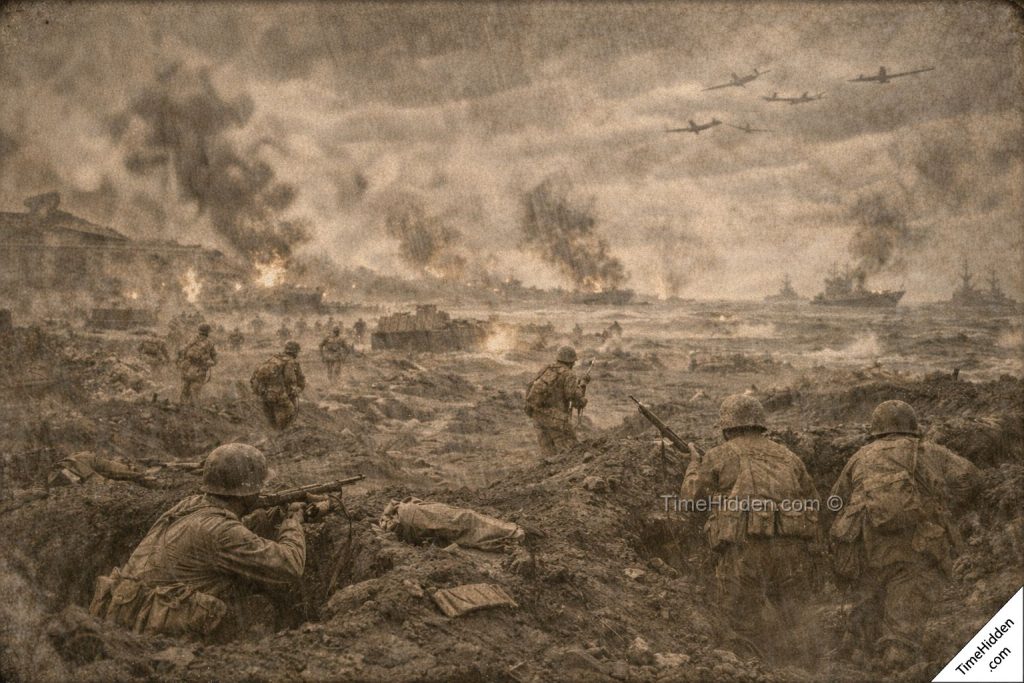
World War II Battles: Battle of Okinawa
Introduction
The Battle of Okinawa was the largest and one of the most decisive battles of the Pacific Theater during World War II. Fought between April and June 1945, it marked the final major confrontation before the planned invasion of the Japanese home islands. Okinawa, a strategically vital island in the Ryukyu chain, lay just a short distance from mainland Japan. Control of the island would provide the Allies with airfields and naval bases essential for launching further operations, while its loss would bring the war uncomfortably close to Japan itself.
More than a military engagement, the Battle of Okinawa became a test of endurance, strategy, and resolve for both sides. The United States and its allies aimed to secure a foothold that could force Japan toward surrender, while Japanese commanders sought to inflict maximum losses in order to weaken Allied morale and negotiating power. The battle unfolded over nearly three months of intense combat on land, at sea, and in the air. Its outcome profoundly influenced political decisions, military planning, and the final phase of World War II, making Okinawa a critical turning point in modern history.
Historical Background
By early 1945, the momentum of World War II in the Pacific had clearly shifted in favor of the Allies. After costly but successful campaigns in the Solomon Islands, the Philippines, and Iwo Jima, the United States had established a steady advance toward Japan. Each island captured brought Allied forces closer to the Japanese mainland, increasing pressure on Japan’s leadership to consider how long resistance could be sustained.
Okinawa held particular strategic importance. Located approximately 340 miles south of Kyushu, it was the largest island in the Ryukyu chain and possessed terrain suitable for airfields and harbors. From Okinawa, Allied bombers could operate more effectively against Japanese industrial centers, and naval forces could support a future invasion of Japan itself.
Japan, recognizing the significance of Okinawa, prepared extensive defensive measures. Rather than relying on traditional beach defenses, Japanese planners adopted a strategy of defense in depth. They aimed to draw Allied forces inland, prolong the battle, and cause heavy casualties. This approach reflected Japan’s deteriorating military situation: limited resources, weakened air power, and shrinking naval capabilities. Okinawa was intended to be a decisive stand that would demonstrate Japan’s determination and potentially influence Allied decision-making.
Major Events
The Battle of Okinawa began on April 1, 1945, when Allied forces launched Operation Iceberg. The initial landings by the U.S. Tenth Army were surprisingly unopposed. Japanese commanders had deliberately chosen not to contest the beaches, instead preserving their forces for prolonged resistance in the island’s interior. Within days, American troops secured key airfields and began advancing southward.
As the campaign progressed, resistance intensified. Japanese forces made effective use of Okinawa’s rugged terrain, including hills, ridges, and fortified positions. The battle became a slow and methodical struggle, characterized by careful advances and persistent countermeasures. Rain and difficult terrain further complicated operations, turning movement and supply into constant challenges.
At sea, the battle expanded into one of the most intense naval engagements of the Pacific War. Japanese air attacks focused on Allied ships supporting the land campaign. These operations aimed to disrupt supply lines and weaken naval dominance. Although the Allies maintained control of the seas, the sustained pressure underscored the scale and seriousness of the conflict.
One of the most notable naval events was Operation Ten-Go in April 1945, when the Japanese battleship Yamato set out on a one-way mission toward Okinawa. The ship was intercepted and sunk by Allied aircraft before reaching its destination, symbolizing the decline of Japan’s once-powerful navy and reinforcing Allied air superiority.
By May, Allied forces had captured much of the island, but resistance continued in the south, where Japanese defenses were strongest. The fighting remained intense as U.S. troops advanced against well-prepared positions. Gradually, Japanese resistance weakened as supplies dwindled and command structures collapsed.
On June 22, 1945, organized Japanese resistance on Okinawa officially ended. The island was secured after nearly three months of sustained combat, marking the final major battle of the Pacific War.
Key Figures
Several military leaders played crucial roles in the Battle of Okinawa. On the Allied side, Lieutenant General Simon Bolivar Buckner Jr. commanded the U.S. Tenth Army. He oversaw ground operations and coordinated efforts between Army and Marine units. Buckner emphasized cautious advances to minimize unnecessary losses, though the nature of the battle made progress slow and demanding.
Admiral Raymond A. Spruance commanded the Fifth Fleet, which provided naval support and coordinated air and sea operations. His leadership ensured that Allied forces maintained control of surrounding waters and protected supply lines essential to the campaign’s success.
On the Japanese side, Lieutenant General Mitsuru Ushijima served as the overall commander of Japanese forces on Okinawa. A disciplined and methodical officer, Ushijima adhered strictly to the strategy of prolonged defense. His chief of staff, Lieutenant General Isamu Cho, supported aggressive tactics designed to exhaust Allied forces and prolong the battle.
These commanders represented differing strategic realities. Allied leaders focused on coordination and overwhelming resources, while Japanese commanders sought to compensate for material disadvantages through careful planning and determination.
Significance and Impact
The Battle of Okinawa had far-reaching consequences for the final stage of World War II. Militarily, it demonstrated the immense cost of capturing well-defended territory close to Japan. The scale and duration of the battle highlighted the challenges that an invasion of the Japanese home islands would likely entail.
Strategically, Okinawa provided the Allies with a vital base for air and naval operations. Airfields on the island allowed for more sustained and effective bombing campaigns, increasing pressure on Japan’s industrial and military infrastructure. The capture of Okinawa also secured important sea lanes, ensuring that Allied forces could operate with greater flexibility.
Politically and psychologically, the battle had a profound impact. For Allied leaders, the experience of Okinawa influenced discussions about how to bring the war to an end as quickly as possible. The prospect of further large-scale battles raised concerns about prolonged conflict and its human and economic costs.
For Japan, the loss of Okinawa marked the collapse of its outer defensive perimeter. The battle demonstrated that even determined resistance could not reverse the overwhelming advantages held by the Allies in resources, technology, and coordination. Okinawa thus became a powerful symbol of the war’s approaching conclusion.
Conclusion
The Battle of Okinawa stands as one of the most significant engagements of World War II. Fought at the crossroads between continued resistance and inevitable defeat, it represented the final barrier before the Japanese mainland. Through months of determined fighting, the battle revealed the strengths and limitations of both sides, shaping the strategic decisions that followed.
Okinawa’s capture provided the Allies with a crucial strategic base and underscored the reality that Japan could no longer defend its territory effectively against sustained Allied pressure. At the same time, the scale of the battle left a lasting impression on military and political leaders, influencing how the war would ultimately end.
Today, the Battle of Okinawa is remembered not only for its military importance but also for its role in bringing World War II to its final chapter. It remains a key moment in global history, illustrating the complexity of modern warfare and the profound consequences of strategic decision-making in times of conflict.