
World War II Battles: Battle of Berlin
Introduction
The Battle of Berlin was the final major battle of the European Theater of World War II and marked the definitive collapse of Nazi Germany. Fought from mid-April to early May 1945, it represented the culmination of years of total war across Europe. As Allied forces closed in from both the west and the east, Berlin became the symbolic and strategic heart of the conflict. For the Soviet Union, capturing the German capital was a matter of military necessity and political prestige. For Nazi Germany, defending Berlin was a last attempt to delay defeat and preserve the regime for as long as possible.
More than a struggle for territory, the Battle of Berlin was a clash of ideologies, ambitions, and historical momentum. The city had immense symbolic value as the seat of Adolf Hitler’s power and the center of the Third Reich. Its fall would signal the end of Nazi rule and the conclusion of a devastating war in Europe. The battle unfolded amid widespread destruction, collapsing command structures, and intense pressure on both military leaders and civilians. The outcome reshaped Europe’s political landscape and set the stage for a new global order in the postwar world.
Historical Background
By early 1945, Nazi Germany was facing inevitable defeat. Allied forces from the west had crossed the Rhine River and were advancing rapidly into German territory. Meanwhile, the Soviet Red Army had pushed through Eastern Europe, capturing key cities and dismantling German defensive lines. Germany’s industrial capacity was severely weakened, its air force largely neutralized, and its military stretched thin across multiple fronts.
Berlin, once a symbol of German strength and ambition, had become increasingly isolated. The city was surrounded by advancing Soviet forces, while Western Allies halted their advance short of Berlin, largely due to prior agreements and strategic considerations. The decision left the capture of the German capital to the Soviet Union, which had already suffered immense losses during the war and was determined to secure a decisive victory.
Inside Germany, political and military leadership was fragmented. Adolf Hitler refused to accept defeat and remained in Berlin, issuing unrealistic orders and placing faith in nonexistent or exhausted units. Civilian morale was strained by constant air raids, shortages, and uncertainty. Despite the obvious imbalance of power, German authorities prepared for a final defense, mobilizing remaining military units and hastily formed formations. The stage was set for a battle that would bring the European war to its dramatic conclusion.
Major Events
The Battle of Berlin began on April 16, 1945, when Soviet forces launched a massive offensive toward the city. The Red Army advanced from the east and southeast, encountering determined but increasingly disorganized German resistance. Initial progress was slowed by defensive positions along key approaches, but the overwhelming numerical and material superiority of Soviet forces soon became decisive.
By April 20, Soviet artillery began reaching central areas of Berlin, coinciding with Adolf Hitler’s final birthday. As Soviet troops advanced closer, the German command structure deteriorated further. Communications broke down, coordination weakened, and many units operated independently or without clear direction.
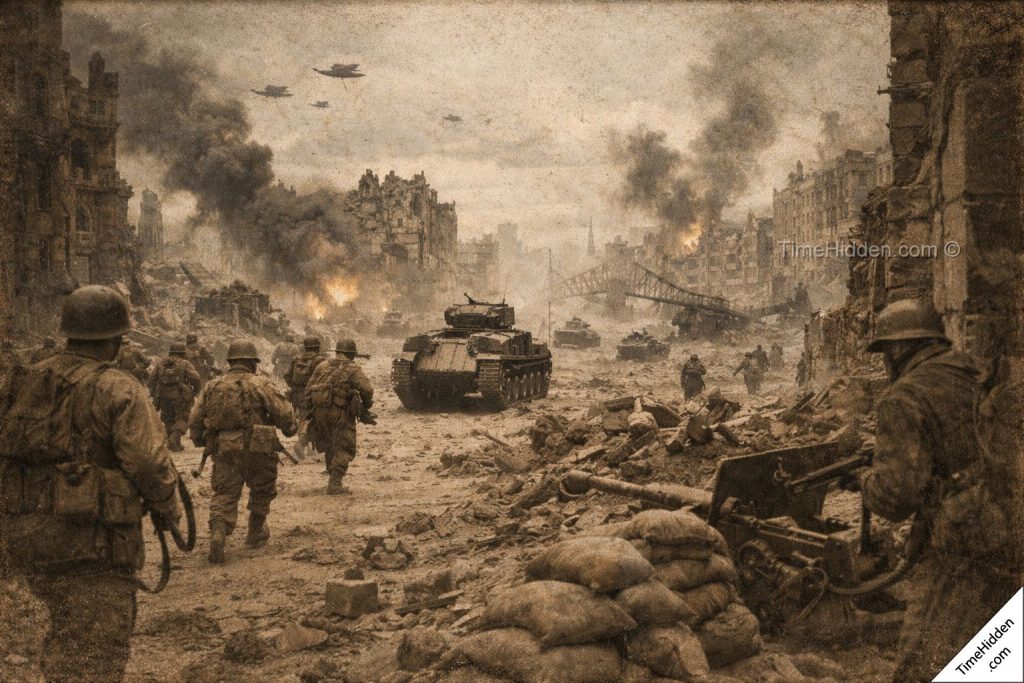
Encirclement of Berlin was completed by April 25, when Soviet forces linked up west of the city, cutting off remaining escape routes. Within the city, fighting shifted to an urban environment, where progress was measured in blocks rather than kilometers. Soviet units advanced steadily, capturing key government buildings, transportation hubs, and strategic locations.
One of the most symbolically important moments occurred on April 30, when Soviet troops reached the Reichstag, a powerful symbol of the Nazi state. That same day, Adolf Hitler took his own life in his underground bunker, acknowledging the inevitability of defeat. Leadership of Germany passed briefly to Admiral Karl Dönitz, who sought to negotiate surrender with the Western Allies while hostilities continued in Berlin.
Resistance in the city gradually collapsed as remaining German forces exhausted their supplies and options. On May 2, 1945, Berlin formally surrendered to Soviet forces. Less than a week later, on May 7, Germany signed an unconditional surrender, officially ending World War II in Europe.
Key Figures
Several prominent figures shaped the Battle of Berlin and its outcome. On the Soviet side, Marshal Georgy Zhukov was one of the principal commanders leading the assault on the city. Known for his experience and determination, Zhukov coordinated large-scale operations and played a central role in the final victory over Nazi Germany. Marshal Ivan Konev, commanding another major Soviet front, also contributed significantly by advancing from the south and tightening the encirclement of Berlin.
On the German side, Adolf Hitler remained the central figure, despite his diminishing control over events. His refusal to leave Berlin and his insistence on unrealistic counteroffensives contributed to confusion and ineffective defense. General Helmuth Weidling, appointed as the commander of Berlin’s defenses in the final days, faced an impossible task with limited resources and collapsing morale.
Other figures included Joseph Goebbels, the Nazi propaganda minister, who remained in Berlin until the end, and Admiral Karl Dönitz, who attempted to manage Germany’s surrender after Hitler’s death. These individuals reflected the internal divisions and desperation of Germany’s leadership during the final days of the war.
Significance and Impact
The Battle of Berlin had profound military, political, and historical significance. Militarily, it marked the complete defeat of Nazi Germany and the end of large-scale combat in Europe. The fall of the German capital eliminated any remaining hope of organized resistance and confirmed the dominance of Allied forces.
Politically, the battle shaped the postwar division of Europe. Soviet control of Berlin and much of Eastern Europe influenced the formation of political systems in the region and contributed directly to the emerging tensions between former Allies. These developments laid the groundwork for the Cold War, which would define global politics for decades.
Symbolically, the capture of Berlin represented the destruction of the Nazi regime and the collapse of its ideological ambitions. For many across Europe, it signaled the end of years of occupation, repression, and total war. At the same time, the scale of destruction in Berlin highlighted the devastating consequences of prolonged conflict and urban warfare.
The battle also underscored the human and material costs of World War II. It demonstrated how total war mobilized entire societies and left lasting scars on cities, populations, and political structures. Berlin’s fall became both an ending and a beginning: the end of one of history’s darkest chapters and the start of a new, uncertain era.
Conclusion
The Battle of Berlin stands as the final and decisive confrontation of World War II in Europe. It brought together years of military campaigns, political decisions, and ideological conflict in a single, defining moment. As Soviet forces captured the heart of the Third Reich, the Nazi regime collapsed, and the war that had devastated the continent came to an end.
Beyond its immediate military outcome, the battle reshaped Europe’s future. It influenced borders, governments, and international relationships that would endure long after the fighting stopped. The events in Berlin in the spring of 1945 remain a powerful reminder of the consequences of total war and the importance of historical memory.
Today, the Battle of Berlin is remembered not only as the fall of a city, but as the moment when Europe turned from war toward reconstruction. Its legacy continues to shape discussions about power, responsibility, and the lasting impact of global conflict on human history.