
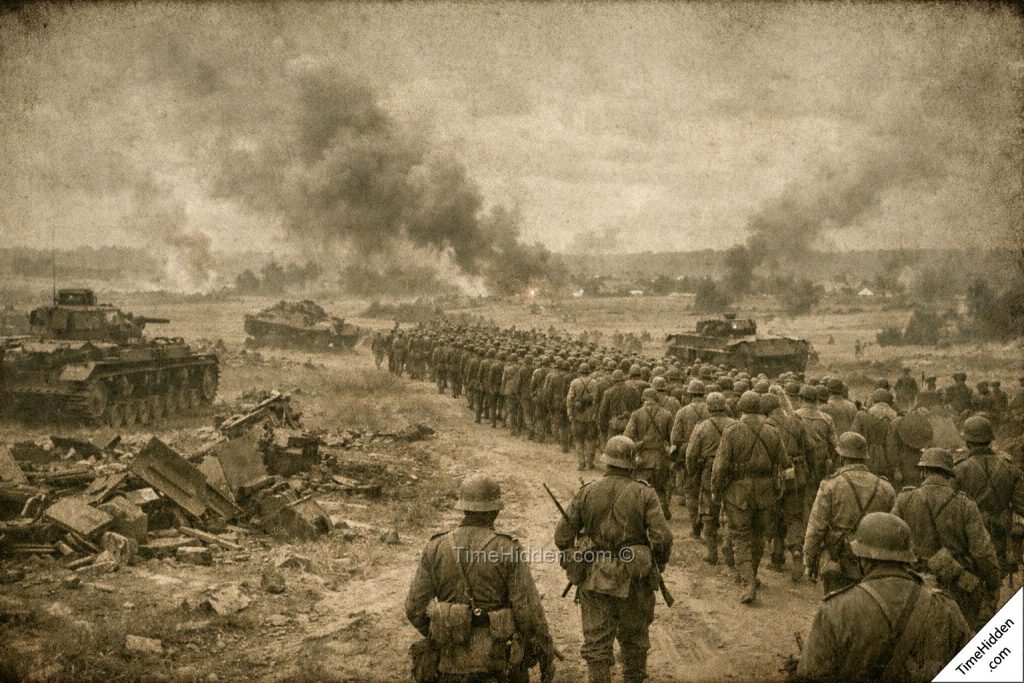
World War II Battles: Siege of Leningrad
Introduction
The Siege of Leningrad stands as one of the longest and most consequential sieges in modern military history. Lasting nearly 900 days, from September 1941 to January 1944, it was not only a massive military operation but also a profound test of endurance, organization, and morale. Leningrad—today known as Saint Petersburg—was a city of immense symbolic, industrial, and cultural importance to the Soviet Union. Named after Vladimir Lenin, it represented the revolutionary heart of Soviet identity and housed vital factories, ports, and transportation networks.
For Nazi Germany, capturing Leningrad was a central objective of Operation Barbarossa, the invasion of the Soviet Union. Adolf Hitler believed that destroying the city would deal a devastating psychological blow and eliminate a key Soviet stronghold in the north. Instead of a swift conquest, German and allied forces became locked in a prolonged blockade, aiming to isolate the city from supplies and reinforcements.
What followed was not a single battle, but a sustained campaign involving land, air, and artillery pressure, combined with the Soviet Union’s determined efforts to keep the city alive. The Siege of Leningrad became a defining episode of World War II, illustrating the strategic stakes of the Eastern Front and the extraordinary resilience of a city under relentless pressure.
Historical Background
In June 1941, Nazi Germany launched Operation Barbarossa, the largest military invasion in history, targeting the Soviet Union across a vast front stretching from the Baltic Sea to the Black Sea. German strategy divided the invasion into three main army groups: Army Group North, Army Group Center, and Army Group South. Army Group North, under Field Marshal Wilhelm von Leeb, was tasked with advancing through the Baltic states and capturing Leningrad.
Leningrad was the Soviet Union’s second-largest city, a major industrial hub, and home to critical shipyards and arms factories. It also held enormous political and cultural significance. For Hitler, Leningrad was not merely a military target but an ideological one. He envisioned its destruction as a symbol of the collapse of Bolshevism.
By late summer 1941, German forces, supported by Finnish troops advancing from the north, had pushed deep into Soviet territory. Although Finland officially pursued limited objectives related to territory lost in the Winter War, its cooperation effectively tightened the ring around Leningrad. Soviet forces, weakened by earlier defeats and leadership disruptions, struggled to halt the advance.
Rather than storming the city directly, German leadership opted for encirclement. The plan was to cut off supply routes, isolate Leningrad, and force its collapse over time. This decision set the stage for a prolonged siege that would reshape the strategic balance in northern Europe.
Main Events
Encirclement of the City (1941)
By early September 1941, German forces had captured key positions south of Leningrad, including the town of Shlisselburg, effectively severing the city’s last land connection to the rest of the Soviet Union. Finnish forces halted their advance north of the city, but their presence contributed to the overall blockade. Leningrad was now surrounded on almost all sides, with Lake Ladoga as its only tenuous link to Soviet-controlled territory.
German artillery and air forces began regular bombardments aimed at infrastructure, factories, and transportation hubs. At the same time, the blockade disrupted food, fuel, and raw material supplies. Soviet authorities, led by local party officials and military commanders, organized emergency defenses, mobilized civilian labor, and attempted to maintain industrial production despite the growing isolation.
Survival and Adaptation (1941–1942)
As winter approached, the situation inside Leningrad became increasingly severe. Supply shortages worsened, and heating and electricity became unreliable. Yet the city did not cease functioning. Factories were relocated or adapted to produce military equipment under extreme constraints, while civilians were organized into work brigades to build defenses and maintain essential services.
A critical development was the establishment of supply routes across Lake Ladoga. In winter, when the lake froze, vehicles traveled over the ice in what became known as the “Road of Life.” This route allowed limited food and fuel deliveries into the city and enabled the evacuation of civilians, particularly children and the elderly. Though vulnerable to enemy fire and harsh weather, the route was essential in preventing complete isolation.
Soviet Counteroffensives (1942–1943)
Throughout 1942, the Soviet High Command planned and executed multiple operations aimed at breaking the siege. While early efforts achieved limited success, they gradually weakened German positions and forced the diversion of resources. The Red Army improved coordination between ground forces, artillery, and air support.
In January 1943, Operation Iskra marked a turning point. Soviet forces launched a coordinated attack south of Lake Ladoga, opening a narrow land corridor to Leningrad. Although the city remained under threat and within artillery range, the partial breakthrough allowed for more reliable supply lines and the construction of a railway connection.
Lifting the Siege (1944)
By early 1944, the strategic situation on the Eastern Front had shifted decisively in favor of the Soviet Union. Large-scale offensives pushed German forces back across multiple fronts. In January 1944, the Red Army launched the Leningrad–Novgorod Offensive, driving German troops away from the city and ending the blockade.
On January 27, 1944, Soviet authorities officially declared the siege lifted. Celebrations marked the end of one of the most prolonged and demanding military campaigns of the war. Leningrad had survived, remaining under Soviet control throughout the conflict.
Key Figures
Adolf Hitler
As Germany’s leader, Hitler made the strategic decision to encircle Leningrad rather than capture it through direct assault. His ideological hostility toward the city influenced German strategy and contributed to the prolonged nature of the siege.
Wilhelm von Leeb
Commander of Army Group North, von Leeb oversaw the initial advance toward Leningrad and the early stages of the siege. He later expressed reservations about the prolonged blockade, though strategic decisions ultimately rested with higher leadership.
Georgy Zhukov
One of the Soviet Union’s most prominent commanders, Zhukov played a key role in organizing the defense of Leningrad in 1941. His leadership helped stabilize the front and improve coordination during critical phases of the siege.
Andrei Zhdanov
As the senior Communist Party official in Leningrad, Zhdanov was responsible for political leadership and civilian organization. He coordinated efforts to maintain order, mobilize labor, and sustain morale under extreme pressure.
Leonid Govorov
Commander of the Leningrad Front during later stages of the siege, Govorov played a significant role in planning and executing the operations that eventually broke the blockade and pushed German forces away from the city.
Significance and Impact
The Siege of Leningrad had far-reaching military, political, and symbolic consequences. Strategically, it tied down large numbers of German and Finnish troops for nearly two and a half years, limiting their availability for other fronts. The failure to capture Leningrad undermined Germany’s northern campaign and contributed to the overall strain on Axis resources.
For the Soviet Union, the defense of Leningrad became a powerful symbol of resistance and unity. The city’s continued operation as an industrial and military center, even under blockade, demonstrated the capacity of Soviet society to adapt and endure. Lessons learned during the siege influenced later Soviet approaches to urban defense, logistics, and civilian mobilization.
Internationally, the siege highlighted the scale and intensity of the Eastern Front, shaping Allied perceptions of the Soviet war effort. Leningrad’s survival reinforced its status as a cultural and historical capital, and its experience became a central element of postwar memory and commemoration.
Conclusion
The Siege of Leningrad was not defined by a single decisive battle, but by persistence over time. It was a confrontation between strategic calculation and human endurance, fought across frozen lakes, factory floors, and defensive lines surrounding a city of immense importance. Despite isolation, limited resources, and constant pressure, Leningrad did not fall.
From its encirclement in 1941 to the lifting of the blockade in 1944, the siege demonstrated the complexity of modern warfare, where logistics, morale, and civilian organization were as critical as military strength. The survival of Leningrad marked a significant failure of German strategic objectives and contributed to the broader shift of momentum on the Eastern Front.
Today, the Siege of Leningrad is remembered as one of World War II’s most defining episodes—a testament to resilience, strategic endurance, and the profound impact of prolonged warfare on the course of history.