
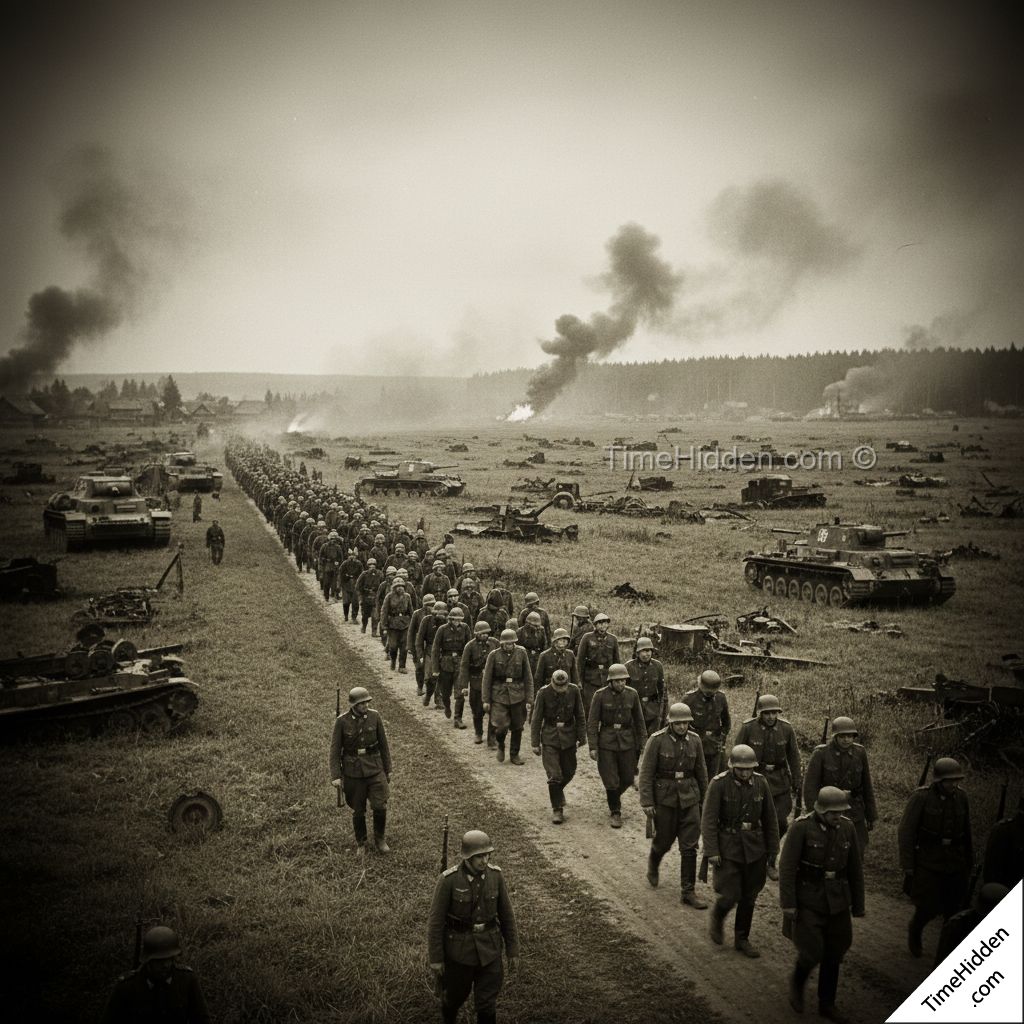
World War II Battles: The Battle of Kiev
Introduction
The Battle of Kiev, fought between August and September 1941, was one of the most significant and consequential engagements during the early phase of World War II on the Eastern Front. Taking place only weeks after the launch of Operation Barbarossa, the German invasion of the Soviet Union, the battle represented a critical struggle for control over Ukraine, a region of immense strategic and economic importance. Kiev, the capital of the Ukrainian Soviet Socialist Republic, stood as a major political center, transportation hub, and symbol of Soviet authority in the southwest of the country.
The battle is often remembered as one of the largest encirclement operations in military history. German forces, employing rapid maneuver warfare, succeeded in surrounding and defeating major Soviet formations defending the region. While the outcome was a decisive German victory in the short term, it also revealed underlying strategic tensions within the German command and contributed to delays that would later influence the broader course of the war. The Battle of Kiev was not merely a tactical confrontation; it was a defining episode that shaped the direction, tempo, and ultimate fate of the Eastern Front.
Historical Background
When Germany launched Operation Barbarossa on 22 June 1941, its objective was to defeat the Soviet Union in a swift campaign lasting only a few months. The German High Command divided its invasion forces into three major army groups: North, Center, and South. Army Group South, under Field Marshal Gerd von Rundstedt, was tasked with advancing into Ukraine, a region prized for its fertile farmland, industrial capacity, and access to vital resources.
Ukraine held enormous strategic value for both sides. For Germany, control of Ukraine promised food supplies to sustain the Reich, raw materials for industry, and a gateway toward the Caucasus oil fields. For the Soviet Union, Ukraine was a cornerstone of economic strength and population, as well as a critical buffer protecting the interior of the country. Losing Kiev would mean not only a territorial setback but also a severe psychological blow.
In the early weeks of the invasion, German forces advanced rapidly across western Ukraine, defeating Soviet units in a series of border battles. However, unlike in other sectors, Soviet resistance in the south proved more resilient. The Red Army committed substantial forces to defend Kiev, and Soviet leadership believed that holding the city was essential to preventing a deeper German penetration. As a result, a large concentration of Soviet troops remained deployed around Kiev well into the summer of 1941.
Main Events
Timeline of the Battle of Kiev
-
22 June 1941: Operation Barbarossa begins; German Army Group South advances into Ukraine.
-
July 1941: German forces push eastward; Soviet troops establish defensive positions around Kiev.
-
Early August 1941: German advances slow as Soviet resistance stiffens in the Kiev region.
-
21 August 1941: Adolf Hitler orders a major encirclement operation around Kiev.
-
Late August – Early September 1941: German armored forces execute a wide pincer movement.
-
16 September 1941: Encirclement around Kiev is completed.
-
19–26 September 1941: Organized Soviet resistance collapses; German forces secure Kiev.
The Strategic Debate
By August 1941, the German invasion faced a critical strategic dilemma. Army Group Center, advancing toward Moscow, had achieved major successes but was encountering increasing resistance. Many German generals argued that a direct push toward Moscow should take priority. Adolf Hitler, however, was increasingly focused on economic objectives, particularly Ukraine.
Hitler believed that destroying Soviet forces in Ukraine and securing its resources was more important than an immediate advance on the Soviet capital. On 21 August 1941, he ordered key armored units from Army Group Center, including formations led by General Heinz Guderian, to turn south and assist in the encirclement of Soviet forces around Kiev. This decision set the stage for one of the most dramatic operations of the campaign.
The Encirclement
The German plan involved a massive double envelopment. Armored units from the north and south would drive deep into Soviet-held territory, meeting east of Kiev and trapping the Soviet Southwestern Front. From the north, Guderian’s Second Panzer Group advanced southward. From the south, General Ewald von Kleist’s First Panzer Group moved northward after breaking through Soviet defenses.
Despite signs of danger, Soviet command hesitated to authorize a withdrawal from Kiev. Joseph Stalin and the Soviet High Command feared that abandoning the city would have severe political and symbolic consequences. As a result, large Soviet forces remained in place even as German armored columns closed in from both directions.
By mid-September 1941, the German pincers met near the town of Lokhvitsa, completing the encirclement. Soviet armies defending Kiev found themselves surrounded, with limited supplies and no clear avenue of escape. Within days, organized resistance diminished as German forces tightened their control over the area.
The Fall of Kiev
On 19 September 1941, German troops entered Kiev, effectively ending the battle for the city. Over the following days, remaining Soviet units were forced to surrender or disperse. The battle resulted in the destruction of several Soviet armies and the loss of a vast quantity of equipment.
For Germany, the Battle of Kiev represented a spectacular operational success. The scale of the encirclement and the number of Soviet forces neutralized exceeded anything achieved in earlier campaigns. However, the victory came at a cost: valuable time and momentum were lost, and German forces became increasingly stretched across a vast front.
Key Figures
German Commanders
-
Adolf Hitler: German leader whose decision to prioritize Ukraine over Moscow directly shaped the Battle of Kiev.
-
Field Marshal Gerd von Rundstedt: Commander of Army Group South, responsible for operations in Ukraine.
-
General Heinz Guderian: Leader of the Second Panzer Group, played a crucial role in the northern arm of the encirclement.
-
General Ewald von Kleist: Commander of the First Panzer Group, led the southern thrust toward Kiev.
Soviet Commanders
-
Joseph Stalin: Soviet leader whose insistence on holding Kiev influenced the outcome of the battle.
-
Semyon Budyonny: Commander of the Soviet Southwestern Direction during the early stages of the battle.
-
Mikhail Kirponos: Commander of the Southwestern Front, responsible for defending Kiev and surrounding areas.
Broader Participants
In addition to senior commanders, millions of soldiers, support personnel, and civilians were affected by the battle. Soviet railway workers, engineers, and local authorities worked to maintain supply lines and organize defenses, while German logistics units struggled to sustain long-range operations across unfamiliar terrain.
Significance and Impact
The Battle of Kiev was one of the most decisive German victories of World War II, but its strategic implications were complex. In the short term, the destruction of major Soviet forces in Ukraine severely weakened Soviet defensive capabilities in the south. It opened the way for further German advances toward eastern Ukraine and laid the groundwork for later operations aimed at the Caucasus.
However, the battle also contributed to significant delays in the German campaign. The diversion of armored units away from the central axis postponed the advance on Moscow. When German forces eventually resumed their push toward the Soviet capital in October 1941, they faced stronger defenses, deteriorating weather, and an increasingly organized Red Army.
For the Soviet Union, the loss at Kiev was a profound setback, but it also prompted important changes. Soviet leadership began to place greater emphasis on flexible defense, improved coordination, and the preservation of forces. Industrial evacuation to the east accelerated, ensuring that Soviet war production could continue despite territorial losses.
In the broader context of the war, the Battle of Kiev underscored the scale and intensity of the conflict on the Eastern Front. It demonstrated both the effectiveness of German operational maneuver and the resilience of the Soviet state, which absorbed enormous losses yet continued to fight.
Conclusion
The Battle of Kiev stands as a pivotal chapter in the history of World War II. It showcased the height of German operational success during the early months of the invasion of the Soviet Union, while simultaneously planting the seeds of future difficulties. The victory provided Germany with control over a vital region but delayed the decisive confrontation with Soviet forces near Moscow.
Ultimately, the battle revealed that rapid victories and large encirclements were not sufficient to secure a quick end to the war in the east. The Soviet Union’s ability to recover, adapt, and mobilize on an unprecedented scale transformed the conflict into a prolonged struggle that Germany could not sustain. As such, the Battle of Kiev remains a powerful example of how tactical triumphs can coexist with strategic consequences that shape the outcome of an entire war.