
World War II Battles: Battle of Iwo Jima
Introduction
The Battle of Iwo Jima stands as one of the most significant and symbolically powerful engagements of World War II in the Pacific Theater. Fought between the United States and Imperial Japan from February 19 to March 26, 1945, the battle was part of a broader Allied strategy to advance toward the Japanese mainland. Although Iwo Jima was a small volcanic island, its strategic importance far outweighed its size. For the United States, capturing the island meant securing airfields that could support bombing missions and provide emergency landing sites for aircraft. For Japan, Iwo Jima represented a vital defensive outpost and a chance to slow the advancing Allied forces.
The battle became famous not only for its intensity and determination on both sides, but also for the iconic image of U.S. Marines raising the American flag on Mount Suribachi. Beyond its symbolic value, the battle revealed the changing nature of warfare in the Pacific, where entrenched defenses, careful planning, and endurance played decisive roles. The story of Iwo Jima is one of strategy, leadership, and sacrifice, offering important insights into the final stages of World War II.
Historical Background
By early 1945, the momentum of the Pacific War had shifted decisively in favor of the Allies. Following victories at Midway, Guadalcanal, and across the Mariana Islands, the United States was steadily moving closer to Japan. The concept of “island hopping” guided American strategy, focusing on capturing key islands while bypassing others to weaken Japanese defensive networks.
Iwo Jima, located roughly halfway between the Mariana Islands and mainland Japan, held strategic value because of its airfields. Japanese fighter planes based there could intercept American bombers traveling from the Marianas to Japan. Additionally, the island provided Japan with an early warning system against incoming air raids. For the United States, capturing Iwo Jima would reduce these threats and provide emergency landing fields for damaged aircraft returning from bombing missions.
Japan recognized the island’s importance and prepared an extensive defensive system. Rather than relying on traditional beach defenses, Japanese commanders constructed a network of tunnels, bunkers, and fortified positions across the island. This approach aimed to delay and exhaust the invading forces, inflicting maximum losses and demonstrating Japan’s determination to defend its territory.
Main Events
Planning and Preparation (Late 1944 – February 1945)
American planners anticipated a difficult battle but underestimated the scale of the Japanese defenses. The invasion plan involved a massive naval bombardment followed by an amphibious landing by U.S. Marines. Japanese forces, under the command of Lieutenant General Tadamichi Kuribayashi, avoided large-scale counterattacks and instead prepared for a prolonged defensive battle.
The Landing (February 19, 1945)
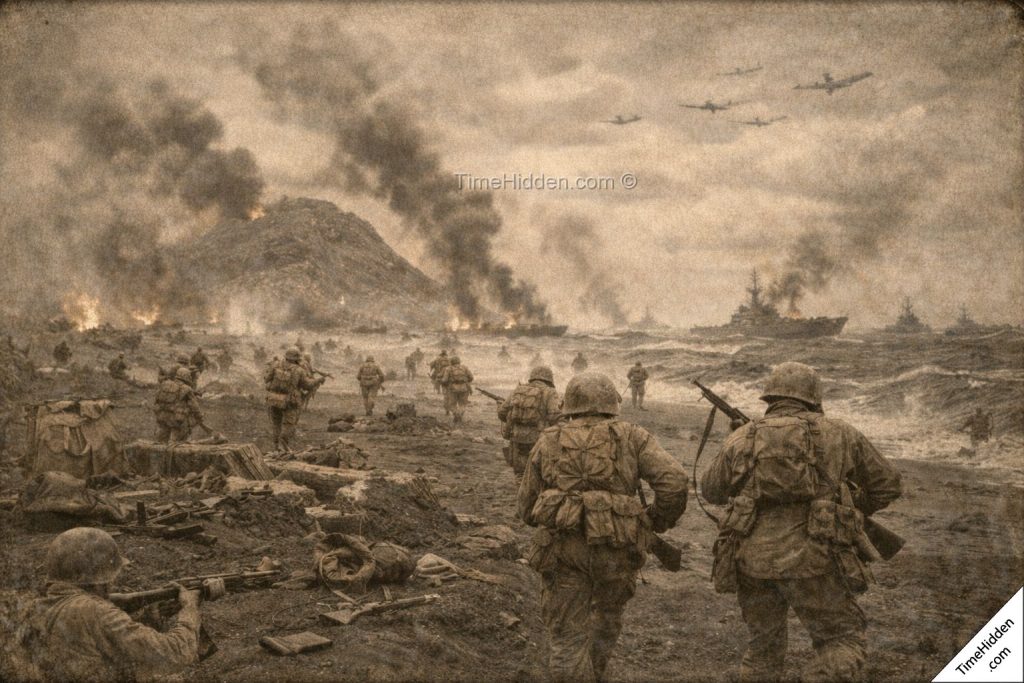
On February 19, U.S. Marines landed on the southeastern beaches of Iwo Jima. Initial resistance appeared limited, leading some to believe the bombardment had been effective. However, once large numbers of troops and equipment were ashore, Japanese forces opened coordinated fire from concealed positions. The volcanic sand made movement difficult and slowed the advance inland.
Advance Across the Island (February 20–23)
In the days following the landing, American forces worked to secure the southern part of the island. Mount Suribachi, a prominent volcanic peak, dominated the area and served as a key observation point. After intense fighting and careful maneuvering, U.S. Marines reached the summit on February 23 and raised the American flag, an event that became a lasting symbol of the battle.
Northern Campaign (Late February – Mid March)
With Mount Suribachi secured, attention turned to the northern part of the island, where Japanese defenses were even more extensive. Progress was slow, as Japanese forces used their tunnel networks to reposition and resist advances. American units relied on coordinated infantry, engineering, and artillery efforts to neutralize fortified positions.
Final Phase (Mid March – March 26)
By mid-March, organized Japanese resistance had largely collapsed, though isolated pockets continued to fight. On March 26, U.S. forces officially declared the island secured. The battle had lasted over a month, far longer than initially expected, highlighting the effectiveness of Japan’s defensive strategy.
Key Figures
Lieutenant General Tadamichi Kuribayashi (Japan)
Kuribayashi was the commanding officer of Japanese forces on Iwo Jima. Unlike many other commanders, he rejected traditional tactics and focused on a defensive strategy designed to prolong the battle. His leadership emphasized discipline, preparation, and coordination, making the battle one of the most challenging faced by U.S. forces in the Pacific.
Lieutenant General Holland M. Smith (United States)
As the commander of the U.S. Marine forces involved in the invasion, Smith played a crucial role in planning and executing the operation. He coordinated naval, air, and ground forces, adapting tactics as the battle unfolded.
Sergeant Michael Strank and the Flag Raisers (United States)
Sergeant Michael Strank and fellow Marines were involved in the famous flag-raising on Mount Suribachi. While the image became symbolic, it also represented the collective effort of thousands of servicemen rather than a single moment of victory.
Admiral Raymond A. Spruance (United States)
Spruance commanded the U.S. Fifth Fleet, which supported the invasion. His leadership ensured effective naval bombardment, logistics, and air support throughout the campaign.
Significance and Impact
The Battle of Iwo Jima had far-reaching military and psychological consequences. Strategically, the capture of the island provided the United States with airfields that proved valuable in the final months of the war. Many damaged aircraft were able to land on Iwo Jima, saving lives and equipment.
The battle also demonstrated the determination of Japanese forces to defend their territory, influencing Allied planning for future operations, particularly the Battle of Okinawa. The prolonged resistance at Iwo Jima reinforced the belief that any invasion of mainland Japan would face intense opposition.
Symbolically, Iwo Jima became a defining moment in American wartime memory. The image of the flag on Mount Suribachi represented perseverance and unity, strengthening morale on the home front. For Japan, the battle underscored the high cost of defense but also became a testament to discipline and resolve.
Conclusion
The Battle of Iwo Jima was more than a struggle for a small island; it was a critical chapter in the final phase of World War II. Through careful preparation, determined defense, and sustained effort, both sides demonstrated their strategic priorities and military capabilities. The battle reshaped Allied expectations, influenced future campaigns, and left a lasting legacy in global history.
Iwo Jima remains a powerful reminder of the complexity of warfare, where geography, leadership, and planning can shape outcomes as much as numbers and technology. Its lessons continue to be studied by historians and military professionals, ensuring that the story of Iwo Jima endures as a key moment in the history of World War II.