
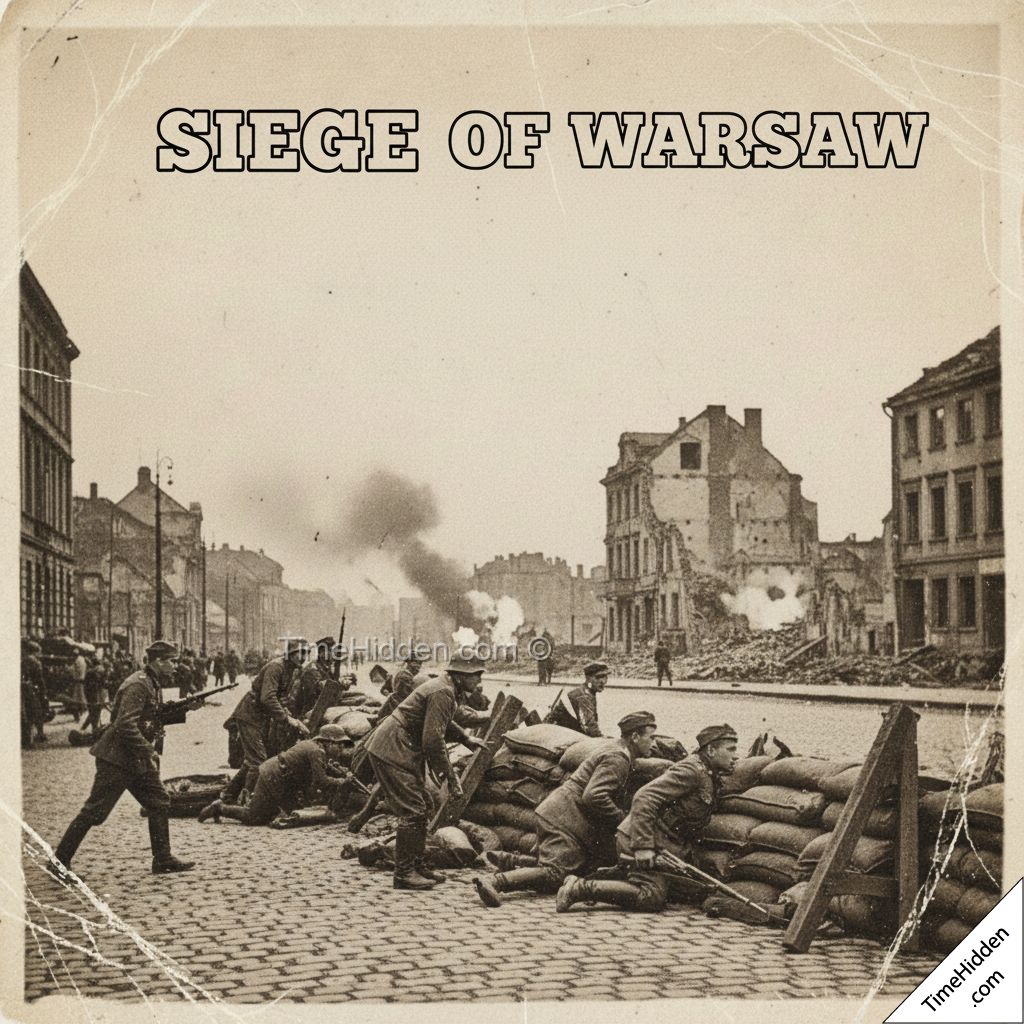
Siege of Warsaw (1939)
Introduction
The Siege of Warsaw in September 1939 was one of the most significant early events of the Second World War—an intense struggle that symbolized Poland’s determination in the face of overwhelming German aggression. As the German invasion advanced rapidly across the country, Warsaw soon became the focal point of both military resistance and civilian endurance. With its strategic location, political importance, and role as the heart of the Polish nation, the capital quickly turned into a battlefield. Over three dramatic weeks, the city endured relentless bombing, artillery barrages, food shortages, and the collapse of infrastructure. Despite these harsh conditions, Polish soldiers, police forces, volunteers, and ordinary citizens fought with remarkable resolve. Their resistance forced Germany to commit substantial resources and revealed the brutality of modern warfare. The fall of Warsaw on September 28, 1939, marked the collapse of Polish organized resistance in the first campaign of the war, but the siege left a profound legacy of courage, suffering, and the high cost of defending national independence.
Historical Background
Europe on the Brink of War
The years leading up to the siege were marked by escalating tensions across Europe. Nazi Germany, under Adolf Hitler, had systematically violated the Treaty of Versailles by rebuilding its military and pursuing aggressive territorial expansion. Following the annexation of Austria in 1938 and the dismantling of Czechoslovakia, Hitler turned his attention to Poland. Germany claimed historical rights to Danzig (Gdańsk) and demanded extraterritorial access through the Polish Corridor—demands that Poland firmly rejected.
Realizing that appeasement had failed, Britain and France offered guarantees of Polish sovereignty in March 1939. Germany responded by preparing for war. The signing of the Molotov–Ribbentrop Pact on August 23, 1939, between Germany and the Soviet Union, sealed Poland’s fate. The pact included a secret clause dividing Eastern Europe into spheres of influence, with Poland scheduled to be partitioned between the two dictatorships.
Poland’s Military Situation
Although Poland had a large army, it was under-equipped compared to Germany’s modern mechanized forces. The Polish Army still relied heavily on infantry, World War I–era artillery, and a small armored force. Warsaw, however, was better prepared defensively. In the months before the invasion, the city strengthened fortifications, anti-aircraft batteries, and strategic command posts. Still, no amount of preparation could fully protect the capital from the destructive power of the Luftwaffe and the German land forces.
Main Events
Timeline Overview
-
September 1, 1939: German invasion of Poland begins.
-
September 1–8, 1939: Heavy air raids strike Warsaw; Polish forces withdraw toward the capital.
-
September 8, 1939: German armored units reach the western outskirts of Warsaw.
-
September 9–14, 1939: Intense street fighting; Polish counterattacks attempt to break encirclement.
-
September 15–22, 1939: Full siege begins; relentless artillery and aerial bombardments.
-
September 23–27, 1939: Final assaults on the city; civilian casualties and fires escalate.
-
September 28, 1939: Warsaw officially surrenders.
-
October 1–6, 1939: Remaining Polish forces in nearby regions capitulate.
The First Bombings (September 1–8)
The siege began even before German troops reached the city. On September 1, 1939—the opening day of the invasion—the Luftwaffe carried out large-scale bombing raids on Warsaw. These air attacks targeted rail lines, bridges, military installations, and civilian areas. Hundreds of civilians were killed, and the city’s infrastructure sustained significant damage.
As German ground forces swept through western and northern Poland, Polish units steadily retreated toward Warsaw. Refugees flooded the capital, creating overcrowded shelters and stretching medical facilities to the limit. Despite the chaos, Warsaw remained determined to defend itself.
German Forces Reach the Capital (September 8–10)
By September 8, the German 4th Panzer Division reached the outskirts of Warsaw from the west. This rapid movement was part of Germany’s Blitzkrieg strategy—a combination of speed, armor, and air power. The Germans expected to take the city quickly but were met with unexpected resistance.
Polish defensive lines, supported by anti-tank guns and barricades, managed to halt the first German push into the city center. Fierce fighting erupted in the districts of Ochota and Wola, where Polish defenders inflicted significant losses on German armor. The failed attempt forced the Germans to reconsider their strategy.
Encirclement and Counterattacks (September 9–14)
While German forces encircled Warsaw from the west, other German armies moved in from the north and south. The encirclement cut the capital off from most external support. However, Polish forces outside the city launched several counterattacks to break through the German lines.
The largest of these was the Battle of the Bzura (September 9–19), where Polish armies led by General Tadeusz Kutrzeba attempted to relieve Warsaw. Despite initial success, the counterattack was ultimately defeated by overwhelming German reinforcements and air superiority.
Inside the city, street fighting intensified. Civilians assisted the army by building barricades, delivering supplies, and caring for the wounded. Tram drivers used their vehicles as roadblocks. Students, firefighters, and city workers joined the defense. The siege increasingly became a battle for survival.
The Full Siege Begins (September 15–22)
Frustrated by Polish resistance, the Germans shifted to a strategy of systematic destruction. Artillery units surrounding the city began continuous bombardment, targeting military positions, water stations, power plants, and residential areas. The Luftwaffe conducted repeated mass bombings.
The most devastating air raid occurred on September 25—known as “Black Monday”—when over 1,000 tons of bombs were dropped on Warsaw. Fires spread uncontrollably. Over 10 percent of the city’s buildings were destroyed in a single day. Civilian suffering reached catastrophic levels.
Meanwhile, shortages of water, food, and medical supplies worsened. Hospitals operated without electricity, performing surgeries by candlelight. Waterworks damaged by bombing forced residents to draw water from the Vistula River under dangerous conditions.
The Final Days (September 23–28)
By the final week of September, German infantry and panzer divisions prepared for a direct assault on the city center. Fighting raged around Żoliborz, Mokotów, and Praga districts. Street-by-street battles became common, with buildings changing hands repeatedly.
Despite exhaustion and dwindling ammunition, Polish defenders continued fighting. But the humanitarian situation inside the city had become unbearable. Civilian casualties surpassed 20,000. Fires consumed entire neighborhoods. Hospitals overflowed.
On September 27, Warsaw’s civilian authorities, led by Mayor Stefan Starzyński, and military commanders convened to assess the situation. With no hope of relief and to prevent further civilian massacre, the Polish command agreed to negotiate a surrender.
Surrender on September 28
The surrender terms allowed Polish soldiers to be taken as prisoners of war, while civilians were promised safety—though German occupation policies soon proved brutal. On September 29, German forces entered the devastated city. The siege had ended, but the suffering of Warsaw and its people was far from over.
Key Figures
Stefan Starzyński
As the Mayor of Warsaw, Starzyński became a symbol of resilience. He organized the city’s defenses, supported civilian morale through radio broadcasts, and coordinated emergency services. His leadership during the siege earned him lasting admiration.
General Juliusz Rómmel
Commander of Warsaw’s defense. Rómmel coordinated the city’s military operations and made the difficult decision to surrender to avoid further humanitarian catastrophe.
General Tadeusz Kutrzeba
Commander of the Poznań Army. He led the counterattack along the Bzura River, which delayed the German advance and allowed Warsaw more time to organize its defenses.
Adolf Hitler
As Germany’s leader, Hitler ordered the destruction of Warsaw, viewing the capital as a symbol of Polish nationalism. He visited the front near Warsaw during the siege.
Walther von Reichenau
Commander of the German 10th Army, Reichenau played a central role in coordinating the siege operations and encirclement.
Significance and Impact
A Symbol of Resistance
The defense of Warsaw showcased extraordinary bravery. Soldiers and civilians stood together against overwhelming odds, delaying Germany’s campaign timetable and complicating their logistics.
Massive Civilian Suffering
The siege resulted in catastrophic civilian casualties and the destruction of over 20 percent of Warsaw’s buildings. The city’s cultural institutions, schools, churches, and hospitals suffered enormous losses.
German Occupation and Repression
Following the siege, Warsaw became a major center of German occupation policies. Thousands of Polish political leaders, clergy, and intellectuals were arrested or executed. The Jewish population of Warsaw was forced into the Warsaw Ghetto, setting the stage for later atrocities.
Lessons for Modern Warfare
The siege demonstrated how air power and artillery could devastate cities and populations. It became one of the earliest examples of a modern urban siege in the age of total war.
Polish Legacy in Exile
Despite the fall of Warsaw, Polish soldiers continued the fight abroad. Many escaped to France and Britain, contributing significantly to the Allied war effort.
Conclusion
The Siege of Warsaw in 1939 stands as a powerful testament to human resilience, courage, and sacrifice. Though facing an enemy with superior technology and resources, Warsaw resisted for nearly a month, enduring relentless bombardments and unimaginable hardship. The fall of the city did not mark the end of Polish resistance but the beginning of a long and painful struggle against occupation. The siege also revealed the destructive potential of modern warfare and the vulnerability of civilians in total war. Today, the Siege of Warsaw remains one of the most important and tragic episodes of World War II’s opening chapter—a reminder of the high cost of defending freedom and the enduring strength of the human spirit in the darkest of times.