
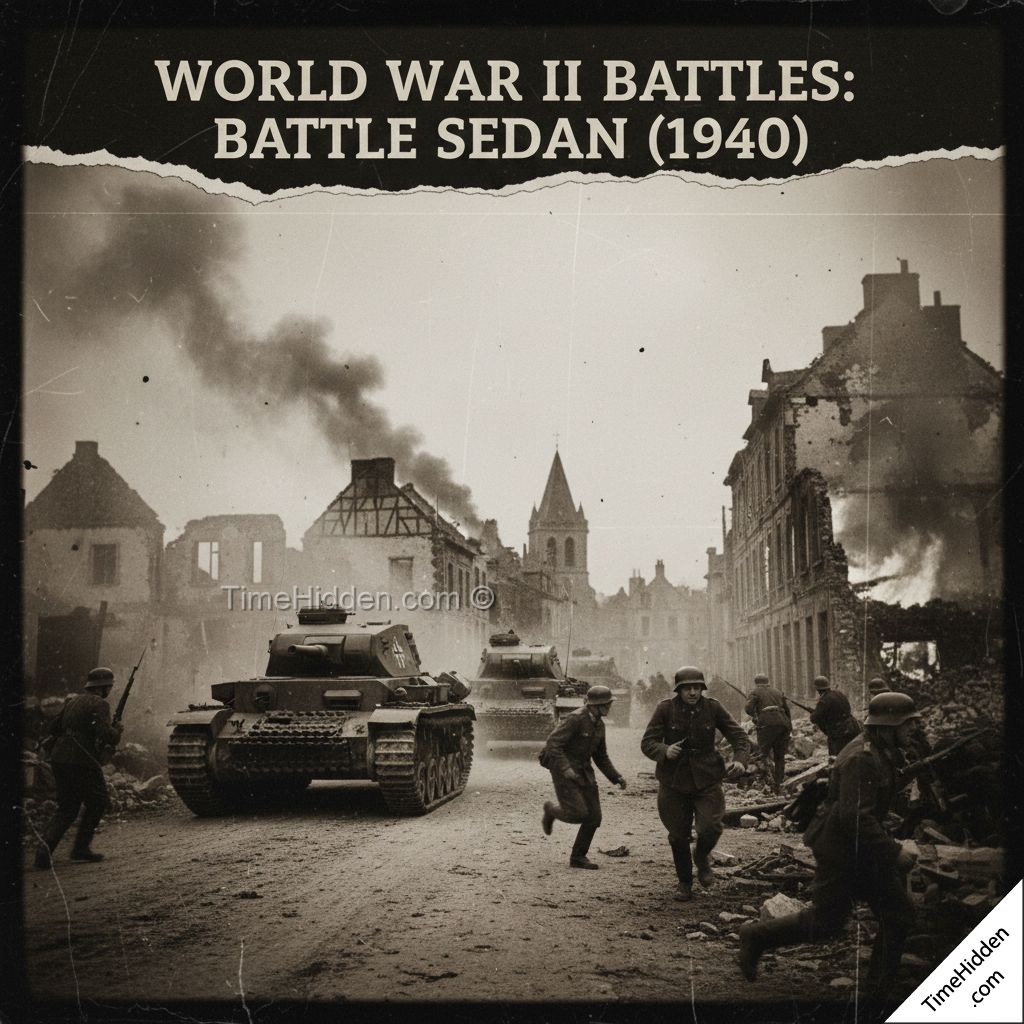
World War II Battles: Battle of Sedan
Introduction
The Battle of Sedan, fought from May 12 to May 15, 1940, was one of the most decisive engagements of the entire Battle of France and a defining moment in World War II. It marked the critical breakthrough of German forces through the French defensive lines along the Meuse River, opening the path for the sweeping armored advance toward the English Channel. The fall of Sedan exposed fatal weaknesses in French strategy and command, and it showcased the devastating effectiveness of Germany’s Blitzkrieg doctrine. Though the fighting lasted only a few days, its consequences reshaped the course of the war: France’s collapse was set into motion, the British Expeditionary Force was soon forced toward Dunkirk, and Germany emerged as the dominant power in Western Europe. The events at Sedan have since been studied as a masterclass in operational surprise, speed, and combined-arms warfare.
Historical Background
Following the devastation of World War I, France built its postwar military strategy on defense. The heart of that strategy was the massive Maginot Line, a system of concrete fortifications, bunkers, artillery casemates, and underground tunnels stretching along the German frontier. French planners believed these static defenses, combined with a carefully controlled reserve force, would prevent a rapid German breakthrough as had occurred in 1914.
Germany, however, had completely transformed its military doctrine. Under Adolf Hitler, German strategists such as Heinz Guderian, Erich von Manstein, and Gerd von Rundstedt developed a new form of warfare known as Blitzkrieg—a rapid, coordinated strike using tanks, mechanized infantry, artillery, and close air support. The goal was to penetrate enemy lines at a decisive point, disrupt communications, and advance so quickly that defenders could not reorganize.
In 1939–1940, after the fall of Poland, Europe entered the “Phoney War,” a period of relative calm on the Western Front. France and Britain anticipated a German attack through Belgium, just as in World War I. Therefore, when Germany launched Fall Gelb (Case Yellow) in May 1940, French and British forces advanced into Belgium to confront what they believed was the main German thrust.
But the real German strategy was far more daring. The strongest armored force was secretly massed opposite the Ardennes, a heavily forested region the French believed impossible for large mechanized units to cross. The point of the planned breakthrough: Sedan, a quiet industrial town on the Meuse River. Once Sedan fell, German Panzers could race unopposed across northern France, cutting off the Allied armies in Belgium.
Timeline of Key Events
May 12, 1940 – Germans Reach the Meuse at Sedan
German Panzer divisions from General Guderian’s XIX Corps emerged from the Ardennes after a forced march. French defensive forces in the region—mostly inexperienced reservists—were caught by surprise.
May 13 – Massive Luftwaffe Bombardment
The Luftwaffe launched one of the largest concentrated air attacks of the campaign, striking French fortifications, artillery positions, and communication lines around Sedan. German infantry began crossing the Meuse under this air umbrella.
Evening of May 13 – Breakthrough at the French Lines
German assault teams established bridgeheads across the river. French counterattacks failed due to lack of coordination and communication breakdowns.
May 14 – Expansion of the German Bridgehead
Armored units crossed hastily constructed pontoon bridges and exploited gaps in the French defenses. Panic spread among French troops as rumors of massive tank forces circulated.
May 15 – The Collapse of the Sedan Front
French defensive lines disintegrated. Guderian’s Panzers began their rapid dash westward toward the English Channel, effectively ending the possibility of a coordinated French resistance in the region.
Major Events and Operational Overview
1. The Ardennes Advance: Germany’s Great Gamble
Germany’s entire Sedan operation depended on the element of surprise. The Ardennes was considered by French commanders as unsuitable for armored warfare, but Guderian viewed it as the perfect route precisely because it was lightly defended. Over three days, thousands of vehicles—including tanks, half-tracks, artillery, and supply trucks—poured through narrow forest roads. Although traffic jams stretched for miles, German air superiority prevented French reconnaissance from disrupting the movement.
By May 12, German forces had reached the Meuse near Sedan, ahead of schedule. Their rapid arrival shocked the French command, which had expected at least several more days before a major engagement there.
2. The Bombardment of Sedan: Psychological Warfare in Action
On May 13, the Luftwaffe launched a devastating air assault. Wave after wave of Stuka dive-bombers targeted French bunkers, artillery positions, and crossroads. Although actual physical damage to fortifications was limited, the psychological effect was immense. French soldiers—many of them reservists with little training—faced near-constant bombardment for hours. Telephone networks were destroyed, commanders could not communicate, and rumors of catastrophic losses spread through the ranks.
The French artillery, which could have repelled German assault boats, failed to coordinate fire. This allowed German infantry units to cross the river in rubber boats and establish footholds on the west bank.
3. Crossing the Meuse: The Decisive Moment
German infantry, supported by engineers, crossed under heavy smoke and sporadic fire. By nightfall, several strong bridgeheads were established. As French counterattacks began, they were hindered by confusion, lack of air support, and poor coordination.
Meanwhile, German engineers worked tirelessly through the night building pontoon bridges for tanks. By early May 14, the first Panzers were crossing.
4. Breakdown of French Counterattacks
French doctrine emphasized carefully planned, methodical offensives—unsuited for rapid crisis response. Mobile reserves under General Charles Huntziger were deployed too late, misdirected by poor communication. Most of the French tanks never reached the battlefield in time.
Worse, many French units mistook retreating soldiers for defeated formations, spreading panic. Entire battalions withdrew without ever encountering German forces.
5. German Armored Breakout
With the bridgeheads secure and armored units now across the river, Guderian unleashed a rapid advance westward. Rommel’s 7th Panzer Division also advanced aggressively further north. Their movements were so fast that even German high command worried they were overextending their supply lines.
But the momentum proved unstoppable. The Panzers bypassed strongpoints, isolated French units, and destroyed communication centers. Within two days, German forces were miles beyond Sedan, heading for the Channel.
The Allies’ entire northern front—consisting of the BEF and the best French armies—was now at risk of encirclement, leading directly to the crisis at Dunkirk.
Key Figures Involved
German Leadership
-
Heinz Guderian – Commander of XIX Panzer Corps; his principles of armored warfare defined the operation.
-
Erwin Rommel – Commanded the 7th Panzer Division; his bold maneuvers contributed to rapid German gains.
-
Erich von Manstein – Planner of the Ardennes breakthrough strategy.
-
Hermann Göring – Oversaw the Luftwaffe, whose air superiority made the crossing possible.
-
Gerd von Rundstedt – Commander of Army Group A, overall leader of the Sedan thrust.
French and Allied Leadership
-
General Charles Huntziger – Commanded the French Second Army defending Sedan.
-
Maurice Gamelin – French Commander-in-Chief; slow decision-making and rigid strategy hampered defensive efforts.
-
Paul Reynaud – Prime Minister of France during the battle; increasingly alarmed by the rapid collapse.
-
Colonel Pierre Lafontaine – Commanded the forces defending the immediate Sedan sector.
-
General Gaston Billotte – Coordinated the Allied armies in northern France but struggled to react to the breakthrough.
Significance and Impact
1. Collapse of the French Defensive Strategy
The Battle of Sedan shattered the illusion of security provided by the Maginot Line. Though the line itself was not breached at Sedan, the German strategy simply bypassed it, demonstrating the obsolescence of static defenses in modern warfare.
2. Birth of Blitzkrieg’s Legend
Sedan became the textbook example of Blitzkrieg:
-
concentrated armor
-
devastating air power
-
speed of movement
-
exploitation of disorganization
The German victory at Sedan was not merely tactical—it validated an entire new way of waging war.
3. Strategic Consequences for France and the Allies
The fall of Sedan made the encirclement of Allied forces in Belgium inevitable. Within weeks:
-
the BEF was evacuated at Dunkirk
-
France collapsed and surrendered
-
Germany gained control of Western Europe
The psychological blow was immense. France, believed to be one of the strongest armies in the world, had fallen in a matter of weeks.
4. Impact on Britain and the Wider World
The Battle of Sedan directly led to Britain standing alone against Nazi Germany. This situation pushed Britain to mobilize fully, prepare for invasion, and seek global alliances. It also influenced U.S. foreign policy, helping build support for aid to Britain.
5. Lessons in Strategic Flexibility
Sedan exposed the dangers of rigid planning. French commanders adhered to outdated tactics, failed to react quickly, and underestimated their enemy. The battle became a lasting lesson in the necessity of:
-
rapid decision-making
-
effective communication
-
flexible, mobile reserves
-
integration of air and ground forces
Conclusion
The Battle of Sedan was far more than a river crossing—it was a turning point in the Battle of France and in World War II itself. Through a combination of surprise, speed, air superiority, and doctrinal innovation, the German army achieved a breakthrough that shattered French defenses and set the stage for the rapid fall of France. The consequences echoed across the world: the Allies were forced into retreat, Britain began its lone struggle against Germany, and Blitzkrieg emerged as the dominant military doctrine of the early war. Sedan demonstrated the power of modern combined-arms warfare and the catastrophic cost of strategic inflexibility. Today, the battle stands as a defining example of how bold planning and rapid execution can reshape the course of history in just a few days.