
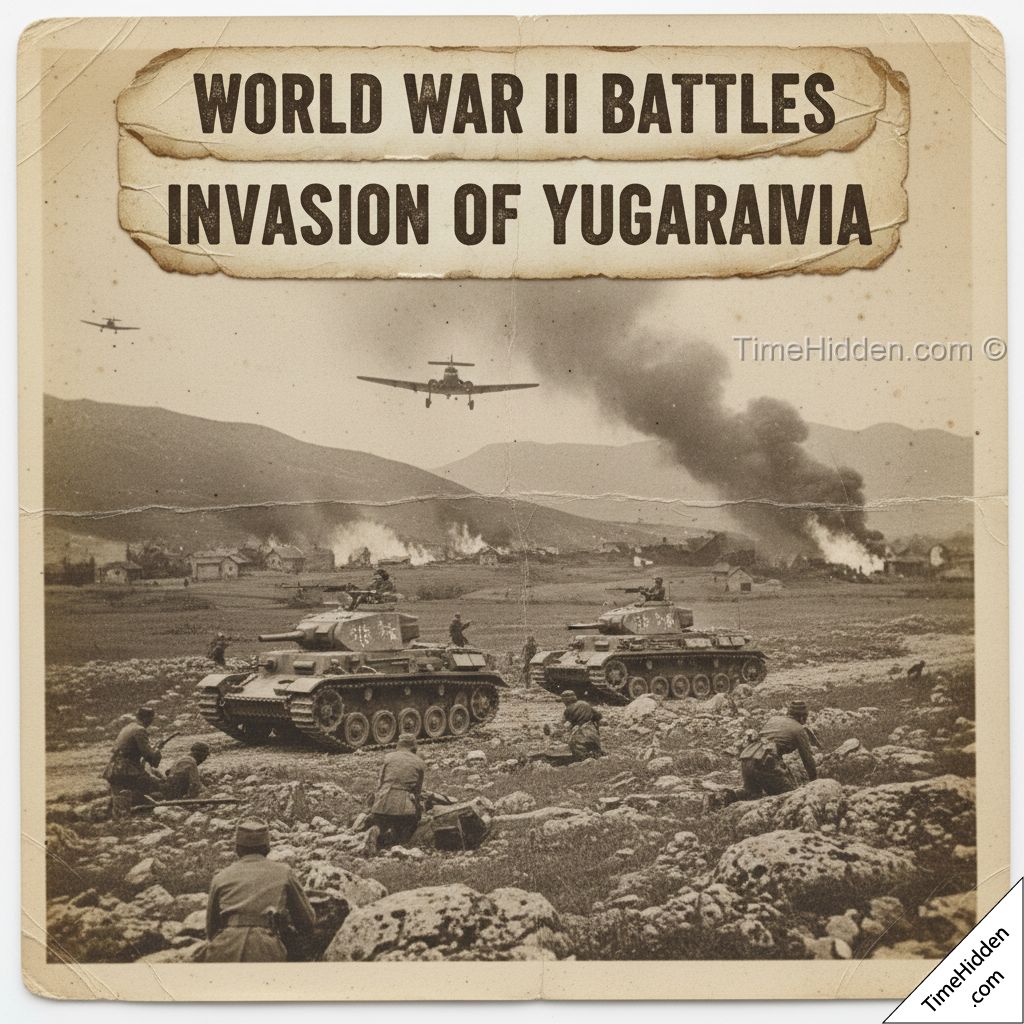
World War II Battles: Invasion of Yugoslavia
Introduction
The Invasion of Yugoslavia, launched in April 1941, was a swift yet highly consequential military operation that reshaped the strategic landscape of the Balkans during World War II. The invasion, conducted by Nazi Germany, Italy, Hungary, and Bulgaria, crushed the Kingdom of Yugoslavia in a matter of days, demonstrating the overwhelming efficiency of the German Blitzkrieg and exposing internal divisions that had long weakened the Yugoslav state. Though brief, the campaign was pivotal: it dramatically delayed Hitler’s timetable for Operation Barbarossa, triggered one of the largest and most complex resistance movements in occupied Europe, and permanently transformed the political structure of the region. The Yugoslav collapse also highlighted the vulnerability of multi-ethnic states under the pressures of total war and political extremism. Through a combination of diplomatic manipulation, strategic aggression, and internal Yugoslav unrest, the Axis powers dismantled a sovereign nation and divided its territories, setting the stage for years of brutal occupation, civil conflict, and resistance.
Historical Background
The origins of the invasion trace back to Yugoslavia’s precarious geopolitical situation in the late 1930s. The Kingdom of Yugoslavia, formed after World War I, was a complex federation of Serbs, Croats, Slovenes, Bosniaks, Macedonians, and other ethnic groups. Despite efforts to create a unified national identity, the kingdom suffered from political instability, economic inequality, and rising nationalism among different ethnic communities.
Following the outbreak of World War II, Yugoslavia attempted to maintain neutrality. However, as the Axis powers expanded across Europe, the country’s strategic location made it increasingly difficult to remain isolated. Germany sought access to the Balkan Peninsula to secure raw materials, stabilize its southern flank before invading the Soviet Union, and ensure faster transport routes to Greece, where German forces were supporting faltering Italian operations.
Under mounting pressure, the Yugoslav regency government signed the Tripartite Pact with Germany on March 25, 1941, effectively aligning with the Axis. The agreement provoked massive public outrage, particularly in Serbia, where pro-Allied sentiment was strong. Just two days later, on March 27, a group of pro-British military officers led a coup d’état, overthrowing the regency and placing 17-year-old King Peter II on the throne. The new government renounced its previous commitments and adopted a more neutral stance.
Hitler, outraged by the coup, saw it as a direct threat to German prestige and strategic goals. He immediately ordered the invasion of Yugoslavia, planning a rapid and devastating campaign to crush the country before the launch of Operation Barbarossa.
Timeline of Major Events
April 6, 1941 – Luftwaffe Bombing of Belgrade
The invasion began on April 6, with a massive air raid on Belgrade. Code-named Operation Retribution, the Luftwaffe’s attack aimed to break Yugoslav morale and paralyze military command. The bombings killed thousands of civilians and destroyed large parts of the capital. Simultaneously, German ground forces launched a coordinated assault from Austria, Hungary, Romania, and Bulgaria.
April 7–10, 1941 – Rapid German Advances
German Panzer divisions employed Blitzkrieg tactics, overwhelming Yugoslav border defenses. The 2nd Army advanced through Croatia and Slovenia, while the 12th Army pushed northward from Bulgaria into Serbia and Macedonia. Italian units attacked from Albania, while Hungarian forces entered northern Yugoslavia, occupying areas with significant Hungarian minorities.
Political chaos further undermined Yugoslav defense. Many Croatian units refused to fight, influenced by the separatist Ustaše movement. Communication between Yugoslav commands deteriorated rapidly.
April 10, 1941 – Collapse of Yugoslav Forces
By April 10, German forces were deep inside Yugoslav territory. On the same day, the Independent State of Croatia (NDH) was proclaimed in Zagreb by the Ustaše, shocking the already-fragile Yugoslav command structure. This new puppet state immediately aligned itself with Germany and Italy, further accelerating Yugoslavia’s collapse.
April 11–13, 1941 – Encirclement of Key Regions
German troops captured Skopje, Nis, and Sarajevo within days. The Yugoslav Army, struggling with ethnic divisions and outdated equipment, retreated in disarray. Italian forces made significant gains along the Adriatic coast, while Bulgarian troops occupied parts of Macedonia and southern Serbia.
April 14–17, 1941 – Final Surrender
Facing total defeat, the Yugoslav high command sought an armistice. On April 17, just eleven days after the invasion began, Yugoslavia officially surrendered. German troops marched into Belgrade, completing one of the swiftest campaigns in the war.
Major Figures Involved
Adolf Hitler
Hitler personally ordered the invasion, viewing the Yugoslav coup as a betrayal. His swift response demonstrated his commitment to punishing defiance and securing strategic control of the Balkans. The operation delayed the start of Operation Barbarossa by several critical weeks.
Field Marshal Wilhelm List
Commander of the German 12th Army, List oversaw the main thrust through the Balkans. His forces coordinated the invasion of both Yugoslavia and Greece, proving crucial to Germany’s rapid victory.
General Dušan Simović
Leader of the March 27 coup, Simović became Yugoslavia’s prime minister. Though he sought neutrality, he lacked sufficient time to prepare defenses or secure foreign support, leaving his government vulnerable to German retaliation.
King Peter II
Although only 17 years old, King Peter II became a symbol of resistance after the coup. He fled the country after the invasion and later worked with Allied governments in exile.
Ante Pavelić
Leader of the Ustaše nationalist movement, Pavelić headed the Independent State of Croatia created during the invasion. His regime became notorious for extreme brutality and collaborated closely with Nazi Germany and Fascist Italy.
Key Events and Developments
Ethnic Fragmentation and Political Instability
Yugoslavia’s multi-ethnic composition played a significant role in its rapid collapse. Tensions between Serbs and Croats, in particular, hindered unified resistance. The Ustaše’s desire for an independent Croatia aligned with German objectives, weakening internal cohesion.
Blitzkrieg Effectiveness
The invasion showcased the devastating effectiveness of Blitzkrieg tactics. German forces combined fast-moving armored units, mechanized infantry, and air support to break Yugoslav lines before they could reorganize.
Lack of Allied Support
Although Britain supported the anti-Axis sentiment in Yugoslavia, it was already deeply engaged in the Mediterranean and could not provide significant military aid. The country faced the Axis coalition alone.
Territorial Division
After the surrender, Yugoslav lands were carved up:
-
Germany occupied Serbia and parts of Slovenia
-
Italy annexed coastal areas and established influence over Croatia
-
Hungary occupied northern territories (Bačka and Baranja)
-
Bulgaria annexed most of Macedonia and southeastern Serbia
-
The NDH controlled Croatia and Bosnia
This division intensified ethnic conflict and set the stage for prolonged resistance.
Significance and Impact
1. Delay of Operation Barbarossa
One of the most important consequences of the invasion was the delay imposed on Hitler’s plan to invade the Soviet Union. The diversion of troops and resources into the Balkans pushed Operation Barbarossa from mid-May to June 22, 1941. Some historians argue that this delay contributed to German forces being caught in the harsh Soviet winter later that year, ultimately influencing the failure of the campaign.
2. Rise of Yugoslav Resistance Movements
The occupation triggered two major resistance factions:
-
the Partisans, led by Josip Broz Tito, a communist movement
-
the Chetniks, a royalist Serbian movement under Draža Mihailović
These groups would later engage in both resistance against Axis forces and a brutal civil war against each other.
3. Harsh Occupation Policies
Axis powers implemented severe reprisals, forced labor, and mass executions. In the NDH, the Ustaše carried out genocidal campaigns against Serbs, Jews, and Roma, creating deep social scars that would later influence post-war politics.
4. Long-Term Balkan Consequences
The disintegration of Yugoslavia in 1941 set patterns that would echo through the 20th century. Ethnic divisions, wartime atrocities, and competing nationalist visions left legacies that later contributed to the Yugoslav Wars of the 1990s.
5. Strategic Control of the Balkans
The Axis victory allowed Germany to secure vital supply routes and support operations in Greece. However, the prolonged guerrilla resistance drained Axis resources for years.
Conclusion
The Invasion of Yugoslavia was a short but profoundly significant campaign in World War II. Its rapid execution demonstrated the overwhelming power of Germany at the time, but the aftermath revealed the fragility of occupation and the destructive consequences of ethnic and political fragmentation. The campaign delayed Hitler’s invasion of the Soviet Union, sparked one of Europe’s most formidable resistance movements, and redrew the map of the Balkans in ways that shaped regional politics for decades. Although the Yugoslav state collapsed quickly, its people endured immense suffering under occupation and emerged deeply transformed. The invasion stands today as a reminder of how swiftly nations can fall—and how enduring the consequences of such collapse can be.