
Introduction
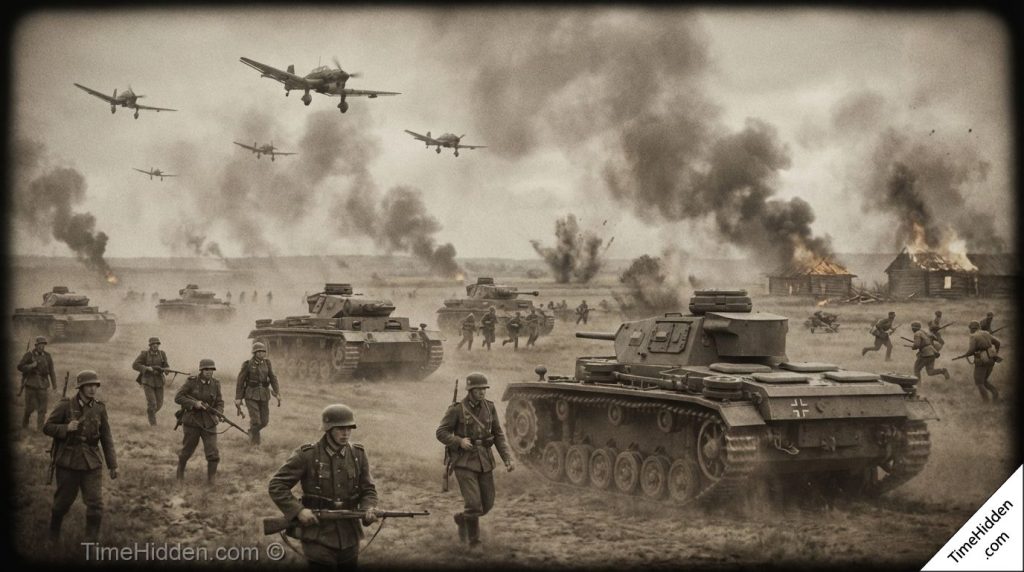
Operation Barbarossa was the largest and most ambitious military operation ever launched in human history. Initiated on 22 June 1941, it marked Nazi Germany’s invasion of the Soviet Union and fundamentally reshaped the course of World War II. Conceived as a rapid campaign to destroy Soviet military power and seize vast territories in Eastern Europe, the operation extended across thousands of kilometers and involved millions of soldiers, aircraft, and armored vehicles. Adolf Hitler believed that a swift and decisive victory in the east would secure Germany’s dominance over Europe and provide the resources necessary to sustain a long-term global war.
Instead of a short campaign, Operation Barbarossa evolved into a prolonged and exhausting conflict that exposed the limits of German military power. The invasion triggered one of the most destructive theaters of war, characterized by massive troop movements, intense logistical challenges, and unprecedented human suffering. It transformed the Soviet Union into Germany’s most formidable enemy and turned the Eastern Front into the central battleground of World War II. Understanding Operation Barbarossa is essential to comprehending why the war ultimately ended in the defeat of Nazi Germany.
Historical Background
In August 1939, Germany and the Soviet Union shocked the world by signing the Molotov–Ribbentrop Pact, a non-aggression agreement that included secret clauses dividing Eastern Europe into spheres of influence. This pact allowed Hitler to invade Poland without fear of Soviet intervention, while the Soviet Union expanded its influence westward. Despite this temporary alliance, Hitler never abandoned his ideological hostility toward communism. From the beginning, he viewed the Soviet Union as a future enemy.
Following the rapid defeat of France in June 1940, Germany stood at the height of its power. Western Europe was largely under Nazi control, and Britain remained isolated. Hitler believed that defeating the Soviet Union would remove Britain’s last potential ally on the European continent and force London to seek peace. Additionally, the vast lands of the Soviet Union promised agricultural resources, oil, and raw materials that Germany desperately needed.
German military planning for an eastern invasion began in the summer of 1940. The plan, code-named Operation Barbarossa after the medieval Holy Roman Emperor Frederick Barbarossa, envisioned a lightning-fast campaign lasting only a few months. The German High Command assumed that the Red Army was poorly led and would collapse under the weight of a coordinated assault. This underestimation of Soviet resilience and industrial capacity would prove to be a critical error.
Main Events
Timeline of Operation Barbarossa
-
July 1940 – December 1940: Initial planning and intelligence assessments for the invasion
-
March – May 1941: Final troop deployments along the Soviet border
-
22 June 1941: Operation Barbarossa begins with a massive surprise attack
-
June – July 1941: Rapid German advances and large-scale encirclements
-
August – September 1941: Battles for Kiev and Smolensk
-
October 1941: Launch of Operation Typhoon toward Moscow
-
December 1941: Soviet counteroffensive halts the German advance
The Opening Assault
In the early hours of 22 June 1941, German forces launched a coordinated invasion along a front stretching from the Baltic Sea to the Black Sea. Without a formal declaration of war, German troops crossed the Soviet border, supported by extensive air operations. The invasion force consisted of over three million Axis soldiers, organized into three massive army groups.
-
Army Group North advanced toward Leningrad.
-
Army Group Center aimed at Moscow, the Soviet capital.
-
Army Group South moved into Ukraine, targeting key agricultural and industrial regions.
The initial phase of the invasion was marked by rapid movement and surprise. German armored units penetrated deep into Soviet territory, encircling large formations of the Red Army. Poor communication and outdated tactics hampered Soviet responses, allowing German forces to achieve significant early successes.
Early German Successes
During the summer of 1941, German forces achieved some of the largest encirclements in military history. Major Soviet formations were surrounded near Minsk, Smolensk, and Kiev. These victories reinforced German confidence and seemed to confirm Hitler’s belief that the Soviet Union would collapse quickly.
However, these rapid advances created serious logistical challenges. Supply lines stretched hundreds of kilometers across damaged infrastructure. Roads were inadequate, rail systems were incompatible with German equipment, and fuel shortages became increasingly common. Meanwhile, Soviet forces continued to mobilize deeper within the country.
The Drive Toward Moscow
By September 1941, German leaders debated their next move. Hitler prioritized economic targets in Ukraine and the Caucasus, while many generals urged a direct push toward Moscow. The delay allowed the Soviet Union valuable time to regroup and strengthen defenses around the capital.
In October, Germany launched Operation Typhoon, a renewed offensive aimed at capturing Moscow before winter. Initial advances again achieved encirclements, but deteriorating weather slowed movement. Autumn rains turned roads into mud, severely hindering vehicles and supply convoys. As temperatures dropped, German troops faced harsh conditions for which they were unprepared.
Soviet Resistance and Counteroffensive
Despite enormous losses earlier in the campaign, the Soviet Union demonstrated remarkable resilience. Factories were relocated east of the Ural Mountains, preserving industrial output. Fresh divisions, including troops from Siberia, were deployed to defend Moscow after intelligence confirmed that Japan would not attack the Soviet Far East.
In early December 1941, the Red Army launched a large-scale counteroffensive. German forces, exhausted and overstretched, were pushed back from the outskirts of Moscow. For the first time in the war, a major German offensive had been decisively halted.
Key Figures
German Leadership
-
Adolf Hitler: Supreme commander of German forces and the driving force behind the invasion. His strategic decisions increasingly overruled military professionals.
-
Field Marshal Walther von Brauchitsch: Commander-in-Chief of the German Army during the early stages of the operation.
-
General Franz Halder: Chief of the Army General Staff, responsible for operational planning.
Soviet Leadership
-
Joseph Stalin: Leader of the Soviet Union, initially shocked by the invasion but later played a central role in mobilizing national resistance.
-
Georgy Zhukov: One of the Soviet Union’s most capable commanders, instrumental in organizing the defense of Moscow.
-
Semyon Timoshenko: Soviet defense minister during the early phase of the invasion.
Military and Civilian Contributors
Beyond top commanders, millions of soldiers and civilians shaped the course of Operation Barbarossa. Soviet workers relocated factories, repaired infrastructure, and supported the war effort under extreme conditions. Their contributions were essential to sustaining resistance against the invasion.
Significance and Impact
Operation Barbarossa was a turning point in World War II. Strategically, it opened a vast second front that Germany was ill-equipped to sustain. The failure to defeat the Soviet Union in 1941 destroyed the myth of German invincibility and marked the beginning of a prolonged war of attrition.
The invasion also transformed the Soviet Union into a central member of the Allied coalition. Economic and military cooperation between the Soviet Union, Britain, and later the United States significantly strengthened Allied capabilities. The Eastern Front absorbed the majority of German military resources for the remainder of the war, reducing pressure on other fronts.
From a military perspective, Operation Barbarossa demonstrated the limits of rapid offensive warfare when logistical planning and long-term strategy are inadequate. It highlighted the importance of industrial capacity, manpower reserves, and national resilience in modern warfare. The lessons learned from this campaign influenced military doctrine long after the war ended.
Conclusion
Operation Barbarossa stands as one of the most consequential military campaigns in history. What began as a bold attempt to secure a swift victory evolved into a struggle that reshaped the balance of power in World War II. The invasion exposed critical weaknesses in German planning and revealed the depth of Soviet determination and capacity for recovery.
By failing to achieve its objectives, Operation Barbarossa ensured that Germany would face a long and exhausting conflict on the Eastern Front. The campaign’s outcome not only sealed the fate of Nazi Germany but also defined the geopolitical landscape of postwar Europe. As a result, Operation Barbarossa remains a powerful example of how ambition, ideology, and miscalculation can combine to alter the course of global history.