
World War II Battles: The Battle of Midway
Introduction
The Battle of Midway, fought in early June 1942, stands as one of the most decisive naval engagements in World War II and a defining turning point in the Pacific War. Occurring just six months after the Attack on Pearl Harbor, the battle dramatically altered the strategic balance between the United States and Imperial Japan. At Midway, a small American force confronted a powerful Japanese fleet that had dominated the Pacific through a series of rapid and successful offensives. What unfolded was not a contest of sheer numbers alone, but a struggle shaped by intelligence, leadership, timing, and strategic foresight.
Unlike earlier clashes in the Pacific, the Battle of Midway was primarily an aircraft carrier battle in which opposing fleets rarely saw one another directly. Aircraft launched from carriers and island airfields became the decisive instruments of combat. Although Japan entered the battle with experienced crews and a strong naval tradition, the United States capitalized on critical intelligence breakthroughs and effective command decisions. The result was a victory that halted Japanese expansion, restored American confidence, and shifted the momentum of the war. Midway demonstrated that the Pacific conflict would be long, complex, and ultimately determined by industrial strength and strategic adaptability.
Historical Background
In the months following Pearl Harbor, Japan achieved a series of stunning victories across the Pacific and Southeast Asia. American, British, and Dutch forces were driven back as Japanese troops captured the Philippines, Malaya, Singapore, and the Dutch East Indies. The Imperial Japanese Navy appeared nearly unstoppable, possessing a formidable carrier force and highly trained aircrews.
Despite these successes, Japanese leaders recognized that the United States remained a dangerous opponent. American industrial capacity far exceeded that of Japan, and time favored a prolonged American war effort. Admiral Isoroku Yamamoto, commander of the Japanese Combined Fleet, believed that Japan must deliver another decisive blow to weaken American naval power and force the United States into negotiations. His plan focused on Midway Atoll, a small but strategically important island northwest of Hawaii.
Midway served as an advanced American outpost and a key link in the defense of Hawaii. Yamamoto believed that attacking Midway would draw out the remaining American aircraft carriers, which could then be destroyed in a decisive fleet engagement. If successful, Japan would gain a stronger defensive perimeter and maintain the initiative in the Pacific.
Unbeknownst to Japanese planners, American naval intelligence had achieved a major breakthrough. Through careful analysis of intercepted communications, U.S. codebreakers determined that a Japanese operation targeting “AF” referred to Midway. This intelligence allowed American commanders to prepare an ambush, setting the stage for a battle that would hinge on information as much as firepower.
Main Events
Timeline of the Battle of Midway
-
April–May 1942: Japanese planning for the Midway operation; American intelligence identifies Midway as the target.
-
27 May 1942: Japanese invasion force departs for Midway.
-
3 June 1942: American aircraft from Midway conduct initial reconnaissance and attacks.
-
4 June 1942: Main carrier battle occurs; decisive air strikes by U.S. forces.
-
5–6 June 1942: Japanese forces retreat; final engagements conclude.
The Japanese Plan
The Japanese operation was complex and ambitious. Yamamoto divided his forces into several groups, including a carrier strike force under Vice Admiral Chuichi Nagumo, an invasion force bound for Midway, and a main battleship force following behind. This dispersal was intended to confuse the enemy but ultimately reduced mutual support between Japanese units.
Nagumo’s carrier force included four fleet carriers that had participated in the attack on Pearl Harbor. These ships represented the core of Japanese naval aviation power. The plan called for an initial air strike on Midway to neutralize its defenses, followed by preparations to engage American carriers once they appeared.
American Preparations
On the American side, Admiral Chester W. Nimitz, commander of the U.S. Pacific Fleet, made the bold decision to concentrate his limited carrier forces near Midway. Despite losses earlier in the war, the United States was able to deploy three aircraft carriers to the area. Although outnumbered, American commanders relied on surprise and precise timing.
Aircraft stationed on Midway Island itself were also integrated into the defensive plan. While many of these aircraft were older or less capable than Japanese models, they added to the overall pressure on Japanese forces and complicated enemy decision-making.
The Battle Unfolds
In the early hours of 4 June 1942, Japanese aircraft launched a strike against Midway Island. Although damage was inflicted, the island’s defenses were not eliminated. Nagumo now faced a critical decision: whether to prepare a second strike on Midway or rearm his aircraft to attack American carriers, whose presence had been reported.
As Nagumo’s carriers maneuvered and rearmed their aircraft, American carrier-based planes began arriving in waves. Initial American attacks were uncoordinated and suffered heavy losses, but they played a crucial role in distracting Japanese defenses and forcing constant maneuvering.
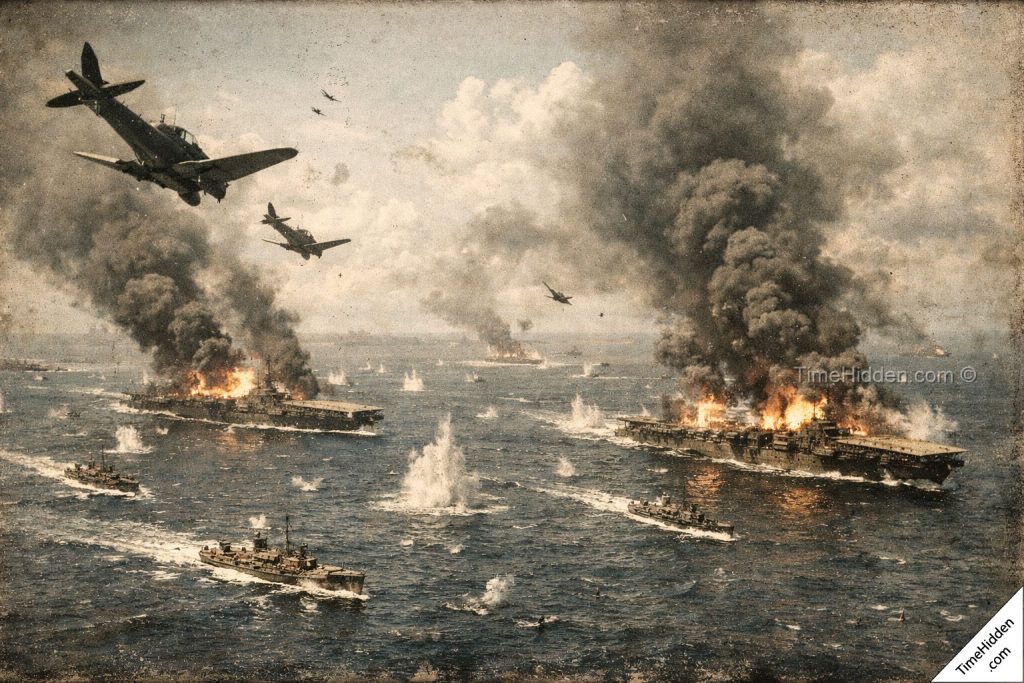
The decisive moment came when American dive bombers arrived over the Japanese fleet at a time when Japanese carriers were particularly vulnerable. In a matter of minutes, multiple Japanese carriers were critically damaged. The sudden shift in fortunes stunned Japanese commanders and reversed the course of the battle.
Japanese Withdrawal
Although Japan attempted to counterattack and inflicted damage on one American carrier, the loss of experienced aircrews and carriers proved decisive. By 5 June, it was clear that the operation had failed. Japanese forces withdrew, abandoning plans to invade Midway. Over the next two days, minor engagements occurred as both sides disengaged, but the outcome was no longer in doubt.
Key Figures
American Commanders
-
Admiral Chester W. Nimitz: Commander of the U.S. Pacific Fleet, whose strategic decisions shaped the American victory.
-
Rear Admiral Raymond A. Spruance: Task force commander who led American carrier operations during the battle.
-
Rear Admiral Frank Jack Fletcher: Senior officer present at Midway, responsible for overall carrier coordination.
Japanese Commanders
-
Admiral Isoroku Yamamoto: Architect of the Midway operation and commander of the Japanese Combined Fleet.
-
Vice Admiral Chuichi Nagumo: Commander of the Japanese carrier strike force at Midway.
Intelligence and Support Personnel
Equally important were the intelligence officers and codebreakers who enabled American success. Their work provided accurate information about Japanese plans and allowed U.S. forces to position themselves effectively. Pilots, deck crews, and support personnel on both sides also played essential roles in executing complex carrier operations under intense pressure.
Significance and Impact
The Battle of Midway marked a fundamental shift in the Pacific War. Strategically, it halted Japanese expansion and destroyed much of the offensive capability of the Imperial Japanese Navy. The loss of several fleet carriers and highly trained aircrews could not be easily replaced, weakening Japan’s ability to conduct large-scale offensive operations.
For the United States, Midway restored confidence after months of setbacks. It demonstrated that Japan could be defeated and that American forces could match and overcome a skilled adversary. The battle also validated the importance of aircraft carriers over battleships as the dominant capital ships of naval warfare.
Midway’s impact extended beyond immediate military outcomes. It allowed the United States to transition from a defensive posture to a gradual offensive strategy across the Pacific. Subsequent campaigns in the Solomon Islands and beyond built upon the momentum gained at Midway.
From a broader perspective, the battle highlighted the decisive role of intelligence, coordination, and leadership in modern warfare. Superior information and timely decision-making proved as important as numerical strength. These lessons influenced naval doctrine and strategy for decades to come.
Conclusion
The Battle of Midway stands as one of the most influential engagements of World War II, not because of its scale alone, but because of its lasting consequences. In a conflict defined by rapid change and technological innovation, Midway demonstrated how preparation, intelligence, and decisive leadership could overcome apparent disadvantages.
By stopping Japanese expansion and shifting the strategic initiative to the United States, Midway reshaped the course of the Pacific War. It marked the beginning of a sustained Allied advance that would ultimately lead to victory in 1945. As such, the Battle of Midway remains a powerful example of how a single battle, fought far from the world’s great capitals, can alter the direction of global history.