
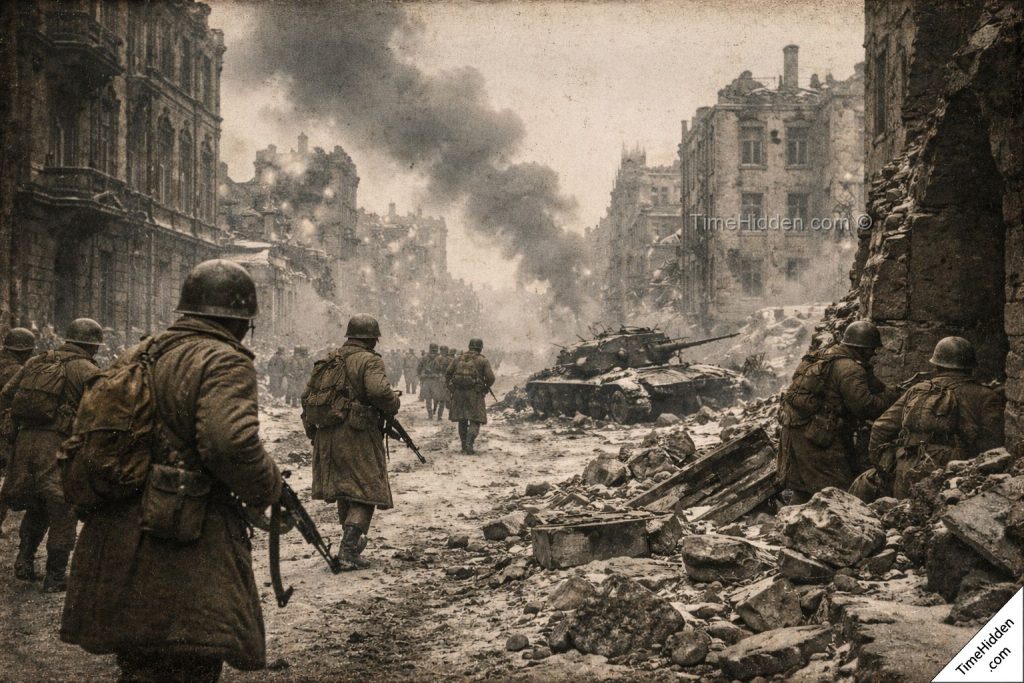
World War II Battles: The Battle of Stalingrad
Introduction
The Battle of Stalingrad stands as one of the most significant and decisive confrontations of World War II. Fought between August 1942 and February 1943, it marked a dramatic turning point on the Eastern Front and reshaped the trajectory of the global conflict. What began as a German offensive aimed at securing strategic resources and breaking Soviet resistance evolved into a prolonged and exhausting struggle that tested the limits of both armies. The city of Stalingrad, situated along the Volga River, became a focal point not only for its strategic location but also for its symbolic value to both sides.
For Nazi Germany, victory at Stalingrad promised control of southern Soviet territories and a path toward the oil-rich Caucasus. For the Soviet Union, defending the city became a matter of national survival and morale. The battle unfolded over months, involving massive troop deployments, complex maneuvering, and relentless pressure under extreme conditions. Ultimately, the outcome shattered the perception of German invincibility and demonstrated the Soviet Union’s capacity to absorb setbacks, adapt strategically, and reclaim the initiative. The Battle of Stalingrad remains a defining moment in modern military history and a powerful symbol of endurance and strategic transformation.
Historical Background
By the summer of 1942, World War II had entered a critical phase on the Eastern Front. Germany’s invasion of the Soviet Union in June 1941, known as Operation Barbarossa, had initially achieved remarkable successes. German forces advanced deep into Soviet territory, capturing vast areas and inflicting heavy losses on the Red Army. However, the failure to seize Moscow before winter marked the first major setback for the German campaign.
In 1942, Adolf Hitler shifted his strategic focus southward. Rather than renewing a direct push toward Moscow, German leadership prioritized economic objectives, particularly the oil fields of the Caucasus. Securing these resources was seen as essential for sustaining Germany’s war effort. To support this southern strategy, control of the Volga River became critical, as it served as a major transportation route linking central Russia with the Caspian region.
Stalingrad, an important industrial city bearing the name of Soviet leader Joseph Stalin, stood directly in the path of this strategy. Its capture would disrupt Soviet logistics, protect the German flank during the Caucasus campaign, and deliver a symbolic blow to Soviet morale. For the Soviet leadership, losing the city was unacceptable. As a result, both sides committed enormous resources to what would become one of the longest and most intense battles of the war.
Main Events
Timeline of the Battle of Stalingrad
-
June–July 1942: German summer offensive begins in southern Soviet Union.
-
23 August 1942: German forces reach the outskirts of Stalingrad.
-
September–October 1942: Intense fighting within the city; Soviet defenses hold key positions.
-
19 November 1942: Soviet counteroffensive, Operation Uranus, is launched.
-
23 November 1942: German Sixth Army is encircled near Stalingrad.
-
December 1942: German attempts to relieve the encircled forces fail.
-
January–February 1943: Soviet forces tighten the encirclement.
-
2 February 1943: Remaining German forces surrender; battle ends.
German Advance Toward Stalingrad
The German summer offensive of 1942, known as Case Blue, aimed to secure southern Soviet territories. Army Group South was divided into two elements: one advancing toward the Caucasus and the other moving toward Stalingrad. Initially, German forces advanced rapidly, benefiting from experience, coordination, and mobility.
By late August, German units reached the outskirts of Stalingrad. Confident of victory, German commanders expected the city to fall quickly. However, Soviet resistance proved far more determined than anticipated. Soviet forces, reinforced by troops brought across the Volga River, established defensive positions that slowed the German advance.
Fighting for the City
From September onward, the battle became a grinding struggle for control of urban areas. The city’s layout, with factories, residential districts, and industrial zones, limited the effectiveness of German mobility and air support. Soviet defenders adapted by emphasizing close coordination and flexible defensive tactics, preventing German forces from achieving a decisive breakthrough.
The Soviet High Command recognized that holding Stalingrad required constant reinforcement and careful management of limited resources. Supply routes across the Volga were maintained despite heavy pressure, ensuring that defenders could continue resisting. German forces, meanwhile, became increasingly focused on capturing remaining Soviet-held areas, committing more troops and resources to the city than originally planned.
Soviet Counteroffensive: Operation Uranus
While German attention remained fixed on Stalingrad itself, Soviet planners prepared a large-scale counteroffensive. Rather than attacking the strongest German positions in the city, the Soviet strategy targeted weaker Axis forces guarding the flanks, composed largely of allied units with limited equipment.
On 19 November 1942, Soviet forces launched Operation Uranus, striking north and south of Stalingrad. The offensive achieved rapid success, breaking through defensive lines and advancing toward key junctions. Within days, Soviet forces linked up west of the city, encircling the German Sixth Army.
Encirclement and German Response
The encirclement of German forces marked a dramatic reversal of fortunes. Trapped within a shrinking perimeter, German commanders requested permission to break out. Adolf Hitler, however, ordered the Sixth Army to hold its position, promising that supplies would be delivered by air.
This decision proved critical. Air transport was unable to meet the needs of the encircled forces, especially as winter conditions worsened. German attempts to relieve the encirclement from the outside, including Operation Winter Storm, failed to achieve their objectives.
Final Soviet Offensive and Conclusion of the Battle
By January 1943, Soviet forces launched a final series of coordinated offensives to eliminate the encircled German troops. Gradually, resistance diminished as conditions deteriorated and options narrowed. On 31 January and 2 February 1943, the remaining German forces surrendered, bringing the Battle of Stalingrad to an end.
Key Figures
German Leadership
-
Adolf Hitler: German leader whose strategic decisions, including the refusal to authorize a breakout, heavily influenced the outcome.
-
Field Marshal Friedrich Paulus: Commander of the German Sixth Army, responsible for operations at Stalingrad.
-
General Hermann Hoth: Commander of German armored forces involved in relief attempts.
Soviet Leadership
-
Joseph Stalin: Leader of the Soviet Union, who prioritized the defense and eventual recapture of Stalingrad.
-
Georgy Zhukov: Senior Soviet commander who played a central role in planning the counteroffensive.
-
Aleksandr Vasilevsky: Chief of the Soviet General Staff and key architect of Operation Uranus.
-
Vasily Chuikov: Commander of Soviet forces defending Stalingrad during the most intense phases.
Broader Participants
Beyond senior commanders, the battle involved millions of soldiers, engineers, logisticians, and support personnel. Soviet industrial workers, transportation crews, and planners played an essential role in sustaining the defense and enabling the counteroffensive.
Significance and Impact
The Battle of Stalingrad represented a decisive turning point in World War II. It was the first time an entire German field army was destroyed, delivering a profound psychological and strategic blow to Nazi Germany. The defeat undermined confidence among Germany’s allies and forced a fundamental reassessment of German strategy on the Eastern Front.
For the Soviet Union, Stalingrad became a powerful symbol of resilience and recovery. The victory demonstrated the effectiveness of Soviet operational planning, coordination, and industrial mobilization. From this point onward, the Red Army increasingly seized the initiative, launching a series of offensives that pushed German forces westward.
The battle also highlighted broader lessons of modern warfare. It underscored the importance of logistics, adaptability, and realistic strategic objectives. The failure of Germany to account for Soviet resilience and the demands of prolonged operations proved decisive.
In the global context, Stalingrad strengthened Allied confidence and cooperation. It confirmed that Germany could be defeated and marked the beginning of a sustained shift in momentum that would eventually lead to Allied victory in Europe.
Conclusion
The Battle of Stalingrad stands as one of the most consequential engagements in the history of warfare. What began as a German offensive aimed at securing resources and strategic advantage evolved into a prolonged struggle that reshaped the balance of power on the Eastern Front. Through determined defense, careful planning, and a decisive counteroffensive, the Soviet Union achieved a victory that altered the course of World War II.
Beyond its immediate military outcome, Stalingrad became a symbol of endurance, strategic adaptation, and the high stakes of total war. The battle demonstrated that determination, planning, and national mobilization could overcome even the most formidable adversaries. As such, the Battle of Stalingrad remains a central chapter in understanding how World War II was ultimately decided.