
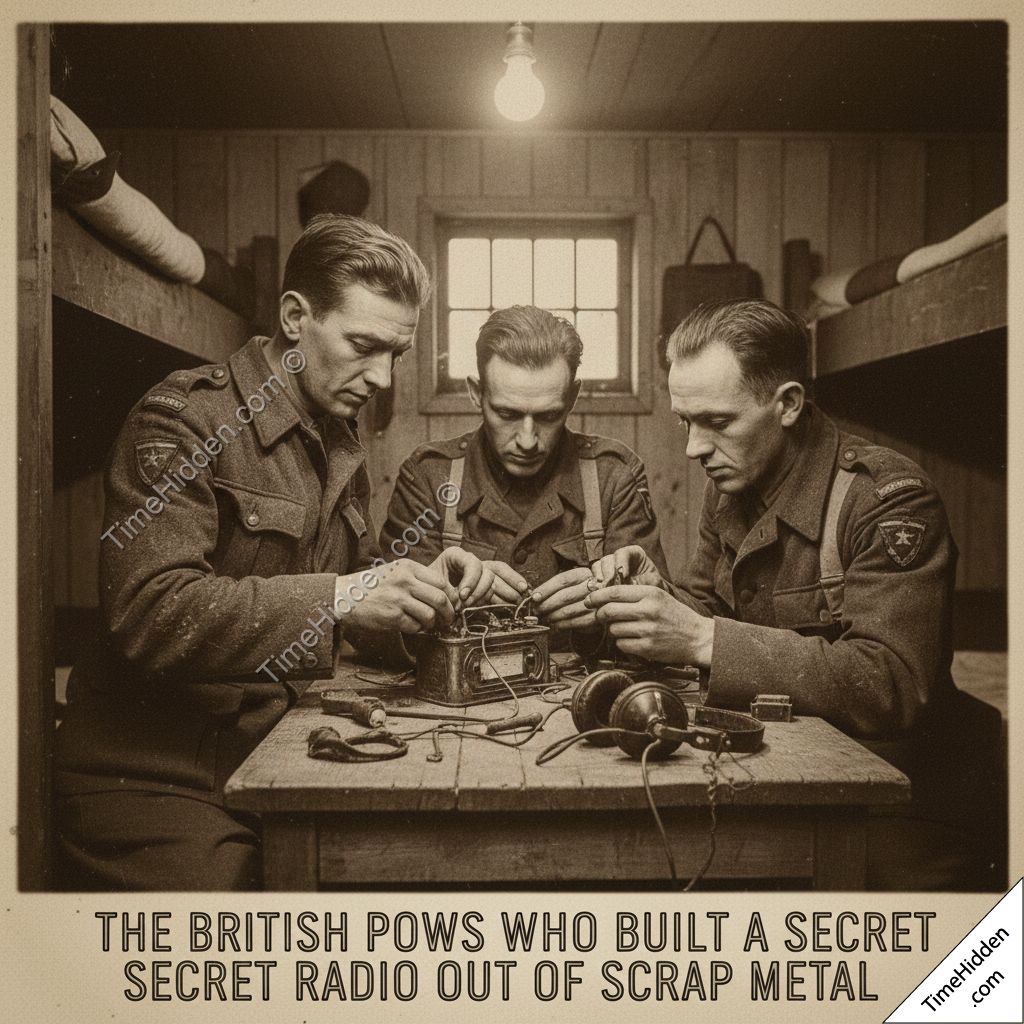
It was 1943. Deep inside Stalag Luft III, one of Nazi Germany’s most heavily guarded prisoner-of-war camps, hundreds of Allied airmen waited… and hoped.
Cut off from the world. Cut off from news.
Cut off from the possibility of knowing whether their countries were winning… or losing.
For many, hope faded a little more each day.
But among these men were a handful of British prisoners who refused to accept silence.
They believed information was as powerful as any weapon.
And they were willing to risk everything to get it.
It began with a rumor: somewhere in the camp, a guard had thrown away a broken German radio.
To most, it was useless junk.
To them, it was a miracle.
Piece by piece, under blankets, in dim corners, inside hidden workshops disguised as “hobby rooms,” they scavenged.
A coil of copper wire from a boot heel.
A razor blade polished into a crude diode.
A tuning coil wound around a wooden bobbin stolen from the laundry.
Dusty headphones ripped from an old intercom.
Every part was forbidden.
Every part was deadly if discovered.
Yet they worked anyway.
Quietly. Methodically.
Hearts pounding with every footstep of a guard.
They hid their creation inside a hollowed-out table leg… so perfectly disguised that no German officer ever thought to tap it.
When the radio finally sparked to life, it wasn’t beautiful.
It wasn’t powerful.
But it worked.
And for the first time in months… the men heard the voice of the BBC.
A whisper.
A lifeline.
A reminder that the world outside the barbed wire still existed.
Word spread through the camp like electricity.
Every night, a tiny group gathered in absolute silence, listening to the news the Germans tried so hard to hide.
They heard about the Allies landing in Italy.
They heard about the turning tide in the east.
They heard that hope was not foolish… but justified.
With every broadcast, morale rose.
And with rising morale came something even more dangerous: unity.
The Germans searched.
They inspected.
They interrogated.
But they never found the radio.
By the end of the war, it had passed through more than a dozen hiding places—inside furniture, inside food crates, even buried under the floorboards during surprise inspections.
And when the camp was finally liberated in 1945, the POWs refused to leave without it.
Not because it was a machine…
but because it had kept them alive.
A radio built from trash.
Scrap metal.
Broken parts.
But to them, it was proof that even in the darkest corners of war, the human spirit can spark something powerful enough to defy an empire.
And sometimes, hope…
is the strongest signal of all.