
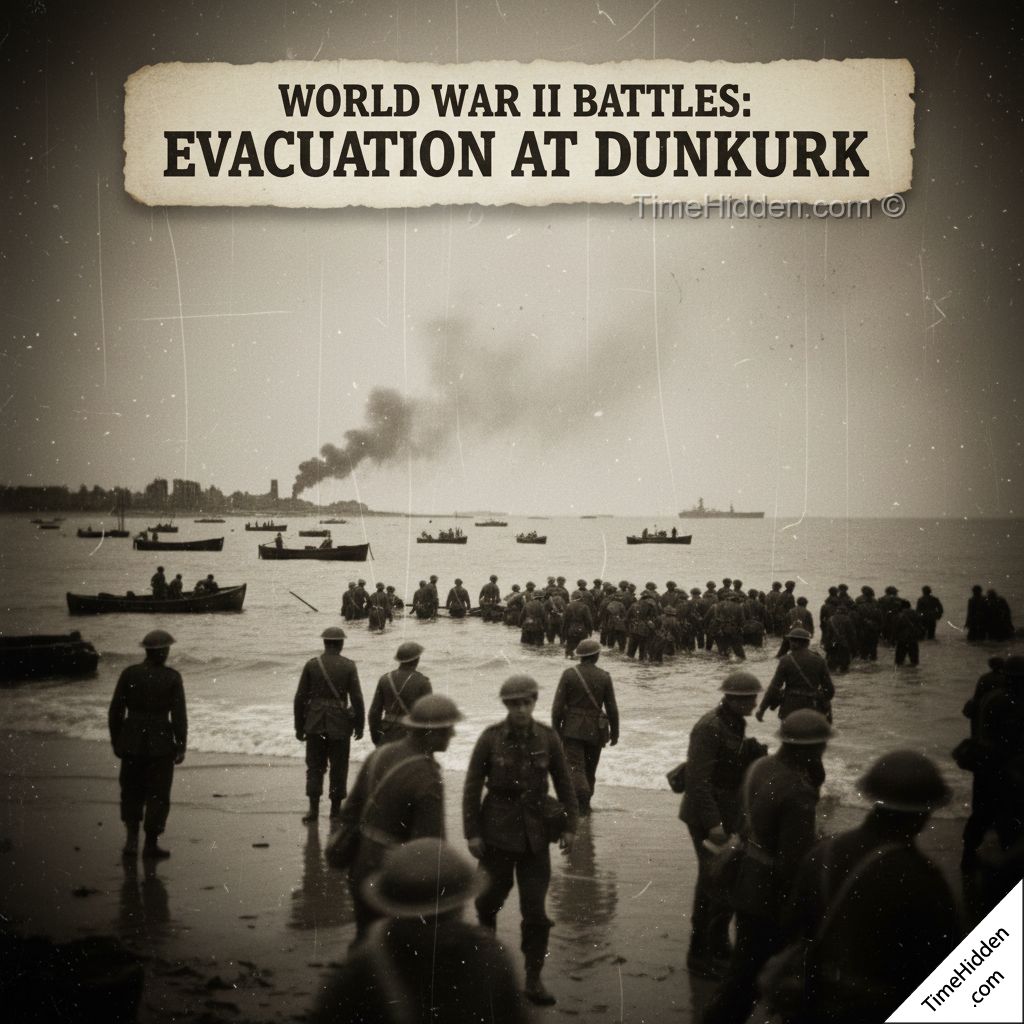
World War II Battles: Evacuation at Dunkirk
Introduction
The Evacuation at Dunkirk, known as Operation Dynamo, remains one of the most dramatic and inspiring events of World War II. Taking place between May 26 and June 4, 1940, the operation was not a traditional battle but a desperate rescue mission that saved the British Expeditionary Force (BEF) and thousands of Allied soldiers from complete destruction. Trapped on the beaches of northern France after the rapid German advance through the Low Countries, nearly 400,000 British, French, and Belgian troops faced annihilation. Yet through a combination of improvisation, naval strength, civilian bravery, and a crucial pause by German forces, more than 330,000 soldiers were successfully evacuated. Although technically a retreat, Dunkirk came to symbolize determination, unity, and hope. The event reshaped British morale, influenced global perceptions of the war, and enabled the continuation of Allied resistance against Nazi Germany.
Historical Background
In May 1940, Germany launched Fall Gelb (Case Yellow), a daring offensive that targeted Belgium, the Netherlands, and northern France. Instead of repeating World War I’s frontal attack, German forces executed the Ardennes breakthrough, cutting behind the main Allied armies and driving rapidly toward the English Channel. The stunning victory at Sedan opened the path for German Panzer divisions to sweep across northern France, severing the connection between the BEF and the rest of the French Army.
By mid-May, the Allied position had deteriorated rapidly. Despite early advances into Belgium, the British and French soon realized they were being encircled. German forces under General Gerd von Rundstedt and Heinz Guderian raced westward, eventually reaching the coast near Abbeville on May 20. This maneuver trapped the BEF, several French armies, and remnants of the Belgian Army in a shrinking pocket around the port city of Dunkirk.
Cut off, low on supplies, and under constant attack from ground and air forces, the Allies faced total defeat. British Prime Minister Winston Churchill and the War Cabinet recognized that saving the army—even through a painful evacuation—was essential to continue the war effort. On May 26, they approved the launch of Operation Dynamo, the largest rescue operation in British history.
Timeline of Key Events
May 20–25, 1940: The Encirclement Tightens
German Panzer divisions reach the Channel coast. Allied attempts to break the encirclement fail. Dunkirk is identified as the only viable evacuation point.
May 26: Operation Dynamo Begins
British naval forces begin organizing a massive evacuation effort. Destroyers, transport ships, merchant vessels, and civilian boats are mobilized.
May 27–28: First Evacuations and Heavy Bombing
German artillery and the Luftwaffe bombard Dunkirk. The first large groups of soldiers begin loading onto ships under fire.
May 29: Harbor Damage and Shift to the Beaches
Air raids destroy the harbor’s facilities. Evacuation must rely heavily on the beaches, requiring small boats to ferry soldiers to larger ships offshore.
May 30–31: Peak Evacuation Period
German ground forces close in, but the pace of evacuation accelerates. Tens of thousands of British and French troops are saved each day.
June 1–2: Allied Rearguard Defends the Perimeter
French divisions and remaining British units fight desperately to hold back German attacks. More French troops are taken off during nighttime operations.
June 3–4: Final Withdrawals
The last British units depart on June 3. On June 4, Operation Dynamo officially ends with evacuation of remaining French defenders. In total, over 338,000 soldiers are rescued.
Major Events and Operational Overview
1. The Strategic Crisis at Dunkirk
The Allied collapse in northern France was one of the most rapid and catastrophic strategic defeats in modern history. With Germany’s Blitzkrieg proving unstoppable, British and French commanders were soon overwhelmed. The BEF, under General Lord Gort, began withdrawing toward the coast as early as May 23, fearing encirclement. Decision-making grew chaotic as communication broke down, French political leadership faltered, and German mobility outpaced Allied reactions.
Despite intense pressure, the British government resolved that preserving the army was more important than holding ground. Without the BEF, Britain would have lacked the manpower to defend the homeland or to support future operations. Dunkirk, with its long beaches and breakwaters, offered the only realistic evacuation site.
2. The Halt Order: Germany’s Critical Mistake
One of the most debated decisions of the entire campaign was the German Halt Order, issued on May 24. Adolf Hitler, influenced by Rundstedt and fearing a potential Allied counterattack in the marshy Flanders terrain, ordered the Panzer divisions to stop their advance. Hermann Göring assured Hitler that the Luftwaffe could finish the job and destroy the trapped armies.
This pause—lasting nearly 48 hours—proved crucial. It gave the Allies enough time to stabilize defensive positions around Dunkirk and begin the evacuation. When the Panzer divisions finally resumed the offensive, the Allies had gained an invaluable window of survival.
3. Luftwaffe Attacks and the Firestorm Over Dunkirk
From the beginning, Dunkirk was subjected to relentless air raids. The Luftwaffe targeted ships, beaches, harbor infrastructure, and the town itself. Bombs ignited massive oil storage tanks, creating dark smoke clouds visible from miles away.
However, the Royal Air Force (RAF) played a critical but often misunderstood role. Although many soldiers on the beaches felt abandoned, the RAF conducted intense air battles inland, preventing larger, more devastating attacks on the evacuation zone. Fighter squadrons such as No. 54 and No. 74 engaged German bombers daily, suffering heavy losses but ensuring the operation continued.
4. The “Little Ships” of Dunkirk
One of the most iconic elements of Operation Dynamo was the use of civilian boats—known collectively as the “Little Ships”. These included fishing boats, pleasure yachts, ferries, tugs, and even small motorboats. Many were piloted by Navy personnel, but others were captained by civilian volunteers.
Their role was essential because large destroyers could not approach shallow beaches. The Little Ships ferried soldiers from the sandbanks to the larger naval vessels waiting offshore. Over 700 of these boats participated, turning the evacuation into a symbol of national unity and civilian courage.
5. The Rearguard: Holding the Line
While hundreds of thousands of troops escaped the beaches, thousands of others stayed behind to fight as a rearguard. These included British units such as the 2nd Battalion Warwickshire Regiment and French divisions including the 12th Motorized Infantry Division.
Their mission was heroic and grim: delay the German advance long enough to allow others to escape. The rearguard suffered heavy casualties and many were taken prisoner, but their sacrifice made the evacuation possible.
6. Completing the Evacuation
Peak evacuation occurred on May 30–31, when nearly 70,000 men were rescued in a single day. Despite worsening conditions and heavy bombing, the Royal Navy continued to push ships into the harbor and hold evacuation stations throughout the night.
By June 4, when the Germans finally captured Dunkirk, the bulk of the BEF and many French soldiers were already across the Channel. Operation Dynamo had exceeded all expectations.
Key Figures Involved
British Leadership
-
Admiral Bertram Ramsay – Architect and commander of Operation Dynamo; directed naval coordination from Dover.
-
General Lord Gort – Commander of the BEF; made critical decisions to pull back toward Dunkirk.
-
Winston Churchill – British Prime Minister; his leadership ensured national resolve and continued resistance.
-
Vice Admiral Frederick Wake-Walker – Managed evacuation operations from Dunkirk’s beaches and harbor.
-
Air Chief Marshal Hugh Dowding – Oversaw RAF Fighter Command during the evacuation.
German Leadership
-
Adolf Hitler – Approved the Halt Order that unintentionally aided the evacuation.
-
Hermann Göring – Promised the Luftwaffe could prevent evacuation; his miscalculation proved costly.
-
Gerd von Rundstedt – Supported the Panzer halt due to concerns about terrain.
-
Heinz Guderian – Leader of one of the main German armored thrusts, though temporarily restrained by the Halt Order.
French and Belgian Commanders
-
General Maxime Weygand – French Commander-in-Chief during the crisis.
-
General Jean-Baptiste Blanchard – Commanded French First Army, many of whose units fought in the rearguard.
-
King Leopold III of Belgium – His army surrendered on May 28, complicating the Allied position.
Significance and Impact
1. A Strategic Defeat but a Moral Victory
Militarily, Dunkirk was a retreat forced by German superiority. Yet the scale of the evacuation transformed it into a symbol of resilience. Britain celebrated the event as a “miracle of deliverance,” a phrase coined by Churchill.
This morale boost was vital at a time when France was collapsing and invasion seemed imminent.
2. Preservation of the British Army
Without the successful rescue of over 330,000 soldiers, Britain would likely have been unable to continue the war. The BEF formed the nucleus of future Allied armies, including those that returned to liberate Europe in 1944.
3. Influence on Global Politics
Dunkirk strengthened Britain’s international standing. The United States, then officially neutral, viewed the evacuation sympathetically and increased material support soon after, laying foundations for the Lend-Lease program.
4. German Overconfidence and Miscalculation
The Halt Order became an infamous strategic blunder. Had the Panzers pressed forward, the entire BEF might have been destroyed or surrendered. Instead, Germany’s partial reliance on air power allowed the Allies a narrow escape.
5. The Beginning of Britain’s “Finest Hour”
Dunkirk set the stage for the Battle of Britain. Emboldened by the successful evacuation, Britain refused to contemplate surrender. Churchill’s speeches surged in power, reinforcing both national unity and international admiration.
Conclusion
The Evacuation at Dunkirk stands as one of the most remarkable episodes in World War II. What began as a desperate retreat turned into a triumph of organization, determination, and courage. Through the combined efforts of civilians, sailors, soldiers, and airmen, hundreds of thousands of lives were saved from the brink of disaster. The operation preserved Britain’s ability to fight on, bolstered the nation’s morale, and became a symbol of hope in one of history’s darkest hours. Although a tactical setback, Dunkirk’s success ensured that the Allies would survive long enough to rebuild, regroup, and ultimately return to liberate Europe. It remains a powerful reminder that even in the face of overwhelming odds, resilience and unity can shape the course of history.