
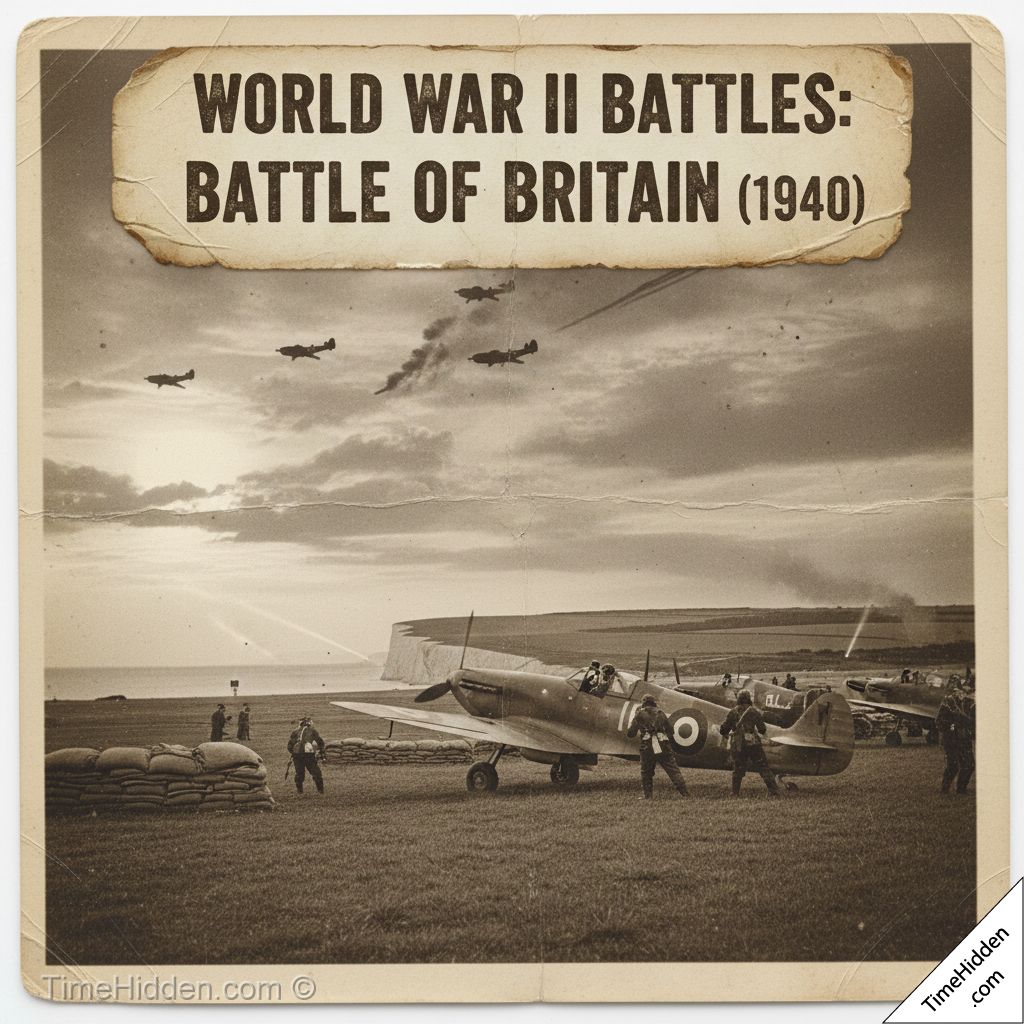
World War II Battles: Battle of Britain
Introduction
The Battle of Britain stands as one of the most decisive air campaigns in world history and a defining moment in World War II. Fought between July and October 1940, the conflict marked the first major military campaign fought entirely by air forces. After the fall of France in June 1940, Nazi Germany expected Britain to surrender or negotiate peace. Instead, Britain chose to resist, setting the stage for a clash between the Royal Air Force (RAF) and the Luftwaffe, the powerful German air force. This confrontation not only determined the fate of the United Kingdom but also shaped the strategic direction of the entire war. The battle demonstrated the importance of air superiority, showcased the resilience of the British people, and ultimately delivered Adolf Hitler his first major defeat. Through a mixture of technology, intelligence, effective leadership, and the unbreakable spirit embodied by Winston Churchill’s declaration—“The Few”—Britain managed to withstand the might of Germany at the height of its power.
Historical Background
The origins of the Battle of Britain lie in the dramatic and rapid conquests made by Germany during the first nine months of World War II. By the summer of 1940, Poland, Denmark, Norway, the Netherlands, Belgium, and France had all fallen to German military advances. This left the United Kingdom standing alone against Hitler’s expanding European empire.
Hitler’s strategic plan at the time, known as Operation Sea Lion, envisioned a full-scale invasion of southern England. However, such an invasion could only succeed if Germany achieved air superiority over the English Channel and the British Isles. The Luftwaffe, led by Hermann Göring, was confident that the RAF could be destroyed within weeks. Göring believed that German bombers and fighters—particularly the Messerschmitt Bf 109 and Junkers Ju 87 Stuka—would easily overpower Britain’s defenses.
On the British side, the nation was preparing for the worst. The evacuation of hundreds of thousands of soldiers from Dunkirk in May–June 1940 had saved manpower but left Britain with a shortage of equipment. Nevertheless, the British possessed two crucial advantages. First, the RAF Fighter Command, under Air Chief Marshal Hugh Dowding, had built a highly organized defense system that incorporated radar technology, the Dowding System, and rapid communication networks. Second, the people of Britain were united under Prime Minister Winston Churchill, who inspired defiance with his speeches, famously stating: “We shall never surrender.”
This combination of technological innovation and national resolve set the foundation for the upcoming air war.
Timeline of Major Events
Phase 1: The Channel Battles (July 10 – August 12, 1940)
The battle began with German attacks on British shipping in the English Channel. The Luftwaffe aimed to lure the RAF into combat while testing British defenses. These engagements were intense but limited in scale. The RAF proved effective at protecting convoys, and the Luftwaffe realized that destroying the RAF would require more direct action.
Phase 2: The Attack on Airfields (August 13 – September 6, 1940)
August 13, known as Adlertag (Eagle Day), marked the Luftwaffe’s full-scale assault on RAF Fighter Command. Airfields, radar stations, and aircraft factories became primary targets. RAF pilots, flying Hawker Hurricanes and Supermarine Spitfires, engaged in near-constant combat, sometimes flying multiple missions per day.
British losses were severe, but German intelligence consistently underestimated RAF strength. Meanwhile, Britain’s home production rapidly replaced lost aircraft. The German decision to avoid consistently destroying radar stations also allowed Britain to maintain its early-warning capabilities.
Phase 3: The London Blitz Begins (September 7 – October 1940)
On September 7, German bombers shifted their focus from military installations to London and other major cities, beginning what became known as the Blitz. The change in target was partly retaliation for a small British raid on Berlin. However, this strategic shift proved to be a critical mistake.
By easing pressure on RAF airfields, the Luftwaffe allowed Fighter Command to recover, reorganize, and strengthen its forces. The RAF seized this opportunity, and September 15 became a turning point. On that day, later known as Battle of Britain Day, the Luftwaffe launched one of its largest daylight attacks. The RAF successfully intercepted and inflicted heavy losses on German formations, convincing Hitler that air superiority would not be achieved.
Phase 4: German Withdrawal (October 1940)
By early October, the Luftwaffe recognized that it had failed to win the battle. German losses were mounting, and winter weather made large-scale operations increasingly difficult. Hitler indefinitely postponed Operation Sea Lion, effectively ending Germany’s hopes of invading Britain.
Major Figures Involved
Winston Churchill
As the British Prime Minister, Churchill played an essential leadership role. His speeches motivated the nation and defined the conflict in moral terms. His tribute to the RAF—“Never in the field of human conflict was so much owed by so many to so few”—cemented the pilots’ heroic legacy.
Air Chief Marshal Hugh Dowding
Dowding designed the RAF’s integrated air defense system and insisted on conserving fighter reserves. His strategic decisions were critical to Britain’s survival, though he would later be replaced for political reasons.
Hermann Göring
As commander of the Luftwaffe, Göring made several strategic errors, including underestimating the RAF, misreading intelligence, and shifting attacks from airfields to cities. These miscalculations greatly contributed to Germany’s defeat.
The Pilots: “The Few”
The RAF’s frontline fighters were a diverse group, including not only British pilots but also men from Poland, Czechoslovakia, Canada, Australia, New Zealand, South Africa, and even the United States. Polish pilots, in particular, were renowned for their skill and aggressiveness.
Key Events and Turning Points
The Dowding System
Britain’s revolutionary integrated air defense network used radar, ground observers, and centralized command to detect and intercept enemy formations. This system allowed the RAF to concentrate fighters precisely where they were needed and conserve critical resources.
Aircraft Performance
The RAF’s Spitfire was one of the most advanced fighters of the era, excelling in speed and maneuverability. The Hurricane, though older, proved vital in large-scale battles and shot down more enemy aircraft than any other British fighter during the campaign.
German Miscalculations
Several mistakes weakened Germany’s position:
-
underestimating RAF production capabilities
-
shifting to city bombing, relieving pressure on airfields
-
operating at the limits of Bf 109 fuel range
-
misreading British morale (which only strengthened under attack)
British Resilience
Despite the destructive Blitz, the British population maintained a spirit of defiance. Shelters, firewatch volunteers, and civil defense organizations contributed significantly to the nation’s ability to endure sustained bombing.
Significance and Impact
1. Preventing a German Invasion
The most immediate impact was the failure of Operation Sea Lion. Without control of the skies, any invasion attempt would have been a disaster for Germany. By defending its territory, Britain ensured that Germany could not dominate Western Europe entirely.
2. A Turning Point in World War II
The Battle of Britain marked Hitler’s first major defeat. It proved that the Axis powers could be resisted and that modern air power could determine geopolitical outcomes.
3. Boost to Allied Morale
Britain’s survival gave hope to resistance movements across Europe and reassured the United States, which was watching closely before entering the war. The battle strengthened ties between Britain and the U.S., eventually leading to increased American support under the Lend-Lease program.
4. Technological and Tactical Legacy
The battle demonstrated the importance of:
-
radar integration
-
efficient communication networks
-
coordinated air defense
-
fighter-bomber escort requirements
These lessons shaped air combat doctrines for decades.
5. The Symbol of “The Few”
The RAF pilots who fought became symbols of courage and sacrifice. Their legacy continues to influence British national identity and serves as a reminder of the high cost of freedom.
Conclusion
The Battle of Britain was far more than an air campaign; it was a struggle for the survival of a nation and the preservation of democratic values. Through innovative technology, strategic discipline, and unwavering national resolve, Britain withstood one of the most powerful air forces in history. The victory prevented a German invasion, disrupted Hitler’s plans for domination, and marked a crucial turning point in World War II. The battle’s legacy endures not only in military history but also in the collective memory of nations that continue to honor “The Few” who stood against overwhelming odds. Their triumph ensured that Britain remained a free nation and helped pave the way for the eventual defeat of Nazi Germany.