
World War II Battles: Guadalcanal Campaign
Introduction
The Guadalcanal Campaign was a decisive turning point in the Pacific War during World War II. Fought between August 1942 and February 1943, it marked the first major offensive launched by Allied forces against Imperial Japan. Centered on the island of Guadalcanal in the Solomon Islands, the campaign became a prolonged struggle for control of land, sea, and air, shaping the strategic direction of the war in the Pacific.
At stake was more than a remote island. Guadalcanal occupied a critical position along sea routes linking the United States, Australia, and New Zealand. Japanese efforts to construct an airfield there threatened Allied communications and raised fears of further expansion into the South Pacific. For the Allies, stopping this advance and seizing the initiative became an urgent priority.
The campaign unfolded over six intense months, involving a series of land battles, naval engagements, and air operations. Neither side achieved a quick victory. Instead, Guadalcanal became a test of endurance, logistics, leadership, and strategic vision. Its outcome fundamentally altered the balance of power in the Pacific and demonstrated that Japanese expansion could be halted and reversed.
Historical Background
Following the attack on Pearl Harbor in December 1941, Japan rapidly expanded across Southeast Asia and the Pacific, capturing territories and establishing a defensive perimeter. By mid-1942, Japanese forces had seized much of the western Pacific and were advancing southward, aiming to isolate Australia and secure key sea lanes.
Guadalcanal emerged as a focal point when Allied intelligence detected Japanese construction of an airfield on the island. If completed, the airfield would allow Japanese aircraft to threaten Allied shipping routes between the United States and Australia. The island itself had limited infrastructure, but its strategic location made it highly valuable.
The United States and its Allies recognized that allowing Japan to consolidate its position would pose long-term risks. Despite limited resources and ongoing commitments elsewhere, Allied leaders decided to launch an offensive to seize Guadalcanal and nearby islands. This decision marked a shift from defensive operations to a strategy of gradual advance, later known as island hopping.
Japan, for its part, underestimated Allied willingness and capability to launch such an offensive so soon. Japanese planning focused on holding newly captured territories and defending them through a combination of strongpoints and naval power. These differing assumptions set the stage for a prolonged and unexpected campaign.
Main Events
Allied Landings on Guadalcanal (August 1942)
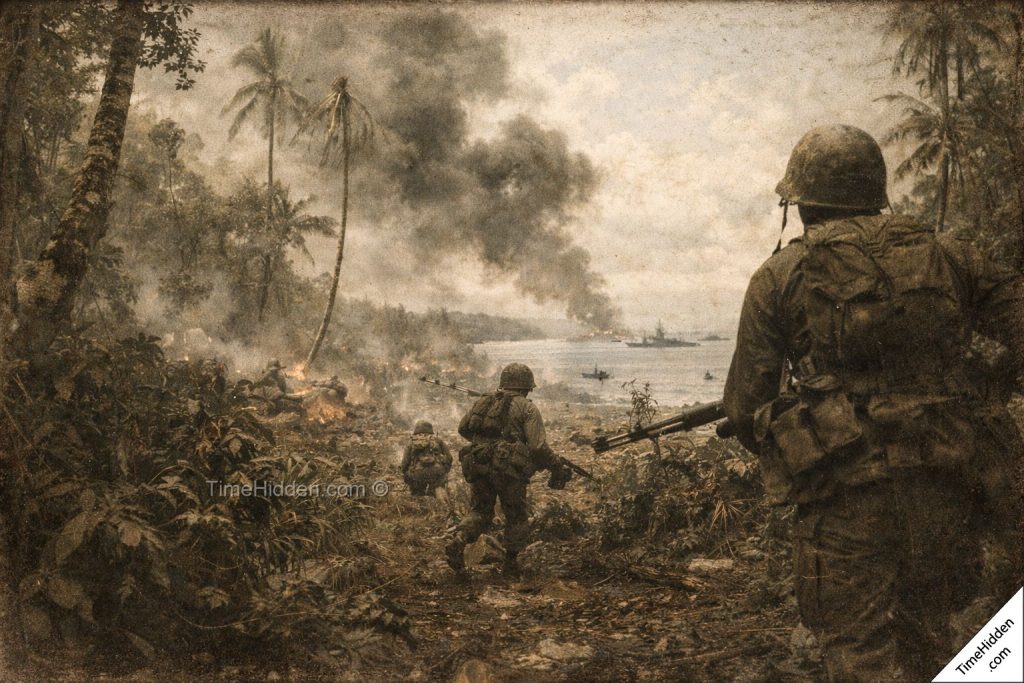
On August 7, 1942, Allied forces, primarily United States Marines, landed on Guadalcanal, Tulagi, and nearby islands. The landings achieved strategic surprise, encountering limited initial resistance. Within days, Allied troops captured the partially completed Japanese airfield, later named Henderson Field.
Securing the airfield became the central objective of the campaign. Control of Henderson Field allowed the Allies to base aircraft on the island, providing crucial air support and limiting Japanese freedom of movement during daylight hours. However, Japanese forces quickly began efforts to retake the island, setting the stage for months of intense fighting.
Naval Battles and Supply Struggles (August–October 1942)
The struggle for Guadalcanal extended beyond land combat. A series of naval engagements unfolded in the surrounding waters as both sides attempted to reinforce and resupply their forces. These included major nighttime battles that tested command, coordination, and tactical skill.
Japanese naval forces sought to deliver troops and supplies under cover of darkness, while Allied forces aimed to intercept these efforts. Control of the seas fluctuated, with losses on both sides. The inability to maintain consistent supply lines became a critical factor, affecting operations on the island and shaping strategic decisions.
Japanese Offensives and Allied Defense (September–October 1942)
Japanese ground forces launched multiple attempts to retake Henderson Field. These operations involved coordinated attacks aimed at overwhelming Allied defenses. Despite being stretched thin and facing challenging conditions, Allied troops held their positions.
Leadership and organization proved decisive. Allied commanders emphasized defensive preparation, effective use of terrain, and coordination with air and naval support. Each failed Japanese offensive further weakened their position and strained their ability to sustain operations.
Turning Point and Allied Consolidation (November 1942)
The campaign reached a critical turning point in November 1942 with a series of major engagements, including intense naval battles off Guadalcanal. These clashes disrupted Japanese efforts to deliver reinforcements and inflicted heavy losses on their naval forces.
With Japanese supply lines increasingly compromised, Allied forces strengthened their hold on the island. Additional troops and equipment arrived, improving defensive depth and enabling limited offensive actions to expand the perimeter around Henderson Field.
Japanese Withdrawal (January–February 1943)
By early 1943, Japanese leadership recognized that holding Guadalcanal was no longer feasible. A decision was made to evacuate remaining forces rather than continue a costly and unsustainable campaign. Through a carefully planned operation, Japanese troops were withdrawn from the island.
In February 1943, Allied commanders confirmed that Guadalcanal was secure. The campaign officially ended, marking the first major Allied victory against Japanese land forces in the Pacific War.
Key Figures
William F. Halsey Jr.
As a senior United States naval commander in the South Pacific, Halsey played a crucial role in directing naval operations and reinforcing Allied resolve during critical phases of the campaign.
Alexander Vandegrift
Commander of the 1st Marine Division, Vandegrift led Allied ground forces during the early and most challenging stages of the campaign. His leadership helped maintain cohesion and defensive effectiveness.
Isoroku Yamamoto
Commander-in-Chief of the Japanese Combined Fleet, Yamamoto oversaw naval operations in support of the Guadalcanal campaign. His efforts reflected the importance Japan placed on controlling the surrounding seas.
Richmond K. Turner
A key Allied naval commander responsible for amphibious operations, Turner coordinated the initial landings and the complex logistics required to sustain forces on Guadalcanal.
Masao Maruyama
A Japanese army commander involved in ground operations on Guadalcanal, Maruyama led efforts to recapture the airfield and demonstrated the challenges Japan faced in coordinating large-scale operations under difficult conditions.
Significance and Impact
The Guadalcanal Campaign had far-reaching consequences for the Pacific War. Strategically, it halted Japanese expansion and shifted the initiative to the Allies. For the first time, Japan was forced onto the defensive, altering the momentum of the conflict.
The campaign demonstrated the importance of joint operations involving land, sea, and air forces. Success depended on effective coordination, logistics, and adaptability rather than rapid conquest. These lessons shaped Allied strategy for subsequent operations across the Pacific.
For Japan, the loss of Guadalcanal represented a significant depletion of experienced personnel and naval strength. The campaign exposed limitations in Japan’s ability to sustain prolonged operations far from its industrial base.
Beyond its military impact, Guadalcanal had psychological significance. It boosted Allied morale and confidence, proving that Japanese forces could be defeated in sustained combat. This victory laid the groundwork for future campaigns that would gradually push Allied forces closer to Japan itself.
Conclusion
The Guadalcanal Campaign stands as a defining chapter in World War II and the history of the Pacific War. It was not a single battle but a complex, extended struggle involving multiple domains of warfare and a wide range of participants. From the initial landings in August 1942 to the final Japanese withdrawal in February 1943, the campaign tested the resolve and capabilities of both sides.
Through persistence, coordination, and strategic vision, the Allies achieved a crucial victory that reshaped the course of the war. Guadalcanal marked the transition from defense to offense and demonstrated the effectiveness of sustained pressure against a determined opponent.
In the broader narrative of World War II, the Guadalcanal Campaign symbolizes the moment when the balance in the Pacific began to shift. Its legacy endures as a testament to the importance of leadership, logistics, and strategic patience in determining the outcome of global conflict.