
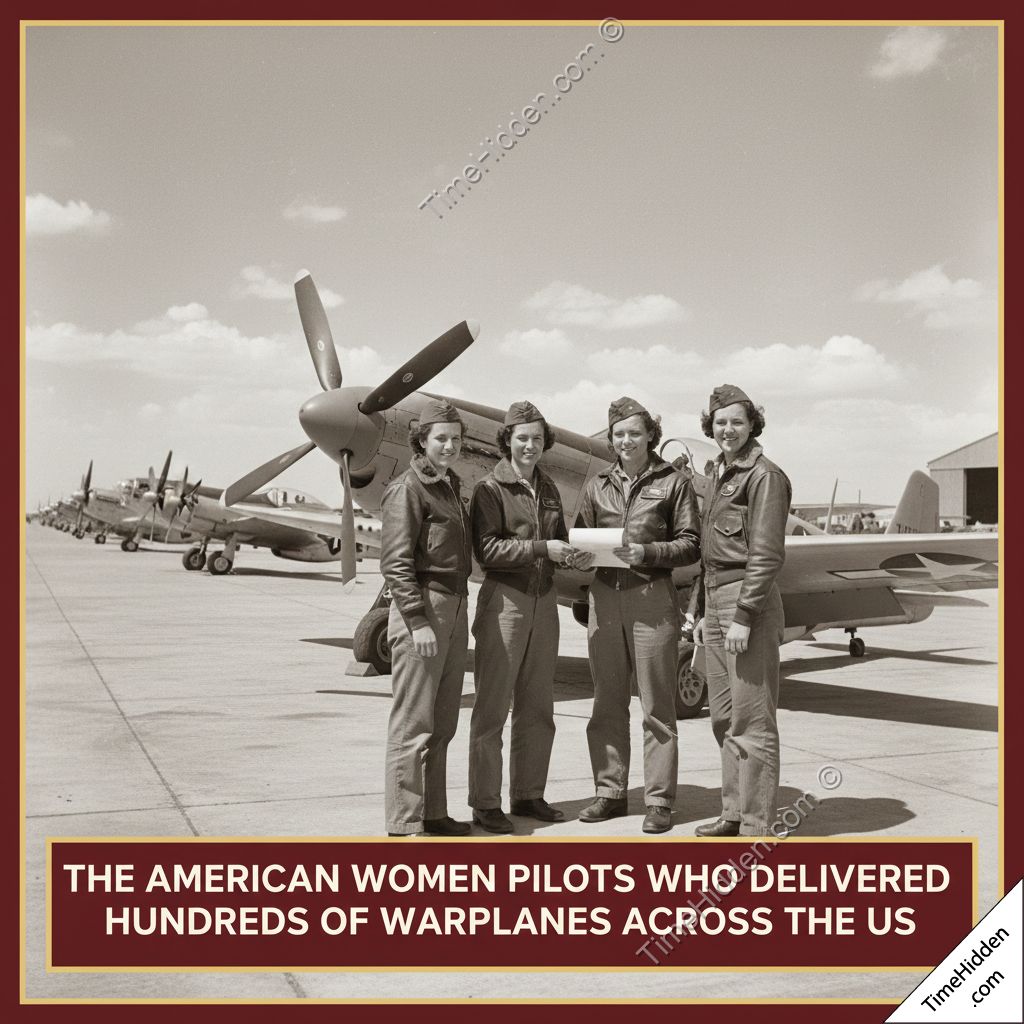
It was 1942—America was deep in World War II, fighting across Europe, the Pacific, and North Africa. Factories roared day and night, producing thousands of aircraft for a war that seemed impossible to win. But there was a problem no general wanted to admit: male pilots were disappearing to the front lines faster than the aircraft could be delivered. Hundreds of brand-new warplanes were sitting on factory runways… with no one to fly them.
And that’s when a group of women stepped forward.
They were called the WASP — Women Airforce Service Pilots, and they were about to change the story of the war in a way no one expected. They were young. They were bold. And they were dismissed by almost everyone who saw them. Many officers laughed, calling them “girls playing pilot.” Some mechanics refused to brief them. A few commanders openly doubted they would survive even a training flight.
But the women didn’t argue.
They didn’t protest.
They simply climbed into the cockpits… and proved everyone wrong.
From 1942 to 1944, these women delivered everything America built. P-51 Mustangs, P-47 Thunderbolts, B-25 bombers, even the giant B-17 Flying Fortress. No co-pilot. No weapons. No armor. Just raw engine power, unpredictable weather, and thousands of miles of open sky.
They flew through snowstorms.
They flew past mountains wrapped in fog.
They flew aircraft that had never been tested.
Some planes still had the factory smell. Others still had factory defects.
But the WASP pushed on — because every delivery meant one more plane in the hands of a pilot fighting overseas, one more chance to turn the war.
And they paid the price.
Thirty-eight women died, their bodies sent home without military honors. The government refused to pay for funerals. Fellow pilots had to pass a hat to gather donations, just to send their sisters home with dignity. Yet even through grief, the women kept flying.
By 1944, they had delivered over 12,000 aircraft across 48 states, logging millions of miles. They flew more types of planes than most male pilots in the entire war. Some even tested repaired aircraft — planes returning from the front, scarred and unpredictable.
And still… they received no veteran status. No medals. No recognition.
But the truth couldn’t stay buried forever.
Decades later, America finally admitted what history already knew:
These women weren’t backups.
They weren’t stand-ins.
They were pioneers — warriors of the air who carried the weight of a nation long before anyone was willing to salute them.
Their legacy is simple, powerful, and emotional:
When the world doubted them, they flew anyway.
And because they did… hundreds of warplanes reached the men who needed them.
Because they did… lives were saved.
Because they did… victory came closer.
This is the story of the women who flew without glory, without recognition—
but with courage that changed the course of World War II.