
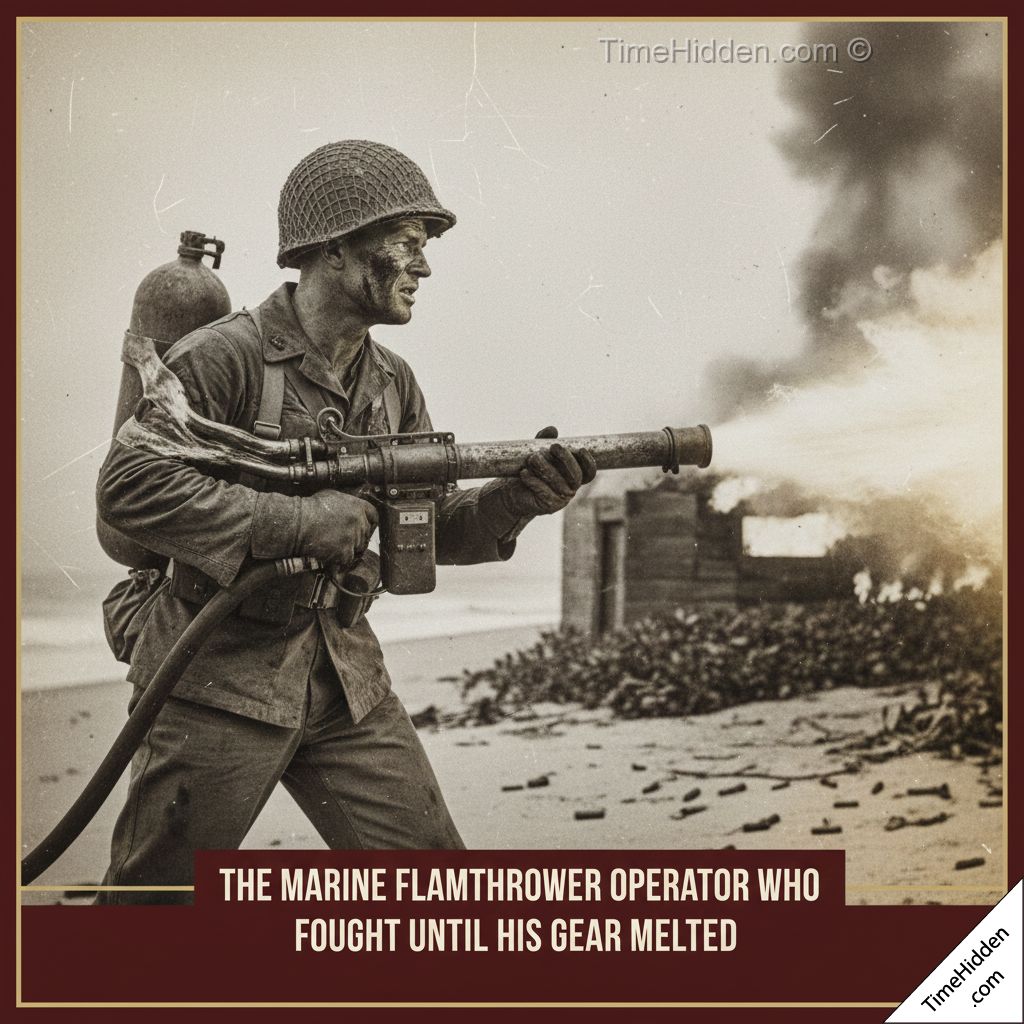
He arrived on the black-sand beaches of Iwo Jima, February 1945, long before he ever felt like a hero.
The air was already burning with smoke, sulfur, and fear.
Marines were pinned down everywhere—caught beneath the hidden guns of Mount Suribachi.
But one man… one weapon… and one impossible task stood between his squad and certain death.
His name was Private First Class Richard “Red” Anderson, a flamethrower operator in the 5th Marine Division.
And on that day, he learned what it meant to walk straight into hell.
The Japanese bunkers were nearly invincible—concrete, volcanic stone, and tunnels stretching deep into the mountain.
Machine-gun fire ripped across the sand, slicing through entire lines of Marines trying to move forward.
Red watched two friends fall beside him.
He didn’t scream.
He didn’t hesitate.
He just felt something inside him break—a choice between running… or deciding this had to end now.
He strapped the M2 flamethrower to his back, feeling the weight—70 pounds of fuel, pressure, and danger.
Every Marine knew the truth: one hit from a stray bullet could turn the operator into a fireball.
But Red stood up anyway.
He sprinted forward through flying sand and tracer fire.
Each step felt stolen from death itself.
Marines watched him go—watched him rise into gunfire like a man who had already accepted his fate.
Red dove behind a crater, lit the igniter, and leaned forward as flames roared out like a dragon tearing apart the dark.
The bunker shook.
The firing stopped.
But the danger didn’t.
Another bunker opened up on his left—closer, louder, deadlier.
And his fuel tank was overheating.
The metal straps burned against his uniform.
His gloves were smoking.
The heat was so intense he felt it through the suit, searing his back, melting the webbing that held the tank in place.
Any other Marine would have dropped the gear and crawled for safety.
But men were dying behind him.
He couldn’t stop.
He wouldn’t stop.
Red charged again—this time almost blind from smoke and sand.
He fired the flamethrower into the second bunker until the fuel gauge hit empty.
The gear buckled.
The straps softened.
The tank began to sag from the heat.
His equipment was literally melting off his body.
And yet… the guns fell silent.
For the first time in hours, the Marines behind him could move forward.
They rushed past, patting his shoulders, shouting his name, dragging the wounded out of the kill zone he had single-handedly broken open.
Red collapsed to his knees—exhausted, shaking, half-burned—but alive.
When the battle finally ended, officers counted seven destroyed enemy positions along the path he cleared.
Seven fortifications that had held hundreds of Marines in place.
Seven positions that one man had decided he would not allow to stand.
He never called himself a hero.
He said he was just doing what had to be done.
But history remembers him differently—
as the Marine flamethrower operator who fought until his gear melted,
and still kept going.